Her Stepmother Kept the $480 I Sent for Tires. Then My Daughter Called Me From the Shoulder of I-80 in an Ice Storm.
At 2:40 on a Sunday afternoon my phone rang. I was on my back under a grain truck near Overton, with sleet ticking on the fender above my face and a flat inside dual that didn’t want to come off the hub. I almost let it go to voicemail. Then I saw the name on the screen and answered with my glove still on.
“Mom, I’m off the road.”
Josie is 16. She has had her license for seven months. Her voice was high and thin, the way it used to get when she was little and trying not to cry in front of other kids.
“Where are you, baby?”
“Mile marker 212. The car just went sideways. I wasn’t even going fast, I swear, I was going like forty.”
“Are you in the ditch?”
“No. I’m on the shoulder. I’m facing the right way. I don’t know how.”
She was on the shoulder and not in the ditch. Thank God. I slid out from under the truck so fast I scraped my elbow through my coveralls. “Seatbelt on. Flashers on. Stay put. Do not get out and stand behind the car. I’m coming.”
I told the farmer I’d be back for his dual in the morning and that there’d be no charge for the call. He had daughters of his own, and he waved me off before I’d finished saying it.
I should explain how a tire technician’s kid ended up on the interstate in an ice storm on tires like that, because people have asked me, and I’ve asked myself.
I’ve run road service for a tire shop in Kearney for 12 years. For the first six I ran the west truck out of our garage outside Ogallala, where Brent and I had a house on five acres. When we divorced, I moved to Kearney, where the shop is. The parenting plan out of Keith County left Josie in her school, with her dad, in the bedroom she’d had since she was a baby. She was ten and that’s what she asked for. I pay $412 a month in child support through the state payment center and have never been late.
Her school went to a four-day week a couple of years ago, with Mondays off. So every other Sunday she drives home to me, 140 miles from her dad’s place, and drives back Monday evening. Brent bought her the Corolla last spring, a silver 2010 with 160,000 miles on it. It’s titled and insured in his name.
In October she came to Kearney on the team bus for a volleyball tournament and stayed the night with me. At breakfast she held out her phone. “Mom, is this bad? The back end feels kind of squirmy when it rains.” It was a picture of her rear tires, taken in the school parking lot. There were cords showing. Steel wire, right through the rubber, all the way around the inside edge. Whoever owned that car before had never rotated them once.
If the car had been in my driveway, I’d have had new tires on it before she finished her eggs. It was 140 miles away. So I sent the photo to her stepmother, Tamsin, because Tamsin keeps the money at that house. Brent works nights at the packing plant and sleeps days, and he will tell you himself he hasn’t looked at a bank statement in four years. I wrote, “These are down to the cords. She can’t drive on them. I’m sending cash for four new ones.” Then I put $480 in an envelope, wrote “Josie tires” on the front, and sent it back on the bus in her gym bag.
Tamsin texted that afternoon. “Got it. I’ll take care of it.”
I asked again in November. She wrote back, “All handled.” Josie missed one of her Sundays that month for a band trip, and the other one I drove out and got her myself because I had a service call in North Platte anyway. So I hadn’t laid eyes on that car since summer.
People ask why I didn’t just get a lawyer when I first saw the photo. A judge takes months. I had a text that said it was handled, and I had a job and a daughter who hated it when her two houses fought. That Sunday in December she was sitting on the shoulder of I-80, and no lawyer was going to be any help to her there.
It was 36 miles of glaze from Overton to mile marker 212. The freezing rain had started around noon, and by the time I got on the interstate the road had that dull shine that means it has quit being pavement. I drove 45 with the light bar going and both hands on the wheel. There were cars in the median every couple of miles, and a pickup on its side near the Lexington exit with a deputy already there. Each time I came up on one I looked for silver.
I said please about forty times. That was the only prayer I had. I’m not a churchgoing person, and I didn’t know who I was saying it to.
I called her twice on the way. The first time she said a semi had gone by so close the car rocked. The second time she said her feet were cold and asked if she could run the engine, and I told her yes, but to crack a window and make sure the tailpipe wasn’t packed with slush.
Fifty minutes after she called, my truck was behind her little silver Corolla with every amber light I own turned on. She was standing at her open door in her purple coat, hugging herself, with ice in her hair. I had told her to stay in the car. I didn’t have it in me to bring that up.
I got my arms around her first. She was shaking so hard her teeth clicked. “I’m sorry,” she kept saying. “I’m sorry, Mom, I didn’t do anything, it just went.”
“I know it did. Get in my truck. The heater’s running.”
She wouldn’t. She wanted to watch me. I think she needed to see somebody do something about it.
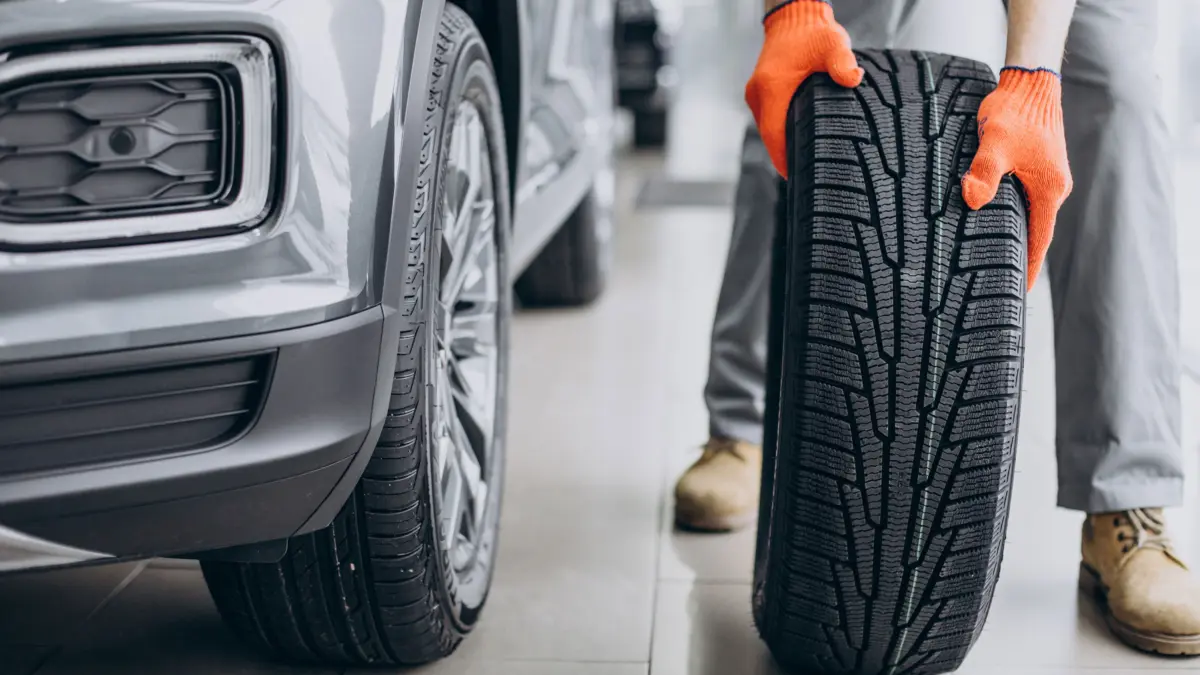
I walked around the back of her car and crouched down, and my stomach turned over. The rears were bald as a dinner plate. Past that, really. There was a band of bright wire two inches wide running clear around both of them, and on the left one a patch where the wire itself had started to fray. Those were the same tires in the photo from October, with two more months of driving on them. The fronts had some tread left, enough to pass if you didn’t look hard. I wasn’t going to leave them on either.
I had four 15-inch tires on my rack that would fit. I carry them because half the cars in Buffalo County run that size. I put up my hood and knelt in the sleet with the impact gun.
It goes the same way every time, and I was glad of that, because my hands knew what to do while the rest of me was not much use. Floor jack under the pinch weld. Five lugs. Wheel off and rolled to the back of the truck. I broke the bead on the changer mounted to the bed, going easy around the pressure sensor inside the rim, because those run sixty dollars apiece and a careless tech snaps them. Old tire off. New rubber on. Thirty-two pounds from the compressor. Back on the hub, lugs run down in a star.
The semis went by close enough to shove me sideways. Each one threw a wall of gray slush across my back, and after the third I stopped flinching. My knees went numb on the second wheel. I could feel the cold coming up through the pads like water through a rag.
That’s when Josie finally climbed into the cab. I’d left a gas station donut on the dash that morning, a glazed one in a paper sleeve, never touched. When I looked up from the third wheel she was eating the whole thing with both hands, watching me through the windshield.
Four tires. Every lug torqued by hand with the click wrench, seventy-six foot-pounds, because I wasn’t going to trust the gun on my own daughter’s car. Forty minutes, start to finish. I’ve done it faster in a warm bay, though never with so much riding on it.
I was lifting the bald ones onto my rack when red and blue lights came up behind my amber ones. Troopers out here stop to light you up so nobody hits you. This one parked at an angle to push traffic into the left lane and took his time getting out. He was a broad man in his fifties with ice on the brim of his hat. His name tape said MRKVICKA.
“Afternoon,” he said. “You the tow?”
“I’m her mother. I’m also the tire truck.”
He put his flashlight on the tire in my hands. Then he pulled off one glove, thought better of it, put the glove back on, and ran it across the wire. A few broken strands caught on the leather.
“These came off that car?”
“All four. Those two are the rears.”
He looked past me at Josie in my cab, sixteen years old with glaze on her chin, holding an empty paper sleeve. He looked at her a good while. Then he looked back at the tire.
“Who sent her out on these?”
I told him. I showed him the photo on my phone with the date on it, October 11th. I showed him my message about the cords and the cash, and the reply that said, “Got it. I’ll take care of it.” I showed him “All handled” from November. He read each one twice, holding my phone at arm’s length like a man who needs glasses and won’t admit it.
“She lives with her father?”
“School year. He works nights. He’s asleep right now.”
“You got the father’s number?”
Josie read it to him through the cracked window. He dialed with his thumb, and with his other hand he stood the worst tire up on its edge beside his boot. It rang a long time. Then I heard Brent answer, thick with sleep, a voice I was married to for eleven years.
“Mr. Vavra, this is Sergeant Mrkvicka, Nebraska State Patrol. Your daughter is safe. She’s sitting in her mother’s truck.”
I could hear Brent’s voice go up, tinny and fast. The sergeant waited for him to run down. He turned the tire so the cords caught his light.
“Now I want you to listen to me,” he said. “I am standing on the shoulder of Interstate 80 at mile marker 212, in freezing rain, holding a tire that came off the back of a Toyota registered to you. There is steel showing all the way around it. I’ve got another one just like it at my feet. Your daughter spun this car on the interstate about an hour and a half ago and by the grace of God came to rest pointed the right direction with nothing behind her.”
Brent said something. I caught the words “new ones” and “October.”
“No, sir. They were not replaced in October. I’m looking at them. Her mother just put four new tires on that car out of her own truck, on her knees in the ice, while I watched the last of it.” He paused. “I’ve worked this stretch nineteen years, Mr. Vavra. I have knocked on doors for kids on better tires than these in better weather. I’d like you to be awake enough to understand what I’m telling you.”
There was a long silence on the other end. The sergeant let it sit.
“Whose name is on the registration?” he asked.
I heard Brent say, “Mine.”
“Then I could write a citation for unsafe tires, and the driver I’d be handing it to is a sixteen-year-old girl. I’m not going to do that to her. I am going to write a report, with photographs, and it’s going to have your name in it and your wife’s. What anybody does with that report afterward is not up to me.” He looked at me. “Her mother wants a word.”
He handed me his phone. I walked a few steps down the shoulder with it.
“Dana.” Brent sounded like he’d been punched. “Dana, she told me they were done. She told me she had them put on at the co-op while Josie was at school. I asked her. I swear to you I asked.”
“Did you look?”
He didn’t answer.
“It takes four seconds to look at a tire, Brent. You bend over.”
“I work twelve-hour nights. I come home and I fall down.” His breath hitched. “Is she hurt? Let me talk to her.”
“She’s not hurt. She’s eating a donut. She’ll call you tonight if she wants to.” I waited a second, because I was angrier than I had been in years and I didn’t want to say something Josie would hear through the glass. “I sent four hundred and eighty dollars in an envelope. Find out where it went.”
I gave the sergeant his phone back. He wrote my name in his notebook, Dana Reinke, and my number, and tore off a slip with a report number on it. He told me I could request a copy from the Patrol in a week or so. He took six or seven pictures of the tires on my rack with a little camera from his coat pocket, and one of the Corolla’s plate.
“I don’t want her driving the rest of the way in this,” he said. “New tires or not.”
“She’s riding with me.”
“Gothenburg exit is a mile up. There’s a truck stop. I’ll follow the both of you in and you can leave the car.”
So I drove the Corolla that one mile myself, at twenty miles an hour, with Josie in my truck behind me, gripping the wheel at ten and two the way I taught her, and the sergeant behind her with his lights going. The new tires held. I parked the car at the far end of the truck stop lot and gave the woman at the counter twenty dollars and my phone number. When I came out, the cruiser was already pulling back onto the ramp. He lifted two fingers off the steering wheel as he went by.
It took an hour and forty minutes to make Kearney. Josie didn’t say much for the first half of it. She held her hands in front of the heater vent and watched the reflector posts go by.
Somewhere past Cozad she said, “I told her it was icing.”
“Told who?”
“Tamsin. This morning. I looked at the radar and I said maybe I should wait or go tomorrow. She said they’d have the interstate salted by the time I got to it, and that you’d throw a fit if I didn’t show up. She said you’d make it into a thing.” Josie picked at a hangnail. “And I asked about the tires again, like two weeks ago. She said the guy at the co-op looked at them and they were fine for now and he’d call when the new ones came in. I thought they were on order. I thought that’s what was taking so long.”
“You saw the wire, Jo. You took the picture.”
“I know.” Her voice got small. “I didn’t want to be the reason you guys had a fight. I figured if a grown-up said it was fine, it was fine.”
I reached over and put my hand on the back of her neck, under her wet hair. I couldn’t be mad at her for that. I had spent six years teaching her to keep the peace between two houses, and that was the same thing I’d been doing when I mailed cash instead of driving out there.
She was asleep against the window by the time we passed the Overton exit, where a grain truck was still sitting on three good tires and a jack stand. At home I heated up chili from the freezer. She ate two bowls and went to take a shower, and about ten minutes later I heard her crying in there. I sat on the hall floor outside the bathroom door until the water shut off. Brent called four times that evening. She let it ring.
Monday morning I took her to the shop with me. My boss, Russ Hadley, was at the counter when I carried the two rear tires in from my truck and set them on the floor mat by the register. He came around and looked. Russ has been selling tires for thirty-one years and I have never known him to be short of something to say.
“Whose are those?” he asked finally.
“Josie’s. I pulled four tires off my rack yesterday to replace them. I need to write myself a ticket.”
He went back behind the counter and wrote it himself. Four tires at his cost, no labor, no road call, no mileage. It came to $401.28 with the tax and the disposal fee. He said he’d take it out of my check in two pieces if I wanted, and I said one was fine.
“Don’t scrap those,” he said, nodding at the floor. “Put a tag on them and stick them in the back of the warehouse.”
I tagged all four with the date and the report number off the sergeant’s slip and stacked them behind the tractor rears. Josie spent the morning in the waiting area doing chemistry homework and drinking the bad coffee. Two of the bay guys walked her out to the warehouse and showed her the tires, in case she hadn’t understood. She’d understood.
Brent showed up at my house at a quarter past two that afternoon. He had worked his shift, clocked out at six, and driven 140 miles without sleeping. I saw his pickup from the kitchen window and went out on the step before he could knock. He looked gray. He had a white envelope in his hand, a new one, and a folded piece of paper.
“Can I come in?”
“That’s up to her.”
Josie was behind me in the doorway by then. She looked at him for a long moment and then stood aside, and that was all the permission he got.
He sat at my kitchen table with his cap in his lap. He laid the folded paper down first and smoothed it flat. It was a receipt from the farm and home store in North Platte, dated October 17th. One outdoor patio heater, stainless, $429.99. One propane cylinder. With the tax it came to $474 and some cents.
“It’s on the deck,” he said. “I’ve sat under it. I asked her where it came from and she said it was on clearance and she’d had some money set by.” He rubbed his face with both hands. “Your envelope was in the junk drawer under the phone books. Empty. It’s got your handwriting on it.”
Josie made a noise in her throat and walked out of the room. I heard her door shut.
“What did she say?” I asked.
He took a while to answer. “She said the household money is hers to budget and she budgets it. She said you already pay support and that covers the car, and if you choose to send extra, that’s a gift to the house. She said Josie is your kid and you’d have bought her tires regardless, so nobody was ever in danger.” He looked up at me. “She said every time we spend a dollar on Josie it feels like writing a check to my first wife.”
“Josie is your kid too, Brent.”
“I know that.” His eyes were red around the rims. “I know whose kid she is.”
He pushed the white envelope across the table. There was $900 in it, in fifties and twenties, which he’d pulled from the credit union on his way out of town. It was the $480, and the rest was for the tires and my time. I counted out what the shop had charged me, added that to the $480, and slid the rest back to him. He didn’t want to take it. I told him I wasn’t going to make money off this, and he put it in his shirt pocket.
Then he knocked on Josie’s door and went in. They were in there forty minutes. I didn’t listen at the wall, though I’ll admit I ran the dishwasher so I wouldn’t be tempted. When he came out his face was wet, and he said she wasn’t ready to come back that night. I said she could stay the week and I’d square it with the school. He nodded and drove home to work another twelve hours.
Tamsin texted me that evening. I still have it. “I’m sorry Josie was frightened. I had every intention of getting to the tires after the holidays. I won’t be painted as a monster over a budgeting decision, and I don’t appreciate a state trooper calling my home.”
I typed about nine different replies and deleted them all. In the end I took a screenshot and didn’t answer.
On Wednesday I sat in the office of an attorney named Marguerite Olsen, above the abstract company on Central Avenue. The consultation was $250, and the retainer after that was $1,500, which I put on a credit card. I brought a folder. It had the October photo, the texts, a copy of Russ’s ticket and the receipt for the heater, which Brent had left on my table. The trooper’s report came the following week. It was two pages long and had six photographs attached.
Ms. Olsen read all of it without hurrying. “What do you want out of this?” she asked. “I’m asking because some people sitting in that chair want blood, and I should tell you up front that judges don’t hand it out.”
“I want that car to be mine to take care of. And I don’t want another dollar meant for my daughter passing through that woman’s hands.”
“Do you want to change where Josie lives?”
I had been turning that over for three nights. “I want her to be the one who says.”
She filed the paperwork to modify the parenting plan the Friday before Christmas. Brent didn’t fight it. He didn’t hire anybody, which Ms. Olsen said was unusual and a little foolish, and she made sure he understood he was entitled to. In January the three of us sat down with a mediator in North Platte, the halfway point, in a conference room at the public library. Her name was Carol Ibsen, and she had a bowl of butterscotch candies on the table that nobody touched. My half of her fee came to $180.
Tamsin didn’t come. Brent said she had told him it was between him and me. She also asked him to get it in writing that she’d done nothing illegal. Carol Ibsen said that wasn’t the kind of thing a parenting plan addressed.
It took under three hours. Brent signed the Corolla’s title over to me, and we walked it to the county treasurer’s office the next week to make it official. The car went onto my insurance, which raised my premium about ninety dollars a month, a sixteen-year-old driver being what she is. All maintenance on it is mine. Child support still goes through the state, same as always. Anything extra for Josie goes straight to Brent or straight to Josie, and both of us initialed that line.
There was a paragraph about weather, too, which Josie asked for herself when the mediator brought her in at the end. If there’s a winter advisory, she stays where she is, and neither house is allowed to make her feel bad about it. Brent’s hand shook a little when he signed.
On the question of where she lives, Josie asked to finish her junior year in Ogallala. She has first chair clarinet and a best friend named Abby and a chemistry teacher she likes. She said she’d decide about senior year over the summer. Carol Ibsen wrote it down that way. I drove home from North Platte not knowing whether I’d won anything.
It’s March now. Josie still drives in every other Sunday. She has a tread depth gauge on her key ring that the bay guys gave her for Christmas, and she checks her own pressures at the Casey’s in Ogallala before she leaves and texts me the numbers. I check them again in my driveway anyway. She stands on the step with her arms folded and says, “Mom. Thirty-two. I told you thirty-two.”
Brent calls her on his supper break now, most nights, around eleven. He bought a creeper and a cheap gauge of his own. She says he went around his whole pickup with it one Saturday and found a nail.
Tamsin and I have not spoken. Josie says the house is polite and quiet, and that Tamsin made her a birthday cake in February and didn’t mention any of it. The patio heater is still on their deck. Josie told me they had it going on a cold night last week when some neighbors came over, and that her dad stood out in the yard by the burn barrel the whole evening instead of sitting under it.
The four tires are still tagged in the back of Russ’s warehouse. Twice he has asked whether I’m ready to let them go to the recycler. I told him not yet.
Last Sunday was dry and fifty degrees. Josie pulled in at a quarter to four with the windows down and the radio up, and I had the gauge out of my pocket before she’d shut the engine off.