My daughter had not been pregnant.
I need you to understand that before anything else. Jess had not been pregnant. Not a little bit. Not secretly. Not at all. Three weeks before she disappeared, I’d watched her eat half a pizza on my couch in a pair of skinny jeans and complain that she needed to start running again.
So when she stepped out of that SUV on the tenth morning holding a newborn baby against her chest, my brain just stopped working.
Like a clock somebody had dropped.
But I’m getting ahead of myself.
Let me start where it started.
The morning my daughter dropped off my two grandchildren, she seemed completely calm.
It was a Saturday in late September. Cool and bright. The maple in my front yard was just starting to turn orange at the tips.
Jess pulled into my driveway in her little gray Subaru at a quarter to eight. Ava, who’s eight, climbed out of the back seat with her library book already open. Noah, who’s five, came out sideways, half asleep, dragging his stuffed dinosaur by the tail.
Jess kissed them both on the tops of their heads.
She handed me a small backpack with their clothes in it. Pajamas. Toothbrushes. Noah’s inhaler.
And she smiled.
“I’ll be back before dinner,” she said.
I’d heard those words a hundred times.
Jess is a labor and delivery nurse at Deaconess Hospital in Spokane. She’s been divorced for three years. Her ex, Brandon, lives in Phoenix and sees the kids at Christmas and for two weeks in July. The rest of the year, it’s Jess and me.
She works twelve-hour shifts. She picks up extra ones when she can. Half the time, I’ve got the kids.
I’ll be back before dinner.
Nothing about that morning seemed unusual.
Except for one thing.
Just before she got back into her car, she stopped.
She had her hand on the door handle. And she turned around.
And she stared at my house.
Not a glance. Not the way you look back to wave. She stood there with her hand on the door and looked at it for a long time. At the front porch. At the big window. At the kids, who had already gone inside. At me, standing on the steps in my bathrobe with a cup of coffee.
She looked at all of it like she was trying to memorize it.
Like she was afraid she wouldn’t see it again.
I almost asked her if something was wrong.
I opened my mouth to say it.
Instead, I smiled and waved.
She waved back. She got in the car. And she drove away down Sullivan Road toward the freeway.
That was the last time I saw her for ten days.
Dinner came.
I made spaghetti because that’s what Noah eats. Ava set the table. Four plates. One for her mom.
Six o’clock. Six-thirty. Seven.
I called Jess’s phone. It rang four times and went to voicemail.
I figured she’d gotten held up. A delivery that went long. A double shift somebody begged her to cover. It had happened before.
I texted her. Kids are fine. Let me know when you’re on your way.
No answer.
At nine, I put the kids to bed in my spare room. Ava asked where her mom was. I said she was working late.
At eleven, I called again.
This time, it didn’t ring at all. It went straight to voicemail.
Hi, this is Jess. Leave me a message and I’ll call you back.
At midnight, I called Deaconess.
The night charge nurse in labor and delivery was a woman named Bev who’d worked with Jess for six years. She’d been to Noah’s fifth birthday party.
“Jess isn’t on tonight, Carol,” she said. “She wasn’t on today either. She’s off till Tuesday.”
My stomach dropped.
“She told me she was working.”
There was a pause.
“She didn’t say she was working,” Bev said gently. “Did she? Did she actually say that?”
I thought about it.
I’ll be back before dinner.
She hadn’t said where she was going.
She hadn’t said anything.
I’d just assumed.
At eight the next morning, I called the Spokane County Sheriff’s Office.
A deputy came out at ten. A young man with a buzz cut and a notebook. He sat at my kitchen table and asked a lot of questions.
When had I last seen her? What was she wearing? Jeans. A gray hoodie. White sneakers. Did she have a boyfriend? Not that I knew of. Any problems? Drugs? Money? Depression? No. No. No.
Did she seem upset that morning?
I told him about the way she’d looked at the house.
He wrote it down. He didn’t look up.
“Ma’am,” he said, “she’s a grown woman. Sometimes adults just need a break. Sometimes they come back in a day or two.”
“She left her children,” I said. “She’d never leave her children.”
He looked at me then.
“I’ll put it in,” he said.
By Monday, it was a real search.
Jess’s phone had last pinged a cell tower near Newport. Up on the Idaho border. Saturday morning, 9:14 a.m. After that, nothing.
Her bank cards hadn’t been used.
Her car was gone. No sign of it anywhere. Not in a parking lot. Not in a ditch. Not on any traffic camera on Highway 2.
They put her picture on the news. A detective named Ray Okonkwo from the Sheriff’s Office took over the case. He was in his fifties. Tall. Quiet. He wore the same brown tie every day. He came to my house on Monday afternoon and stood in my living room looking at the photographs on my wall.
“Who does she know up near Newport?” he asked.
I thought about it.
“Nobody,” I said. “Not really. We used to camp at Priest Lake when she was little. But that was twenty years ago.”
He wrote it down.
Every day ended the same way.
No witnesses.
No camera footage.
No clues.
Nothing.
And meanwhile, I was taking care of two frightened children.
Ava stopped reading. That’s how I knew how scared she was. Ava reads at breakfast, at dinner, in the bathtub, under the covers with a flashlight. She stopped. She’d sit on the couch with a book open in her lap and stare at the front door.
Noah started wetting the bed again. He hadn’t done that since he was three.
He’d crawl into my bed at two in the morning, damp and shivering, and I’d change his pajamas and the sheets and hold him until he fell back asleep.
And every single day, they asked the same question.
“When is Mommy coming back?”
At breakfast. At lunch. In the car on the way to school. In the bath.
“When is Mommy coming back?”
I had no answer.
“Soon,” I’d say. “The police are looking really hard. They’re going to find her.”
“What if they don’t?”
That was Ava. On the fourth night. At bedtime.
“They will,” I said.
“How do you know?”
“Because I know your mom,” I said. “And your mom always comes back.”
I didn’t believe it.
Not by the fourth night.
But I said it every night anyway.
I barely slept.
Every time a car slowed down in front of the house, I ran to the window.
Every time my phone rang, my heart stopped.
I kept the porch light on all night. Every night. Like she’d need it to find her way.
On the second day, Sunday, my phone buzzed at three in the afternoon.
I grabbed it so fast I knocked over a glass of water.
It wasn’t Jess.
It was a text from my niece, Tara.
Tara is my late sister’s daughter. Thirty-four. She lives up in Sandpoint, Idaho, with her husband, Wade. Wade’s a wildland firefighter. That fall, he was on a three-week assignment down in Northern California, on one of those big fires you see on the news.
My sister, Linda, died of breast cancer when Tara was fourteen. Tara lived with us for two years after that. In the same spare room where my grandchildren were sleeping now. She and Jess shared a bathroom. They fought over the hair dryer. They were as close as sisters.
Tara had wanted a baby for a long time.
Four miscarriages in six years. I’d driven up to Sandpoint for every one of them. I’d sat with her in her kitchen while she cried.
And in February, she’d called me, sobbing, and said, “Aunt Carol. I’m pregnant. And it’s sticking. It’s really sticking this time.”
She was due in October.
We’d had a baby shower for her in August. At my house. Pink balloons. A cake shaped like a baby carriage. Jess had organized the games. Tara sat on my couch with her hands on her round belly, glowing.
I’d cried when she opened the little knitted blanket I’d made.
The text said:
She’s here!!! Lily Rose. Born yesterday morning. 7 lbs 2 oz. She came SO fast, we didn’t even make it to the hospital. Wade’s still on the fire, trying to get home. We’re both healthy and resting. Taking a few days to bond, no visitors yet please!! 💕
There was a photograph.
A tiny baby girl. Wrapped in a pink blanket. Dark hair. Eyes squeezed shut. Asleep in Tara’s arms.
I sat down on my kitchen floor and cried.
I don’t even know why. Relief, I think. That something good had happened. That something in the world was still okay.
I texted back.
Oh honey. She’s beautiful. I’m so happy for you. I wish I could come up. Jess is missing. Since yesterday. The police are looking. Have you heard from her at all??
The answer came back about ten minutes later.
Oh my God. No. I haven’t heard from her. Aunt Carol I’m so sorry. I’m praying. Please let me know the second you hear anything. ❤️❤️
I remember thinking, Poor Tara. Her baby’s finally here, and this is what she has to deal with.
I remember thinking that.
Detective Okonkwo asked me on Wednesday if Jess had any friends or family up north.
“My niece,” I said. “Tara. In Sandpoint. She just had a baby. Saturday.”
He wrote it down.
“Did you talk to her?”
“She texted. She said she hadn’t heard from Jess.”
“We’ll give her a call,” he said.
He did.
He told me later that Tara had been very upset on the phone. Crying. She said she and Jess talked every couple of weeks. She said the last time was over a week before. She said she was home with a newborn, alone, her husband out of state, and she was terrified for her cousin.
Detective Okonkwo said she sounded completely sincere.
He had no reason to doubt her.
Neither did I.
On day six, I saw something on the news.
I wasn’t really watching. The kids were in bed. I had the TV on for noise. I was folding laundry.
The news anchor said something about an infant abduction.
I looked up.
A newborn baby girl had been taken from Sacred Heart Medical Center in Spokane. A week ago. Early on a Saturday morning. A woman wearing hospital scrubs had walked into the mother’s room around four a.m., told her the baby needed a routine hearing test, and walked out with her. She’d gone down a back stairwell. She was gone in four minutes.
The baby’s security tag had been cut off and found in a trash can in the parking garage.
The FBI was involved. They had a blurry picture from a security camera. A woman with her hair pulled back under a surgical cap. A mask. Blue scrubs. Holding a bundle against her chest.
The baby’s name was Isabel.
They showed the mother.
Ana Ruiz. Twenty-two years old. Sitting in front of a microphone at a press conference, with her husband’s arm around her. She was so young. She was crying so hard she could barely talk.
“Please,” she said. “Please bring her back. She’s only one day old. She needs her mama. Please.”
I turned off the TV.
I sat on the couch with a pile of Noah’s tiny socks in my lap.
I thought, that poor girl.
I thought, how could anybody do that?
I thought, at least Tara’s baby is safe.
I didn’t put it together.
Why would I?
On the ninth night, Ava climbed into my bed.
She hadn’t done that since she was six. She said she was too old.
She got under the covers and put her cold feet on my legs.
“Grandma,” she said. “Can I ask you something?”
“Of course.”
“Is Mommy dead?”
I lay there in the dark.
I didn’t answer right away.
I didn’t lie to her. I couldn’t.
“I don’t know, baby,” I said. “I don’t think so. But I don’t know.”
She was quiet for a long time.
“Mommy said something weird,” she said. “On Saturday. In the car. Before she dropped us off.”
I turned over to look at her.
“What did she say?”
“She said, ‘If I’m late, don’t be scared. Grandma will take care of you. Grandma always takes care of everybody.’”
Ava pulled the blanket up to her chin.
“I asked her why she’d be late,” she said. “And she said, ‘Because sometimes grown-ups have to go help somebody. Even when they don’t want to.’”
I lay awake the rest of the night.
Help somebody.
Who?
Then, on the tenth morning, just after sunrise, I heard tires crunch across my driveway.
I was in the kitchen. Making coffee. I hadn’t slept. I’d been standing at the counter staring at the coffee maker for ten minutes, waiting for it to finish, not seeing anything.
The sound of tires on gravel.
I dropped the mug in the sink.
I ran to the front window.
A familiar SUV had pulled up.
Dark green. A Toyota 4Runner. With a dent in the front bumper and a sticker on the back window that said SANDPOINT WILDLAND FIRE.
I knew that car.
I’d ridden in that car.
It was Wade’s.
Tara’s husband’s.
I didn’t understand.
My first thought was that something had happened to Tara. That Wade had come down to tell me. That something was wrong with the baby.
I ran through the front door.
The driver’s door opened.
And my daughter stepped out.
For a moment, I couldn’t speak.
I just stood on my front porch in my bathrobe, barefoot, staring.
She looked exhausted. Worse than exhausted. Her face was gray. Her eyes were sunken. She’d lost weight. In ten days, she’d lost weight.
Her clothes were dirty. The same jeans and gray hoodie she’d been wearing when she left. There were dark stains on the knees. Mud. Grass.
Her hair was tangled and greasy and pulled back in a knot.
And there was a fresh bruise circling one wrist.
Dark purple. All the way around. Like a bracelet.
Then I noticed what she was holding.
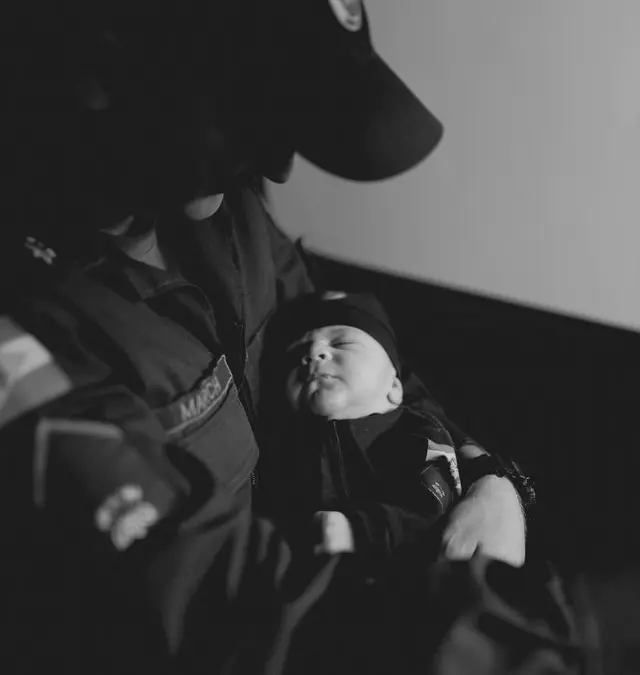
A newborn baby.
Wrapped in a pink blanket. Tight against her chest. Under the front of her hoodie, the way you’d hold a baby to keep it warm.
My mind couldn’t make sense of what I was seeing.
My daughter had not been pregnant.
Not even remotely. Not a chance. There was no possible explanation that made any sense at all.
I rushed down the steps.
“Jess!” My voice came out as a scream. “Jess! Oh my God! Where have you been?”
She looked right into my eyes.
“Please don’t ask me any questions,” she said.
Her voice was so calm. Flat. Like she was reading it off a card.
“What are you talking about?” I said. “We’ve been looking everywhere for you! The police! The news! Your kids—”
“Mom,” she said. “Please.”
She walked past me.
Up the steps. Into the house.
I followed her.
She sat down on my couch. Carefully. Like every part of her body hurt. She kept the baby tucked against her chest.
And then my grandchildren came running into the room.
Ava first. In her pajamas. Her hair sticking up. She’d heard my scream.
She stopped dead in the doorway.
“Mommy?”
Then she ran.
She threw herself across the room and onto the couch and grabbed her mother around the neck so hard Jess winced.
Noah came right behind her, dragging his dinosaur, still half asleep, and climbed up on the other side.
“Mommy, Mommy, Mommy, Mommy.”
Jess held them.
She held all three of them. Ava and Noah and the baby. She pressed her face into Ava’s hair. Her shoulders were shaking. But she didn’t make any sound.
After a minute, Noah pulled back.
He was staring at the bundle in the pink blanket.
“Mommy,” he said. “What’s that?”
Jess looked down at the baby.
Then she looked up at her son.
And she smiled. A very calm, very gentle smile.
“This is Lily,” she said. “This is Cousin Tara’s baby. Remember? Tara was having a baby. Well, here she is. We’re going to take care of her for a little while. Okay?”
Noah stared at the baby.
“She’s really little,” he said.
“She is,” Jess said. “She’s brand new.”
“Can I touch her?”
“Gently. Just her hand.”
Noah reached out one finger and touched the tiny fist poking out of the blanket.
“Hi, Lily,” he whispered.
Ava didn’t say anything.
She was looking at her mother’s wrist. At the bruise.
Then she looked at me.
Jess was talking to them like it was the most normal thing in the world. Like she’d been gone for an afternoon. Like this baby had always belonged in our family.
Like nothing was wrong.
That was the moment fear replaced relief.
Because Tara wouldn’t let anybody take her baby.
Not for an hour. Not for anything. I’d watched Tara lose four babies. I knew what this one meant to her. I knew Tara would never, ever let this baby out of her arms.
So why did my daughter have her?
Why was Jess driving Wade’s car?
Why was there a bruise around her wrist?
Why did she look like she’d been sleeping on the ground?
And why, why, why wouldn’t she let me ask a single question?
I quietly walked into the kitchen.
My hands were shaking so badly I almost dropped the phone.
I called 911.
“911, what’s your emergency?”
I kept my voice low. I turned toward the window so they couldn’t hear me in the living room.
“My daughter,” I said. “Jessica Moore. She’s been missing for ten days. She’s a missing person. The Sheriff’s Office is looking for her. She just came home.”
“Okay, ma’am. Is she hurt?”
“I don’t know,” I said. “She has a bruise. And she has a baby. She has a newborn baby. And it’s not hers. And I don’t know where she got it. And I’m scared.”
There was a pause.
“Ma’am,” the dispatcher said. Her voice had changed. “What’s your address?”
Less than twenty minutes later, two police officers knocked on my door.
Spokane Valley Police. A woman in her forties with red hair, Officer Brennan. And a younger man, maybe thirty, Officer Takahashi.
I let them in.
Jess didn’t get up from the couch.
She didn’t look surprised to see them.
She didn’t look scared.
She’d gotten the kids to go into the kitchen. Ava was making Noah a bowl of cereal. I could hear the spoon clinking.
The baby was asleep against Jess’s chest.
Officer Brennan sat down in the armchair across from her.
“Ms. Moore?” she said. “Jessica Moore?”
“Yes.”
“We’ve been looking for you. A lot of people have. Are you hurt?”
“I’m okay.”
“That bruise on your wrist. How did you get that?”
Jess looked at it like she’d forgotten it was there.
“A door,” she said.
“Somebody close a door on you?”
Jess didn’t answer.
“Where have you been for the last ten days?” Officer Brennan asked.
Jess was quiet for a long time.
“Up north,” she said.
“Where up north?”
“In the mountains.”
“Who were you with?”
Jess didn’t answer.
Officer Brennan looked at the baby.
“And who’s this?”
Jess looked down.
“She’s a baby,” she said.
“Is she yours?”
“No.”
Officer Takahashi had been standing by the door.
He took a step forward. Slowly. Carefully. The way you’d walk toward a skittish dog.
“Ma’am,” he said. “I’m going to need to take a look at the baby. Is that okay?”
My daughter didn’t fight him.
She didn’t panic.
She didn’t hold on tighter.
Instead…
she smiled.
It wasn’t a happy smile. It was something else. Something I’d never seen on her face before. Like the smile of somebody who’s been holding something very heavy for a very long time, and somebody finally reached out to take it.
“You need to scan the ankle,” she said calmly.
The officer froze.
“What?”
“The ankle,” Jess said. “Her left ankle. Under the sock.”
Officer Takahashi looked at Officer Brennan.
Then he crouched down in front of the couch.
Jess shifted the baby in her arms. Gently. She turned her so her little feet were sticking out of the bottom of the blanket.
The baby was wearing tiny white socks. With pink lace around the tops. The kind you buy in a three-pack at Target.
He slowly pulled back the blanket.
Then he took off the left sock.
There was something attached beneath it.
A small white plastic band. Wrapped around the baby’s ankle. The kind they put on babies in the hospital, right after they’re born.
It had printing on it. Small black letters. A barcode.
The officer stared at it.
I leaned over his shoulder. I couldn’t help it.
I could read it.
RUIZ, GIRL. And a date. And a time. And under that: SACRED HEART MEDICAL CENTER. And a long string of numbers.
Ruiz.
The officer looked up at my daughter.
His entire expression changed.
Without saying another word, he stood up and reached for the radio on his shoulder.
“Dispatch,” he said. His voice was tight. “I need you to run an infant identification number immediately. Sacred Heart. And I need you to notify the FBI field office. I think we’ve got the Ruiz baby.”
The room went completely silent.
In the kitchen, Noah’s spoon stopped clinking.
My daughter leaned back against the couch.
She closed her eyes.
And for the first time in ten days, she looked relieved.
Because whatever she’d brought into my house wasn’t something she was trying to hide.
It was something she had been trying desperately to get found.
The FBI was at my house within the hour.
Two agents. A man and a woman. In dark jackets with yellow letters on the back. Then two more. Then Detective Okonkwo, in his brown tie, looking like he hadn’t slept either.
An ambulance came. A paramedic checked the baby. She was okay. Hungry. Dehydrated, a little. But okay. Ten days old.
“Somebody’s been feeding her,” the paramedic said. “Somebody’s been taking good care of her.”
She looked at Jess when she said it.
They took the baby in the ambulance. To Sacred Heart.
To her mother.
Jess watched them go from the front window.
She stood there with her hand pressed flat against the glass until the ambulance turned the corner.
Then she sat back down on the couch.
And she started to shake.
Not crying. Shaking. All over. Her teeth were chattering.
I wrapped her in the afghan off the back of the couch. I sat down next to her and put my arms around her.
“It’s okay,” I said. “It’s okay. You’re home. You’re home.”
“I couldn’t call you,” she said. Her teeth were chattering so hard she could barely get the words out. “Mom. I couldn’t call you. She took my phone. She took my keys. I tried. I tried so many times.”
“Who, baby? Who took your phone?”
Jess looked at me.
And I saw the answer on her face before she said it.
“Tara,” she said.
She told the FBI first.
They sat in my dining room. Agent Hollis and Agent Marquez. Jess at the head of the table. Detective Okonkwo in the corner. A recorder in the middle of the table.
They asked me to leave the room.
I wouldn’t.
Jess said, “Let her stay. She needs to hear it. She’s going to hear it anyway.”
So I stayed.
I sat next to her and held her hand. Her left hand. The one without the bruise.
It started with a phone call.
Saturday morning. September 20th. 6:52 a.m.
Jess was at home in her apartment in Spokane, making the kids breakfast. Her phone rang. It was Tara.
“She was crying,” Jess said. “Hysterical. She said, ‘Jess, the baby came. The baby came and I’m at the cabin and I didn’t make it to the hospital and I’m scared, I’m so scared, something’s wrong, she won’t stop crying, I don’t know what I’m doing.’”
The cabin.
Wade’s family’s cabin. Up near Priest Lake. About two hours north. Way back in the woods off a forest service road. No cell service. No landline. Wade’s grandfather built it in the 1960s. They go up there in the summers.
“I said, Tara, you need to call 911,” Jess said. “You need an ambulance. You need to go to the hospital. You just had a baby by yourself. That’s dangerous. You could bleed out.”
“And what did she say?”
“She said she was calling from the general store in Coolin. On their phone. Because there’s no signal at the cabin. She said she’d driven down there with the baby to call me. She said, ‘Please, Jess. Please. I don’t want to go to the hospital. I can’t do the hospital again. Not after everything. They’ll take her away. Something will go wrong. I can’t. Please. You’re a nurse. You’re the only person I trust. Please come.’”
Jess looked down at the table.
“She’d lost four babies,” she said. “At the hospital. Every time she went in there, she came out without a baby. I understood. I thought I understood.”
“So you went,” Agent Hollis said.
“I said I’d come check on them. Make sure they were both okay. And then I’d convince her to go in. I said I’d be there by ten.”
“And you didn’t tell anyone,” Agent Marquez said. “Where you were going.”
Jess shook her head.
“She made me promise,” she said. “She said Wade didn’t even know yet. She said she wanted to tell everybody herself. In her own way. She said, ‘Please, just give me this. Just one thing in my whole life that goes the way I want it to.’”
I closed my eyes.
That sounded exactly like Tara.
“But you looked at my house,” I said. “When you dropped them off. You stood there and looked at it.”
Jess turned to me.
“Because something felt wrong, Mom,” she said. “On the phone. I couldn’t figure out what. She said the baby came ‘last night.’ Then she said ‘early this morning.’ Then she said ‘around four.’ She kept changing it.”
She swallowed.
“And she said the baby was crying. And I didn’t hear a baby crying. Not once. The whole time we were on the phone. The general store in Coolin opens at seven. She called me at 6:52.”
The room was very quiet.
“I told myself I was being paranoid,” Jess said. “I told myself she was in shock. That new moms say weird things. I see it all the time at work. But I stood in your driveway and I had this feeling. Like if I drove away, I wasn’t coming back.”
She wiped her eyes.
“So I looked,” she said. “I just wanted to look one more time.”
She drove up Highway 2. Through Newport. That’s where her phone pinged the last tower, at 9:14.
Somewhere past Priest River, she turned on the radio.
“It was KXLY,” she said. “The news. And they said a newborn baby had been taken from Sacred Heart. That morning. A woman in scrubs. Around four a.m.”
She looked at the agents.
“I pulled over,” she said. “On the side of the road. And I sat there. For maybe ten minutes. And I thought, no. No. That’s crazy. Tara would never. Tara’s pregnant. Tara’s been pregnant since February. I felt the baby kick at the shower. I felt it.”
“Did you?” Agent Hollis asked.
Jess was quiet for a long time.
“No,” she said finally. “I didn’t. She put my hand on her belly. And she said, ‘Feel that?’ And everybody was watching. And I said yes. Because I didn’t want to be the one who didn’t feel it.”
She covered her face.
“I’m a labor and delivery nurse,” she said. “I’ve felt a thousand babies kick. And I didn’t feel anything. And I said yes anyway.”
She got to the cabin at ten-fifteen.
Tara’s car, a silver Ford Escape, was parked in front. The porch light was on, even though it was broad daylight.
Tara came to the door.
“She was holding a baby,” Jess said. “Wrapped in the blanket you knitted, Mom. The pink one. From the shower.”
My hand went to my mouth.
“And she looked fine,” Jess said. “That’s the first thing I noticed. She looked completely fine. Her hair was done. She had makeup on. She was wearing jeans. Regular jeans.”
Jess looked at the agents.
“A woman who gave birth alone six hours ago doesn’t wear jeans,” she said. “She can barely walk. She’s bleeding. She’s in pain. She’s pale. Tara looked like she was going to brunch.”
“What did you do?” Agent Marquez asked.
“I acted normal,” Jess said. “I hugged her. I said congratulations. I said, ‘Let me look at her. Let me check her out.’ Because I needed to see.”
“And?”
“And Tara gave her to me. And I unwrapped the blanket to check her over. Her color. Her breathing. Her cord.”
She stopped.
“The umbilical cord had a hospital clamp on it,” she said. “A plastic one. The kind we use at Deaconess. The kind every hospital uses. You don’t have those at a cabin in the woods.”
“And then I checked her feet,” Jess said. “Because I always check the feet. Color. Capillary refill.”
She looked down at her hands.
“Her right ankle had a red mark on it. Like a band had been cut off. That’s where the security tag goes. The one that sets off the alarm if a baby leaves the unit.”
She swallowed.
“And her left ankle,” she said, “still had her ID band on it. The regular one. Tara hadn’t cut it off. I think she didn’t know. I think she thought the one she cut was the only one.”
She looked up.
“Every baby gets two bands, Mom. At least two. Sometimes three. She only cut one.”
“RUIZ, GIRL,” Jess said quietly. “Sacred Heart.”
“What happened then?” Agent Hollis asked.
Jess was quiet for a long moment.
“I didn’t say anything,” she said. “I wrapped her back up. I gave her back to Tara. I said she looked perfect. I said, ‘I left my bag in the car, I’ll be right back.’”
“You were going to leave.”
“I was going to drive to the general store in Coolin and call 911.”
“But you didn’t.”
Jess shook her head.
“Tara saw my face,” she said. “I’m not a good liar. I’ve never been a good liar. She saw it. And by the time I got to my car, she was behind me.”
She touched the bruise on her wrist.
“She grabbed my keys out of my hand,” Jess said. “I tried to grab them back. She slammed the car door on my wrist. Hard. I heard it crack. I thought it was broken.”
I made a sound. I couldn’t help it.
“It’s not broken,” Jess said quickly. “It’s not. It’s just bad.”
“Then she took my phone out of my back pocket,” Jess said. “And she threw it in the lake.”
“And then,” Jess said, “she started crying.”
“She sat down on the porch steps with the baby,” Jess said. “And she cried. And she said, ‘Please. Please don’t take her. Please. I’ve lost four. Four, Jess. You don’t know what it’s like. You have two. You have two and you got pregnant just by looking at Brandon. You don’t know. Please. I just want one. I just want to keep one.’”
Nobody in the room said anything.
Detective Okonkwo was looking at the floor.
“I told her she had to give the baby back,” Jess said. “I told her the baby had a mother. A real mother. Who was in a hospital in Spokane right now, screaming. I told her she was going to go to prison. I told her it wasn’t too late. If she gave the baby back right now, today, maybe they’d go easy on her.”
“What did she say?”
Jess looked at me.
“She said, ‘If you try to take her, I’ll take her and drive. And you’ll never find us.’”
That was the beginning of ten days.
Tara kept the keys to both cars in her bra. She slept with them. She hid Jess’s Subaru in the old shed behind the cabin and padlocked it. She kept the baby with her every second.
There was no phone. No neighbors. The nearest house was four miles away. The road was gravel and dirt. The general store in Coolin was eleven miles.
“Why didn’t you walk?” Agent Marquez asked. Gently. “Eleven miles. You could have walked it in a day.”
Jess looked at her.
“And leave the baby with her?” she said.
“Tara didn’t know how to take care of her,” Jess said. “She didn’t know anything. She’d bought formula. One can. And bottles. But she was mixing it wrong. Too much water. The baby was starving. On the first night, Tara gave her a bottle and she screamed for an hour because it was basically just water.”
“So you stayed,” Agent Hollis said.
“I stayed,” Jess said. “I mixed the bottles. I changed her. I burped her. I gave her a bath in the kitchen sink. I watched her sleep. I made sure she was breathing. Every night.”
She looked up.
“If I’d left,” she said, “I don’t know if she’d have been alive when anybody found her.”
“Did Tara hurt you again?” Detective Okonkwo asked. “After the first day?”
Jess shook her head.
“No,” she said. “Not really. She wasn’t… she wasn’t violent. That was the strange part. Most of the time, she was sweet. She’d make me breakfast. She’d sit on the couch with me and talk about when we were kids. About Aunt Linda. About sharing the bathroom. About the hair dryer.”
Jess’s voice cracked.
“She kept saying, ‘Isn’t this nice? Isn’t this like when we were little? Just us girls.’ Like we were on vacation. Like this was normal.”
“But every time I tried to talk about the baby going home,” Jess said, “she’d change. Her eyes would go flat. She’d say, ‘She is home.’ And she’d take the baby into the bedroom and lock the door. Sometimes for hours. And I’d sit outside the door and listen to make sure the baby was okay.”
“She texted you, Mom,” Jess said. “Didn’t she? On Sunday. With a picture.”
I nodded. I couldn’t speak.
“She drove to the general store,” Jess said. “Sunday morning. To get a signal. She took the baby with her. She locked me in the cabin. From the outside. With a padlock on the front door. All the windows were painted shut. I couldn’t get out.”
She looked at me.
“She came back and she showed me,” Jess said. “Her phone. The text she sent you. And your answer. Jess is missing. Have you heard from her at all?”
Jess’s face crumpled.
“And Tara read it out loud to me,” she said. “And she said, ‘See? Everybody’s looking for you. Isn’t that sweet? Your mom loves you so much.’”
I had to leave the room.
I went into the bathroom and sat on the edge of the tub and pressed a towel against my mouth so nobody would hear me.
Tara.
My Tara.
Who I’d sat with through four miscarriages. Who’d slept in my spare room for two years after her mother died. Who’d sat on my couch at the baby shower with her hands on her fake belly while I cried over a knitted blanket.
Who had my daughter locked in a cabin in the woods.
And texted me a picture of a stolen baby.
And told me she was praying for Jess.
When I came back, Jess was telling them about the last day.
“Last night,” she said, “Tara didn’t sleep. She hadn’t slept in days. She was pacing. Talking to herself. She kept saying Wade was coming home. He was supposed to come home Tuesday. And she kept saying, ‘What do I tell Wade? How do I explain you? What do I tell Wade?’”
Jess looked at her hands.
“And then she said, ‘Maybe you should just go away, Jess. Maybe you should just go to sleep and not wake up.’”
Nobody in the room breathed.
“I don’t think she meant it,” Jess said quickly. “I don’t think she would have done anything. I really don’t. But she said it. And I knew I had to get out. That night. Before Wade came home. Before something happened.”
“So what did you do?” Agent Hollis asked.
“I waited,” Jess said.
“Around three in the morning, she finally fell asleep. On the couch. With the baby on her chest. She’d been awake for almost three days. She was so tired she didn’t even move when the baby started fussing.”
“And the keys?”
“In her bra,” Jess said. “Like always.”
She swallowed.
“So I got down on the floor next to the couch,” she said. “And I reached in. Very slowly. And I took them. And she didn’t wake up.”
“Then I picked up the baby,” Jess said. “Off her chest. Very slowly. And she didn’t wake up.”
“And I walked out the front door.”
“The Subaru was padlocked in the shed,” she said. “I didn’t have that key. But Wade’s 4Runner was parked behind the cabin. He’d left it there when he went to the fire. Tara had the spare key on the same ring.”
She looked at me.
“I put the baby inside my hoodie,” she said. “Against my skin. To keep her warm. There was no car seat. I didn’t have anything. I just drove. Down that dirt road in the dark with no headlights for the first mile because I was afraid the lights would wake Tara up.”
“Why didn’t you go to the police?” Agent Marquez asked. “In Coolin? In Priest River? Newport? There’s a sheriff’s substation in Newport.”
Jess looked at her for a long time.
“I don’t know,” she said finally. “I’ve been asking myself that the whole drive. I think… I think I just wanted to go home. I’d been in that cabin for ten days thinking about my kids. About my mom’s house. About how I stood in her driveway and looked at it.”
Her voice broke.
“And I was so tired,” she said. “And so scared. And I thought, if I walk into a police station with a stolen baby, they’ll think I took her. And I didn’t want to say it. Out loud. That Tara did this. I didn’t want to be the one who said it.”
She looked at me.
“So I drove here,” she said. “I knew Mom would call. I knew she’d call the second she saw the baby. I knew she wouldn’t let it go.”
She squeezed my hand.
“You always take care of everybody,” she said. “That’s what I told Ava. Grandma always takes care of everybody.”
They arrested Tara at the cabin that afternoon.
The Bonner County Sheriff’s Office and the FBI. Six cars came up that forest service road. Detective Okonkwo told me about it later.
They found her sitting on the porch steps.
She was holding the pink knitted blanket. The one I made.
She didn’t run. She didn’t fight. When they put the handcuffs on her, she just kept saying the same thing over and over.
“Where’s my baby? Where’s Lily? Somebody took my baby.”
They found Jess’s Subaru in the shed. They found Jess’s purse in a kitchen drawer. They found a set of blue scrubs in the trash, and a surgical cap, and a hospital badge Tara had made on a computer and printed at home.
And they found something else.
In the closet in the back bedroom. A box.
Inside were the things from the baby shower. Gift receipts. Cards. A little pair of shoes. And at the bottom, a silicone belly. Flesh-colored. With straps. The kind actors wear.
Three of them. In different sizes.
One for each trimester.
Wade came home on Tuesday.
He’d driven straight through from California. Fourteen hours. He came to my house first. Before the jail. Before anything.
He stood on my front porch in his firefighter jacket and he couldn’t speak.
I’d known Wade for nine years. He’s a big, quiet man. Steady. He fixed my garbage disposal once without being asked.
He stood on my porch and cried like a child.
“I didn’t know,” he said. “Carol. I swear to God. I didn’t know. I’ve been gone so much. The fires. Every summer. Every fall. She’d send me pictures. Her belly. The ultrasound. I hung the ultrasound on my locker. I showed the whole crew.”
He put his face in his hands.
“I felt it kick,” he said. “In June. Before I left. She put my hand right there and I felt it kick. I cried.”
I didn’t know what to say.
So I didn’t say anything.
I just put my arms around him.
The FBI found out later the ultrasound picture was from a website. A stock photo. Tara had printed it out and written her name on the back.
Jess’s wrist wasn’t broken.
It was a bad sprain. Two torn ligaments. A splint for six weeks.
The doctor at the ER that night said the bruise was from blunt force. The car door.
“You’re lucky,” he said. “Another inch and it would’ve crushed the bones.”
Jess didn’t say anything.
She just looked at her wrist and nodded.
She didn’t sleep for three nights after she came home.
She’d lie in my spare room with Ava on one side and Noah on the other and stare at the ceiling. I’d look in on her at two in the morning and her eyes would be open.
“Are you okay?” I’d whisper.
“I keep checking,” she’d whisper back.
“Checking what?”
“If she’s breathing,” Jess said. “I keep waking up and reaching for the baby. To check if she’s breathing. I did it every two hours for ten days. I can’t stop.”
On the fourth night, she finally slept.
Fourteen hours.
I didn’t wake her.
Ana Ruiz came to my house a week later.
She called first. Through the FBI. She asked if it would be okay. She said she wanted to meet the woman who saved her daughter.
Jess said yes.
She came on a Sunday afternoon.
With her husband, Marco. And her mother. And Isabel, in a car seat, wearing a little purple hat.
Ana was so small. Smaller than she looked on TV. Twenty-two years old. She looked about sixteen.
She stood in my front doorway holding the car seat with both hands.
And she looked at Jess.
Jess was standing in my living room. In sweatpants. With the splint on her wrist.
Neither of them said anything for a long moment.
Then Ana set the car seat down on the floor.
And she walked across my living room and put her arms around my daughter.
They stood like that for a long time.
Both of them crying. Neither of them saying anything.
Marco stood by the door, wiping his eyes with the back of his hand. Ana’s mother was praying in Spanish. Very softly.
Ava and Noah were peeking around the kitchen doorway.
When Ana finally pulled back, she held Jess’s face in both hands.
“They told me,” Ana said. “The FBI. They told me you fed her. Every two hours. For ten days. They told me you could have left. You could have walked out. And you stayed.”
Jess nodded.
“Why?” Ana said. “You didn’t know me. You didn’t know her. Why?”
Jess looked at her for a long time.
“Because she had a mother,” Jess said. “Somewhere. And I’m a mother. And I thought, if it was my baby, I’d want someone to stay.”
Ana started crying again.
She picked up Isabel out of the car seat.
She held her out to Jess.
“Please,” she said. “Hold her. Just once. With nobody scared.”
Jess took her.
Carefully. With her good arm.
Isabel opened her eyes. Dark brown. She looked up at Jess’s face.
And she stuck out her tongue.
Jess laughed.
The first real laugh I’d heard from her since the morning she dropped off the kids.
“She did that,” Jess said to Ana. “At the cabin. Every time she was full. She’d stick her tongue out. Like, okay, I’m done, go away.”
Ana laughed too. Through her tears.
“She does it to me too,” she said. “Every time.”
Ava came out of the kitchen.
She walked over very slowly. She stood next to her mother. She looked at the baby.
“Is that Lily?” she said.
Jess looked at me.
I looked at Ana.
“Her name is Isabel,” Ana said gently. She knelt down in front of Ava. “Isabel Marie. Lily was a different name. Somebody else gave her that name. But her real name is Isabel.”
Ava nodded slowly.
“My mom took care of her,” she said.
“Your mom took care of her,” Ana said. “Your mom is a hero.”
Ava looked up at Jess.
“Are you?” she said.
Jess knelt down too. Holding the baby.
“No, baby,” she said. “I’m not a hero. I was just there. And I was scared the whole time. Every single day.”
“But you stayed,” Ava said.
“I stayed.”
Ava thought about that.
“That’s what Grandma said,” she said. “She said you always come back. She said it every night.”
Jess looked at me over Ava’s head.
I couldn’t say anything.
I just nodded.
Tara pleaded guilty in January.
Federal kidnapping. Unlawful imprisonment. Assault in the second degree. Her lawyer argued she’d been suffering from a severe psychological condition. After four miscarriages. After years of grief. After losing her mother at fourteen.
The psychiatrist who evaluated her called it “a profound break.” He said Tara had believed, by the end, that Isabel really was her baby. That she’d convinced herself so completely that she’d started to forget the truth.
The judge listened to all of it.
Then he sentenced her to twelve years.
I went to the sentencing.
I sat in the back row. By myself.
Jess didn’t come. She couldn’t. Her therapist said she shouldn’t. Not yet.
Wade sat in the front row. Alone. He’d filed for divorce in December. He told me he’d never stop caring about her. He told me he couldn’t stay married to someone he’d never actually known.
When they led Tara out, she turned around and looked for me.
She found me in the back row.
She looked so small. In an orange jumpsuit. Her hair cut short. Her face swollen from medication.
She didn’t look like a monster.
She looked like the fourteen-year-old girl who showed up on my porch in 2005 with a garbage bag full of clothes and her mother’s funeral program folded in her pocket.
She mouthed something at me.
I couldn’t hear it.
But I knew what it was.
I’m sorry.
I didn’t mouth anything back.
I didn’t know how.
I visited her in March.
At the federal detention center in Seattle, before they transferred her. Jess knew I was going. She said she understood. She said she didn’t want to know what Tara said.
We sat across from each other at a metal table in a room with no windows.
Tara cried for the first ten minutes.
Then she said, “How’s Jess?”
“She’s back at work,” I said. “Part-time. She has a therapist. She has nightmares.”
Tara nodded.
“I’m sorry,” she said. “I’m so sorry, Aunt Carol. I don’t even know who that was. In the cabin. I keep trying to remember what I was thinking. I can’t. It’s like it was somebody else.”
I looked at her.
“You texted me,” I said. “That Sunday. A picture of that baby. And I told you Jess was missing. And you said you were praying for her.”
Tara’s face crumpled.
“And she was locked in your cabin,” I said. “With a padlock on the front door. While you typed that.”
“I know.”
“I sat on my kitchen floor and cried because I was happy for you,” I said. “Because I thought, at least something good happened. At least Tara got her baby.”
Tara put her face down on the metal table.
She sobbed.
I let her.
After a long time, I said, “I don’t know if I can forgive you.”
“I know,” she whispered.
“Maybe someday. I don’t know. Not now.”
“I know.”
I stood up to leave.
At the door, I stopped.
“Tara,” I said.
She looked up.
“I’m sorry I didn’t see it,” I said. “The miscarriages. The grief. All of it. I sat with you through every one. And I thought you were getting better. I thought you were okay. And you weren’t. You were drowning. And none of us saw it.”
Tara stared at me.
“That’s not your fault,” she said.
“Maybe not,” I said. “But I’m still sorry.”
It’s September again now.
A year.
Jess is back at Deaconess. Full time. She went back to labor and delivery in June. She was terrified the first day. She told me she stood outside the doors of the unit for ten minutes before she could make herself walk in.
But she walked in.
She says she checks every baby’s ankle now. Every single one. Even when it’s not her patient. Even when she’s just walking past the nursery.
“Two bands,” she says. “Always. I count them.”
Ava is reading again. She’s on the third Harry Potter book. She reads at breakfast. At dinner. In the bathtub. Under the covers with a flashlight.
Noah stopped wetting the bed in November.
Ana sends us pictures every month.
Isabel turned one last week. They had a party in their backyard in the Hillyard neighborhood with a piñata shaped like a unicorn. Ana sent a video of Isabel smashing her face into a pink cake and then sticking out her tongue at the camera.
Jess watched it eleven times.
They invited us to the party. All of us. Jess and the kids and me.
We went.
Ana introduced Jess to everyone in the backyard. Her aunts. Her cousins. Marco’s whole family.
“This is Jess,” she’d say. “This is the one who stayed.”
Last Saturday morning, Jess dropped the kids off at my house at a quarter to eight.
She’s working a twelve-hour shift.
Ava climbed out with her book already open. Noah came out sideways, dragging his dinosaur by the tail.
Jess kissed them both on the tops of their heads.
She handed me the small backpack. Pajamas. Toothbrushes. Noah’s inhaler.
And she smiled.
“I’ll be back before dinner,” she said.
Then she walked to her car.
She had her hand on the door handle.
And she stopped.
She turned around.
And she looked at my house.
At the front porch. At the big window. At the maple tree in the front yard, just starting to turn orange at the tips. At the kids, who had already gone inside. At me, standing on the steps in my bathrobe with a cup of coffee.
My heart stopped.
For just a second.
Then she smiled.
A different smile than last year. A real one.
“I’m just looking, Mom,” she called. “I’m not memorizing it. I’m just looking.”
I laughed.
I couldn’t help it. I stood on my front steps in my bathrobe and laughed until I cried.
“Go to work,” I said.
“Going.”
She got in the car.
And she drove away down Sullivan Road toward the freeway.
She came back at 7:42 that night.
I know because I was watching the clock.
I’ll probably always watch the clock.
She came in the front door and dropped her bag and kicked off her shoes and collapsed on my couch with her feet in my lap.
“Long day?” I said.
“Two sets of twins,” she said. “And a nine-pound baby boy. Mom was a first-timer. She did great.”
She closed her eyes.
“I checked all their ankles,” she said. “Every single one.”
“I know you did.”
Ava came in from the kitchen. She climbed up on the couch and wedged herself between her mother and the armrest.
Noah came in from the bathroom with his pajama top on backward and crawled into Jess’s lap.
“Mommy,” he said. “You came back.”
“I always come back, buddy,” she said.
She looked at me over his head.
“Grandma told you that,” she said. “Right?”
“Every night,” Noah said.
And the four of us sat there on my couch, in the house my daughter once stood in the driveway and looked at like she might never see it again.
The porch light was on.
It’s always on now.
Just in case anybody ever needs help finding their way home.