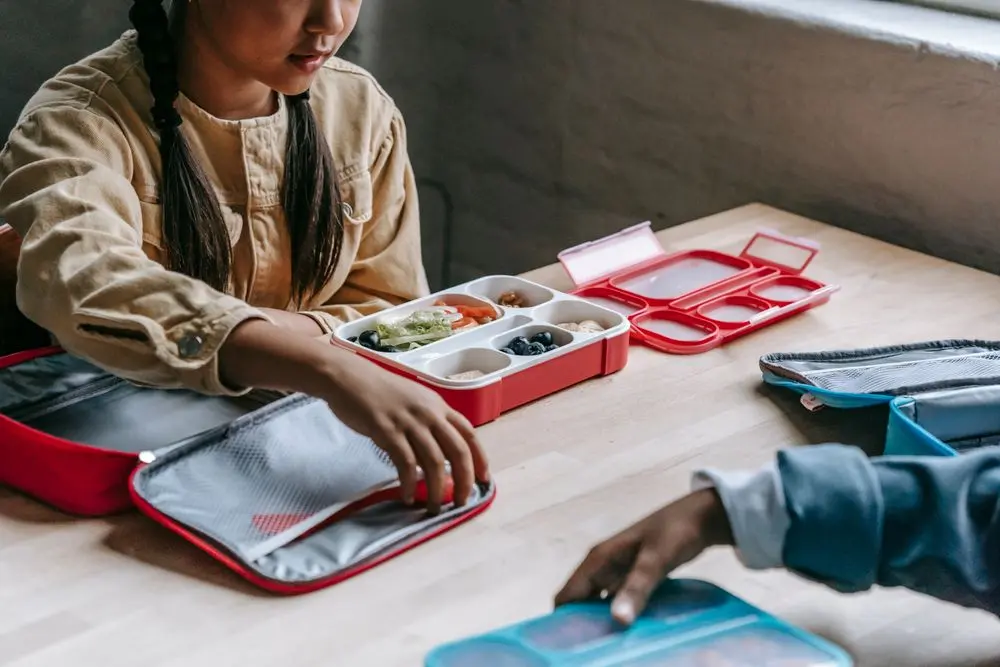
The first thing I noticed was the weight of the lunchbox.
It should have been empty.
Instead, when the older man held it out to me on my front porch, the blue insulated bag sagged heavily from his hand.
Exactly the way it had when Chloe carried it out the door that morning.
“How do you know where we live?” I said.
I didn’t open the screen door all the way. I kept one hand on it. My phone was in my back pocket, and I was very aware of it.
The man looked down at the white label I’d stuck under the handle months ago.
Our last name. My phone number. Our address.
“Your handwriting is very informative, ma’am,” he said.
Under any other circumstances, I might have laughed.
I didn’t.
His coat was worn shiny at the elbows. Brown canvas, the kind construction workers wear, with one pocket torn half off and safety-pinned back on. Gray ran through his beard. His face had the weathered look of somebody who’d spent too many nights outside.
But his eyes held mine.
Dark. Steady. Worried.
He nudged the lunchbox forward.
“I think you should take this,” he said.
“Where’s Chloe?” I asked.
“At school.”
“Did something happen?”
He hesitated.
That hesitation scared me more than anything he could have said.
“There’s something she’s too terrified to tell you,” he said.
My whole body went cold.
“Is someone hurting her?” I breathed.
“No.”
“Did she tell you she’s in danger?”
“Not exactly.”
I opened the screen door and grabbed the lunchbox out of his hand.
It was still cold. The ice pack was still inside. I could feel the hard corners of the sandwich container through the fabric.
“Then what?” I said.
He glanced toward the street. At the bus going by at the end of the block. At nothing.
“My name’s Bram,” he said.
“I know.”
That surprised him. His eyebrows went up.
“Chloe told me,” I said.
His face softened for half a second.
Then it went careful again.
“Ma’am,” he said, “I think your daughter has gotten very good at making sure nobody worries about her.”
My hand tightened around the blue handle.
And that’s when I realized I’d heard almost the exact same sentence before.
Only that time, it had sounded like praise.
Three months earlier, Chloe had started eating like she’d spent the whole school day walking across a desert.
She’d come through the front door around four, drop her backpack in the hall, and go straight to the pantry. Crackers. Granola bars. Peanut butter, straight off the spoon. Once I watched her eat cold leftover pasta right out of the container, standing in front of the open refrigerator, still wearing her coat.
“Didn’t you eat lunch?” I asked.
“Mhm.”
Her mouth was full.
“What did I pack?”
She paused.
“Sandwich.”
I narrowed my eyes.
“Which kind?”
She swallowed.
“Turkey?”
It had been pasta salad.
I let it go that day. Fifteen-year-olds don’t pay attention to what’s in their lunch. I know I didn’t.
But the next day, I decided to test her.
Chloe had an orthodontist appointment after school, so I picked her up at the corner instead of letting her walk home. I waited until we were halfway down Murray Avenue.
“Was the chicken good today?” I said.
Chloe smiled. Automatically. Without even looking at me.
“Yeah. Really good, Mom. Thanks.”
I glanced over at her.
“I didn’t pack chicken.”
Her face collapsed.
For the rest of the block, she stared at her hands in her lap. Picking at the cuticle on her thumb. A thing she’s done since she was four.
Finally, she whispered, “You’re going to be mad.”
“Try me.”
“I’ve been giving him my whole lunch.”
I pulled into our driveway. I turned off the car.
“Giving who?” I said.
She told me.
There was an older homeless man who stayed near the bus shelter on Fifth Avenue, about two blocks from her school. Right by the stop where she got off in the morning.
The first time she noticed him was back in September. The temperature had dropped all of a sudden, one of those Pittsburgh mornings where it’s seventy on Tuesday and forty on Wednesday. He was sitting under the shelter in a thin jacket with his hands tucked in his armpits.
Chloe walked past him.
Then she turned around.
“I just thought he looked hungry, Mom,” she said.
“So you gave him your lunch?”
She nodded.
“Once?”
Silence.
“Chloe?”
“A few times,” she admitted.
“How many?”
She looked embarrassed.
“Most days,” she said.
I should have been frustrated. I know that. A parenting magazine would have told me to talk to her about strangers. About safety. About how she can’t just give away her food.
Instead, I reached across the console and hugged her.
“You wonderful little goofball,” I said.
She laughed against my shoulder.
“I knew you’d be mad.”
“I’m mad you haven’t been eating.”
“I can eat when I get home.”
“That is not the point, honey.”
The next morning, I packed two lunches.
Chloe’s red lunchbox. And a blue one we’d had in the back of the cabinet for years, from when Kenny was doing a job site out in Washington County and needed something that would keep his food cold.
I wrote BRAM on a piece of masking tape and stuck it across the top.
I also stuck one of our spare return-address labels under the handle. The ones I got free from some charity years ago and never use. Just in case the box got lost.
Chloe came downstairs and stopped in the kitchen doorway.
She stared at the blue lunchbox.
“You don’t even know him,” she said.
“I know he apparently likes turkey.”
She grinned.
And after that, two lunches became normal.
What I didn’t realize was that almost nothing else was.
Bram started becoming part of our kitchen without ever coming into our house.
Chloe would report things about him over breakfast. Like he was a weather forecast.
“According to Bram, grapes are just overpriced water balloons.”
“Bram says oatmeal cookies are a scam. He says they’re just a cookie that’s lying to you about being healthy.”
“His biggest rule is that anybody who puts raisins in a cookie belongs in jail.”
“That’s a little harsh,” I said.
“He says the jail can be minimum security.”
Kenny loved these updates.
My husband had never met Bram either. But he started adding things to the grocery cart on Saturdays.
“Get the good mustard,” he told me. Holding up the brown spicy one. “Apparently we’re feeding a food critic.”
At first, I thought the whole thing was simple.
Chloe handed Bram the blue lunchbox before school. After classes, she picked it up on her walk home, and he gave it back empty.
That explained why she sometimes got home ten minutes late.
Then fifteen.
“Sorry,” she’d say, coming in the door. “Bram talks a lot.”
I never questioned it.
Why would I?
Chloe had always been responsible. She got good grades. She never skipped school. She never got in trouble. We’d never once gotten a phone call from a principal.
Whenever her teachers talked about her, I heard the same words.
Helpful.
Mature.
Easy.
At parent-teacher conferences in October, her English teacher, a young guy named Mr. Pace with a cardigan and a wedding ring he kept spinning, smiled at us across his desk.
“Chloe is one of those students you simply never have to worry about,” he said.
I remember squeezing Kenny’s hand under the desk.
I was so proud.
Now, standing on my porch with Bram, I suddenly remembered something else.
That same morning. Just a few hours earlier.
Chloe had come down the stairs with her backpack on, ready to grab the lunches. She’d been smiling. Talking about something on her phone.
But somewhere between the last step and the kitchen, the smile went away.
It didn’t fade. It just stopped. Like a light switching off.
“What’s wrong, sweetheart?” I’d asked.
She adjusted her backpack strap.
“Nothing, Mom.”
And I believed her.
The rest of that morning had been completely normal.
I packed the lunches while Chloe stood next to me, pretending she wasn’t sneaking her cookies into Bram’s box.
Two oatmeal cookies went into the blue box. Despite his opinions on oatmeal cookies, he apparently ate every single one.
Chloe quietly added a third.
I turned around to put grapes into a little container. The overpriced water balloons.
When I turned back, the cookie spot in Chloe’s red box was empty.
“Excuse me,” I said.
She widened her eyes.
“What?”
“Where are your cookies?”
“No idea.”
“Chloe.”
“He likes them.”
“So do you.”
“He likes them more, Mom.”
I took one cookie out of Bram’s box and put it back into hers.
“Communism has limits,” I said.
Chloe rolled her eyes.
I didn’t find out until later that Bram had taught her that joke.
Kenny came through the kitchen with his coffee. He was in his work clothes. Gray Duquesne Light shirt with his name stitched over the pocket. He’s a lineman. He climbs utility poles for a living. He was already late.
He kissed the top of Chloe’s head.
“Big test today?”
“Chemistry.”
“You’ll crush it.”
She groaned. “Don’t say that.”
“Why?”
“Because then if I don’t, it’ll be your fault.”
“Deal,” Kenny said.
She smiled.
Everything looked ordinary.
Except when Chloe picked up the blue lunchbox, she stood there for a second with both hands wrapped around the handle.
Just standing there. Holding it. Looking at it.
I noticed.
I just didn’t understand.
“Sweetheart?”
She blinked. “What?”
“You okay?”
“Yeah.” Then she smiled. “I’m fine.”
That answer should have bothered me.
It didn’t.
Not yet.
Bram stepped down off the porch and sat carefully on the top step. Like he wasn’t sure if I wanted him any closer to the house.
I stayed standing in the doorway. Holding the lunchbox against my chest.
“Tell me what happened this morning,” I said.
He rubbed his hands together. They were red and chapped across the knuckles.
“She brought me lunch like always,” he said.
“And?”
“She told me to keep the box.”
My heart kicked.
“Why?”
“Because she said she wasn’t coming back for it.”
I looked down at the blue lunchbox again.
Such a stupid, ordinary thing. A lunchbox from a hardware store. Still full. Still cold.
“What does that mean?” I said.
“That’s what I asked her.” Bram looked up at me. “She said she was going to the school office after her last class.”
“For what?”
Something dark crossed his face.
“To ask how to leave,” he said.
“Leave what?”
“School,” he said.
I actually laughed.
Because it made no sense.
“Chloe loves that school,” I said.
Bram didn’t answer.
“Her grades are excellent.”
Still nothing.
“She worked for years to get in there.”
“I know,” he said.
“You know?”
“She told me,” he admitted.
Those three words hit me harder than I was ready for.
She told me.
My daughter had been talking about school with this man. About how hard she worked to get in. About things I didn’t even know she was thinking.
He knew enough to hear what I hadn’t.
Let me explain about Halbrook.
Halbrook Academy is a private school in Oakland, near the universities. Old brick buildings. Ivy. Kids whose parents are surgeons and professors and lawyers. Chloe decided she wanted to go there when she was eleven, after she went to a science camp on their campus one summer.
She studied for the entrance exam for a year and a half. She did practice tests at the kitchen table every Sunday night. She wrote her application essay eleven times.
She got in.
She got a scholarship that covered about half.
The other half is fourteen thousand dollars a year.
Kenny and I make decent money. He has a union job. I do medical billing from home for two doctors’ offices. But fourteen thousand dollars a year is a lot for us. It’s the same as a second mortgage.
We never told Chloe that.
At least, I didn’t think we had.
“Why would she leave?” I said.
Bram looked down at his boots.
“That’s the part she doesn’t want to tell you,” he said.
My phone was already in my hand.
I called Chloe.
Straight to voicemail.
I called again.
Voicemail.
School hours. Of course. Halbrook makes the kids put their phones in little locked pouches during the day.
I called Kenny instead.
He picked up on the second ring. I could hear wind and a truck engine. He was out on a job.
“Hey, Fiona.”
“I need you to leave work.”
“What happened?”
I looked at Bram.
At the blue lunchbox in my arms.
At the address label that had led this stranger straight to my front door without me ever knowing.
“It’s Chloe,” I said.
That’s all Kenny needed.
“I’m coming,” he said.
Bram stood up.
“I should go,” he said.
“No.”
He looked surprised.
“You came all this way,” I said, “because you thought I needed to know.”
“Yeah.”
“Then you’re finishing the sentence.”
He looked down.
“I promised her I wouldn’t repeat every detail,” he said.
“She’s fifteen.”
“I know.”
“I’m her mother.”
“I know that too.”
“Then stop protecting a secret that has my daughter trying to leave school without telling us.”
Bram didn’t raise his voice.
“I’m not protecting the secret,” he said. He met my eyes. “I’m protecting the difference between what she told me and what she’s ready to tell you herself.”
That stopped me.
I stood there with my mouth half open.
I didn’t have anything to say to that.
Then he added, quietly, “But there’s one thing you need to know before you talk to her.”
I waited.
He reached into his coat pocket. The good one, not the safety-pinned one. He pulled out a folded piece of notebook paper. Soft from being folded and unfolded a lot.
It wasn’t Chloe’s handwriting.
It was his.
On it were tally marks in two columns.
RED CARS.
CITY BUS.
I stared at it.
“What is this?”
“Our game.”
“What game?”
“After school,” he said.
He pointed at one column. It had a lot more marks than the other.
“She says red cars are more common than buses.”
“And?”
“She’s wrong,” he said.
Despite everything, I almost smiled.
Then Bram folded the paper back up. Carefully. Along the same creases.
“Your daughter doesn’t just stop to pick up this lunchbox,” he said. His voice was soft now. “Some days she sits with me until she can make herself go home.”
I couldn’t speak.
Because suddenly I could see every late afternoon differently.
Every ten-minute delay. Every fifteen.
Every “Bram talks a lot.”
Every snack she tore through before dinner because she hadn’t eaten all day.
Every time I asked “How was school?” and she said “Fine.”
Fine. Fine. Fine.
“And today,” Bram said, “she said something she’s never said before.”
“What?”
He looked toward the road. Kenny’s truck was turning onto our street. The big white Duquesne Light truck with the bucket on the back.
Then Bram looked back at me.
“She said she could survive three more years if she had to,” he said.
Kenny pulled into the driveway before I could answer.
He jumped out without even shutting the truck door all the way. It swung back open. The alarm started dinging.
“What happened?”
He looked at me. Then at Bram, standing on our front steps. His face did something complicated. Suspicion, then confusion, then the beginning of understanding.
I handed him the blue lunchbox.
He took it without thinking. Then he felt how heavy it was.
“Bram says Chloe was planning to ask about leaving school today,” I said.
Kenny stared at me.
“Leaving?”
Bram nodded.
“She thinks she’s costing you too much,” he said.
My husband went completely still.
Kenny is six-foot-three. He climbs eighty-foot poles in ice storms. I’ve seen him carry a refrigerator up our basement stairs by himself.
I’d never seen him look like that.
Like somebody hit him in the chest.
“What?” he said.
“She said you work overtime because of her school,” Bram said. “Saturdays. Nights. She said she heard you on the phone about it. She thinks if she leaves, things will be easier for you.”
Kenny looked at me.
I looked at him.
We were both thinking the same thing.
The phone call.
Three weeks earlier. A Sunday night. Kenny had been in the garage on the phone with his foreman. I’d been in the kitchen. The door to the garage was open.
“Yeah, I’ll take Saturdays through December,” Kenny had said. “Whatever you got. Halbrook’s tuition went up again. Second payment’s due in January. I’ll take the storm calls too.”
I remember he came back in and kissed me and said, “Don’t worry about it. We’ll figure it out.”
I remember I said, “We always do.”
I didn’t know Chloe was sitting on the stairs.
I didn’t even think about it.
“She heard that,” Kenny whispered.
He put the lunchbox down on the porch railing.
“She heard me say that.”
Twenty minutes later, we were sitting in the counselor’s office at Halbrook Academy.
Kenny drove. I sat in the passenger seat. Bram sat in the back of the truck cab, wedged between a cooler and a box of work gloves. I don’t remember deciding to bring him. I just remember Kenny opening the back door and saying, “Get in,” and Bram getting in.
Nobody talked on the way.
The counselor’s name was Ms. Abernathy. Late fifties. Gray bob. A sweater with little embroidered apples on it. Her office smelled like peppermint tea and had a poster on the wall that said YOU ARE ENOUGH in big pastel letters.
She listened to the whole thing.
Then she frowned.
“Chloe?” she said.
“Yes.”
“Chloe Brennan?”
“Yes.”
She blinked. Genuinely startled.
“She’s one of our easiest students,” she said.
“Easy enough,” I said, “that nobody noticed she was miserable?”
Ms. Abernathy looked down at her desk.
She didn’t have an answer.
She called down to the chemistry classroom.
A few minutes later, there was a knock. The door opened.
Chloe walked in.
She saw Kenny first.
Then me.
Then Bram, standing in the corner by the doorway with his hands in his coat pockets. Like he was trying to take up as little room as possible.
Her face crumpled.
“You told them,” she said.
Bram nodded.
“I trusted you!” Chloe blurted.
It came out of her so loud that Ms. Abernathy jumped.
“I know,” Bram said. His voice was gentle. “That’s why I couldn’t help you disappear quietly.”
Chloe started crying.
My first instinct was to ask her why she hadn’t told us.
Why? Why didn’t you come to me? Why did you tell a stranger at a bus stop and not your own mother?
It was right there. On the tip of my tongue.
I stopped myself.
Because I already knew the answer.
She hadn’t told us because we’d spent fifteen years telling her how proud we were that she never needed anything.
Instead, I pulled the empty chair beside me toward her.
“Sit down, honey,” I said.
She sat.
For a few seconds, nobody said anything.
Chloe was crying with her face down. Her hair falling over it. Her hands clenched in her lap.
Kenny reached over and put his hand on her back. She didn’t pull away.
Ms. Abernathy slid a box of tissues across the desk.
Bram stayed in the corner.
Then I said, “I’m sorry.”
Chloe wiped her face with the back of her hand.
“For what?”
“For making being strong sound like the thing I loved most about you,” I said.
That broke her.
She covered her face with both hands and just sobbed. Her shoulders shaking.
“I’m sorry,” she kept saying. “I’m sorry, I’m sorry.”
“You don’t have anything to be sorry for.”
When she could talk again, she talked to her knees.
“I hate it here,” she whispered.
Kenny made a sound. A small one. Like a breath getting knocked out of him.
“Not because anyone did one big thing,” Chloe said. “Nobody’s bullying me. Nobody’s mean. It’s just…”
She stopped. Started again.
“I eat alone,” she said. “Every day. Well. I didn’t eat. I gave my lunch to Bram. And then at lunch period, I go to the library and sit in the corner by the biographies and pretend I’m studying. Because nobody goes over there.”
She wiped her nose.
“Everybody here has known each other since kindergarten,” she said. “They all went to the same Montessori school. They all go skiing in Colorado. Their parents all know each other. I don’t fit. I spend the whole day trying not to look like I don’t fit. And it’s exhausting. And then I come home and I hear Dad talking about overtime and I think about what this place costs and I think, they’re paying fourteen thousand dollars a year for me to be miserable.”
“Chloe,” Kenny said. “Baby. Look at me.”
She looked at him.
“How was I supposed to tell you?” she said. “How was I supposed to tell you I’m miserable somewhere you’re working extra hours to keep me? You’d just feel bad. And you’d still have to pay for it. And it’d be my fault you were working all those Saturdays for nothing.”
Kenny’s eyes filled up.
My husband. Who doesn’t cry. Who didn’t cry at his own father’s funeral because he said somebody had to hold it together for his mom.
“You’re allowed to cost us something,” he said. His voice cracked. “Money. Time. Sleep. Worry. You’re our kid, Chloe. You’re supposed to.”
Chloe looked at him for a long time.
Then she reached into her backpack.
She pulled out a folded piece of paper. Notebook paper. Folded into a small, tight square.
She handed it to me.
I opened it.
It was a letter. In her handwriting. Dated today.
Mom, Dad —
I’ve decided to transfer to Allderdice for the rest of high school. I already looked it up. I can walk there. It’s free. I know you’ll be upset but I’ve thought about it a lot and it’s the right choice. I’ll still get good grades, I promise. You won’t have to worry about me.
I know you already paid for this semester. I’m really sorry. I’ll get a job this summer and
I read until one sentence stopped me.
Mom, Dad… I’ll get a job and pay you back.
I folded the paper up again.
Very carefully. Along the same lines she’d made.
I held it in my lap for a second.
“You don’t owe us for being ours, sweetheart,” I said.
Chloe cried harder.
I pulled her chair closer to mine and put my arms around her, and she leaned against me the way she used to when she was small enough to fit in my lap.
Over her head, I saw Bram in the corner.
He was looking at the floor.
His jaw was tight.
After a while, Ms. Abernathy started talking about options.
Gently. Slowly. She didn’t push.
A different place to eat lunch. There was a small room off the art studio where some kids ate. She’d never thought to mention it to Chloe because Chloe never seemed to need it.
Clubs. Art club. Debate. Robotics. Chloe had never joined any. She said she’d thought about it, but they all met after school, and she had to get the lunchbox back from Bram.
Kenny looked at me when she said that.
Someone she could check in with. Once a week. Ms. Abernathy offered herself.
“I’m sorry I didn’t see it,” she said to Chloe. “I should have. I see a lot of kids who make a lot of noise. And I’m afraid I’ve gotten in the habit of thinking the quiet ones are fine.”
And a transfer.
If Chloe still wanted one after we tried everything else.
“That’s your choice,” Ms. Abernathy said. “Not today. You don’t have to decide anything today.”
For once, nobody needed Chloe to decide right away.
Nobody needed her to be fine.
When we stepped outside into the parking lot, Chloe still looked furious with Bram.
She walked ahead of him. She wouldn’t look at him.
Trust doesn’t fix itself just because someone had a good reason.
Bram walked behind her. A few steps back.
At the edge of the parking lot, he cleared his throat.
She stopped. Didn’t turn around.
He gave the back of her head a crooked smile.
“You can yell at me tomorrow,” he said.
“Maybe I will.”
“Excellent. Gives me something to look forward to.”
She almost smiled.
I saw it. Just at the corner of her mouth.
She didn’t let it out.
Kenny was standing by the truck. He’d been quiet since the counselor’s office. He was looking at Bram.
“Can I ask you something?” he said.
Bram looked at him warily.
“Sure.”
“Why’d you come to our house?”
Bram thought about it.
“Because she gave me back the box,” he said. “Full. And she told me to keep it. And I’ve seen people do that before. Give things away right before they leave.” He shook his head. “I didn’t think she was going to hurt herself. I want you to know that. I asked her straight out. She looked at me like I was crazy. But I thought she was going to disappear. Quietly. From here. And I thought if she did, you’d never know why. And she’d never know that you’d have wanted to know.”
Kenny was quiet.
“You asked her straight out?” he said.
“Yeah.”
“About hurting herself?”
“Yeah. You ask,” Bram said. “You don’t hint around. You ask.”
Kenny looked at him for a long time.
Then he held out his hand.
“Kenny,” he said.
Bram looked at the hand like he wasn’t sure it was real.
Then he shook it.
“Bram,” he said.
“I know,” Kenny said. “The food critic.”
Later, standing by the truck, I asked Bram what he needed.
He said, “Nothing.”
Automatically. Like it was a reflex. Like he’d said it so many times it didn’t mean anything anymore.
Chloe turned around.
For the first time since the counselor’s office, she looked right at him.
“Don’t,” she said.
He sighed.
“Apparently,” he said to me, “I created a monster.”
“What do you need?” I asked again.
He rubbed the back of his neck.
“My wallet got stolen,” he said finally. “In August. At the shelter on Smallman Street. Everything. My ID. Social Security card. Birth certificate. Everything I had.”
“Can you get them replaced?”
“You need ID to get ID,” Bram said. “That’s the joke. And they mail everything. You need an address. I don’t have an address.”
“Use ours,” Kenny said.
Bram stared at him.
“What?”
“Use our address,” Kenny said. “For the mail. We’ll hold onto it for you.”
“You don’t even know me.”
Kenny shrugged.
“I know you like turkey,” he said.
Chloe made a sound. A hiccup. Half laugh, half sob.
Kenny looked it up on his phone. There was an outreach center in East Liberty that helped people get replacement documents. Light of Life. They had a caseworker there on Thursday afternoons.
It was Thursday.
We drove him there.
The waiting room was crowded. Folding chairs. A TV playing a game show with the sound off. A man in the corner was asleep sitting up.
Bram went in to talk to the caseworker. We waited in the truck.
No miracle happened.
He came out forty-five minutes later holding a manila folder and a little card with his next appointment written on it.
Two weeks from Tuesday.
That was enough.
While we were waiting in the truck, Kenny reached into the back seat and grabbed the blue lunchbox.
He handed it to Bram through the window when he came out.
“You didn’t eat today,” Kenny said.
Bram looked at it.
Then he sat down on the curb in the parking lot of the outreach center and opened it up.
Turkey sandwich. The good mustard. Grapes. Carrot sticks. A cheese stick. And one oatmeal cookie.
He ate the sandwich in about four bites.
He ate the grapes, even though they were overpriced water balloons.
He didn’t eat the cookie.
He set it aside on the lid of the lunchbox.
Chloe got out of the truck.
She walked over and sat down on the curb next to him.
She picked up the cookie.
She broke it in half.
She handed Bram one piece.
He groaned.
“We’ve discussed this,” he said.
“Eat.”
“Bossy.”
“Old.”
He looked offended.
“Teenager,” he said.
For the first time all day, she laughed.
That afternoon, when we drove back past Halbrook to drop Bram off near the bus shelter, the last bell had just rung.
Kids were pouring out of the front doors. Getting into cars. Standing in little groups on the steps.
And on a low brick wall by the art building, two girls were sitting together. One had blue streaks in her hair. The other had a sketchbook open on her knees.
The one with the sketchbook looked up.
She saw Chloe in the truck window.
She waved.
“That’s Wren,” Chloe said quietly. “She’s in my chemistry class. She sits behind me. And that’s Nadia. They’re in art club.”
“Do you want to say hi?” I asked.
Chloe looked at me.
Then at the girls.
“I don’t know,” she said.
Kenny pulled over to the curb anyway.
He didn’t say anything. He just put the truck in park.
Chloe sat there for a long moment.
Then she opened the door.
She walked over to the wall.
Wren moved her backpack off the empty spot next to her.
“Chloe?” she said. I could hear it through the open window. “Hey. Are you okay? You got called out of chemistry. We thought you were in trouble.”
My daughter hesitated.
Then she sat down.
I didn’t tell her to go.
I didn’t tell her to stay.
I let her choose.
Bram was getting out of the truck. He had his folder tucked under his arm. He started walking toward the bus shelter.
I rolled down my window.
“Need a ride?” I said.
“No, I’m good.”
He stopped. He looked over toward Chloe, sitting on the wall between the two girls. Wren was showing her something in the sketchbook. Chloe was leaning over to see.
Then he looked back at me.
“Actually,” he said. “Yeah.”
He climbed back in.
Chloe’s backpack was on the floor by his feet. Taking up all the room.
I reached back.
I moved it to the seat behind me.
And made room.
We took him to the shelter on Smallman Street. It was the only one with open beds that night.
Before he got out, I said, “Bram.”
He turned around.
“What did you used to do?” I said. “Before.”
He smiled. A little.
“High school,” he said. “Taught history at Schenley. Twenty-two years. Until it closed.”
Kenny and I looked at each other.
“Communism has limits,” I said.
He laughed out loud. A real laugh. From the belly.
“She told you that one, huh?”
“She told me that one.”
“That’s my best material,” he said. “I used it on sophomores for twenty years. Never once got a laugh.”
He got out of the truck.
He stood on the sidewalk with his folder.
“Tell her I’ll be at the stop tomorrow,” he said. “If she wants to yell.”
“I’ll tell her.”
That night, we sat at the kitchen table.
All three of us.
Chloe had showered. Her hair was wet. She was wearing Kenny’s old Steelers sweatshirt, the one that comes down to her knees. She was eating a bowl of cereal at nine o’clock at night.
Nobody had made dinner. Nobody had thought about it.
“I have to tell you something,” Kenny said.
Chloe put down her spoon.
“The overtime,” Kenny said. “The Saturdays. You heard me on the phone. And you heard me say Halbrook.”
She nodded. She looked at the table.
“Some of it’s for school,” Kenny said. “That’s true. I’m not going to lie to you. The tuition’s a lot. It went up. I picked up Saturdays.”
He leaned forward.
“But I’d have picked up Saturdays anyway. You know why? The roof’s leaking over the back bedroom. I’ve been putting buckets up there since August. The truck needs new tires. Your mom’s car needs a transmission. I’m forty-six and I’m the senior guy on my crew and the overtime is good money. I like it. I like being up on a pole on a Saturday morning when it’s quiet.”
He reached across and put his hand on hers.
“You are not why I work,” he said. “You’re why I come home.”
Chloe’s face crumpled again.
She was so tired. I could see it. She’d been carrying this thing for months, and now she’d put it down, and her arms didn’t know what to do.
“Why didn’t you tell us?” Kenny asked. Gently. “Not about the money. About being lonely. Why couldn’t you tell us that?”
Chloe looked at her cereal.
“Because,” she said. “You always say I’m the easy one.”
I closed my eyes.
“Everybody says it,” Chloe said. “Mr. Pace. Grandma. Aunt Diane. ‘Chloe’s so easy. Chloe never gives anybody any trouble.’ You say it to people on the phone, Mom. You told Mrs. Kowalski next door I’m the easiest kid in the world.”
She looked up at me.
“So I thought, if I’m not easy,” she said, “then what am I?”
I couldn’t answer.
Because I’d said it. A hundred times. A thousand.
I’d said it like it was the best thing I could say about her.
After Chloe went to bed, I sat on the back porch in the cold for a long time.
Kenny came out with two mugs of tea. He sat down next to me. He didn’t say anything.
“I was the easy one,” I said finally.
He looked at me.
“Growing up,” I said. “My dad drank. You know that. My brother was always in trouble. Fights. Cops at the door. Mom was always crying in the kitchen. And I was the one who got straight A’s and made my own lunch and never asked for anything.”
I wrapped my hands around the mug.
“My mom used to tell people, ‘Fiona’s my rock. I never have to worry about Fiona.’”
I laughed. It came out wrong.
“I was so proud of that,” I said. “I thought it meant she loved me the most. And then I spent my whole childhood terrified that if I ever needed anything, I’d stop being the one she didn’t have to worry about. I’d just be one more problem.”
Kenny didn’t say anything.
He put his arm around me.
“I did it to her,” I said. “I did the exact thing to her. And I didn’t even see it.”
“We did it,” Kenny said. “Both of us.”
“I should have seen it.”
“Fi.” He turned my face toward him. “You saw it today. You stopped yourself. In that office. You were going to ask her why she didn’t tell us, and you stopped. I watched you do it.”
He kissed my forehead.
“That’s how you fix it,” he said. “One time. And then the next time. And the next.”
The next morning, I packed two lunches.
Chloe’s red one. And the blue one.
I put two oatmeal cookies in each. Then I put a third in Bram’s.
Chloe came downstairs. She saw the cookies.
“You’re encouraging him,” she said.
“He’s a history teacher,” I said. “He’s earned it.”
She stared at me.
“He told you?”
“He told us. Did you know?”
“He told me in October.” She took the blue lunchbox. Held it with both hands for a second. Then she looked at me. “He said he taught a girl once who was just like me. Straight A’s. Never caused any trouble. Always said she was fine.”
“What happened to her?”
Chloe looked at the floor.
“He said one day she just stopped coming to school,” Chloe said. “And he found out later she’d been working two jobs to pay her mom’s rent. And she’d never told anyone. Not one teacher. Because she didn’t want to be a burden.”
She shifted the lunchbox to one hand.
“He said he always wished he’d asked her more questions,” she said. “He said that’s why he asked me so many.”
Chloe yelled at Bram that afternoon.
She told me about it later. She stood at the bus shelter with her backpack on and told him he’d broken a promise. That she’d trusted him. That he had no right.
He listened to the whole thing.
Then he said, “You’re right.”
“I’m right?”
“I broke a promise. That’s true. I’d do it again. But you’re right that I broke it.”
She said she didn’t know what to do with that. She’d been ready for him to argue.
“So what did you do?” I asked.
“I sat down,” Chloe said. “And we counted red cars.”
The next few weeks weren’t magic.
I want to be honest about that.
Some days were good. Some days Chloe came home and talked for an hour about something Wren said, or something Nadia drew, or how the art teacher, Mrs. Feeney, let them eat lunch in the back room by the kilns where it was warm.
Some days were bad. She’d come home quiet. She’d go upstairs and close her door. I’d stand in the hallway and want to knock. Want to fix it. Want to make her talk.
Sometimes I knocked.
Sometimes I didn’t.
One night in December, she came downstairs at eleven o’clock. I was on the couch watching TV. She sat down at the other end.
She didn’t say anything for a long time.
“I had a bad day,” she said finally.
I muted the TV.
“Do you want to talk about it?”
“Not really. I just wanted to tell you. That it was bad.”
I didn’t say anything.
I didn’t ask what happened. I didn’t tell her it would get better. I didn’t tell her she was strong.
I just held out my arm.
And she slid down the couch and leaned against me, and we watched a cooking show with the sound off until she fell asleep.
That was the first time in her life she’d ever told me she was having a bad day without me having to drag it out of her.
I sat there with her asleep on my shoulder and cried quietly so I wouldn’t wake her up.
Bram’s birth certificate came in the mail on December 11th.
A plain white envelope from the Pennsylvania Department of Health. Addressed to Bram Wilhelm Novak. Care of the Brennan family.
Chloe found it in the mailbox when she got home. She came running into the house holding it over her head like it was a winning lottery ticket.
“It came! Mom! It came!”
She made Kenny drive her to the bus shelter at six o’clock that night so she could give it to him in person. In the dark. In the cold.
I went too.
Bram was sitting under the shelter with a blanket around his shoulders. When he saw Chloe getting out of the truck, he stood up.
She handed him the envelope.
He opened it right there under the streetlight. He took out the birth certificate. He looked at it for a long time.
Bram Wilhelm Novak. Born March 3rd, 1961. Mercy Hospital. Pittsburgh, Pennsylvania.
“Well,” he said. His voice was rough. “Look at that. I exist.”
His Social Security card came two weeks later.
Then, in January, his state ID. With a terrible picture where he looked like he was about to sneeze.
Chloe put it on our refrigerator for a day before she gave it to him. With a magnet shaped like a slice of pizza.
“It’s a celebration,” she said.
With an ID, the caseworker at Light of Life could start the paperwork for his Social Security retirement. He’d turned sixty-two the March before and never applied because he didn’t have the papers.
It took two months.
In March, he moved into a room in a building in Lawrenceville run by a nonprofit. Small. A bed, a dresser, a hot plate, a window that looked out on an alley. A shared bathroom down the hall.
He called it “the penthouse.”
Chloe decided to stay at Halbrook.
She decided in February. On her own.
We’d told her she could transfer at the end of the year. We’d driven past Allderdice. We’d gone to an open house. We’d sat down and looked at the numbers together, at the kitchen table, all three of us. Kenny showed her his paycheck. I showed her our budget. We didn’t hide anything.
“This is how much it costs,” Kenny said. “This is what we have. This is what we’d do with it if you weren’t at Halbrook. We’d fix the roof sooner. That’s about it. That’s the whole difference.”
Chloe looked at the spreadsheet for a long time.
“That’s it?” she said. “The roof?”
“That’s it.”
“I thought it was so much worse,” she said. “I thought you were going to lose the house or something.”
“That’s because we never told you anything,” I said. “So you filled in the blanks with the scariest thing you could think of.”
She stayed.
Not because it was free. Not because she felt guilty.
She stayed because she joined art club. Because Wren and Nadia saved her a seat in the room by the kilns. Because Mrs. Feeney told her she had a good eye for color and asked if she wanted to submit something to the spring show.
“If it gets bad again,” Chloe said, “I’ll tell you. I promise. And then I’ll go to Allderdice.”
“Okay.”
“Is that okay?”
“Baby,” Kenny said. “That’s all we ever wanted. For you to tell us.”
She still sees Bram.
Not every day anymore. She doesn’t need to. But Thursdays, after art club, she takes the bus to Lawrenceville and they sit on the bench outside his building and count red cars.
She’s keeping a new tally. On a new piece of notebook paper.
RED CARS. CITY BUS.
As of last week, red cars were winning.
“It’s because Lawrenceville has more hipsters,” Bram says. “Hipsters drive red cars. It’s a statistical anomaly.”
“You’re just mad you’re wrong,” Chloe says.
“I’m never wrong. I’m a history teacher.”
“You’re a retired history teacher.”
“That’s worse. That means I’ve had more time to be right.”
On Easter Sunday, Kenny asked Bram to dinner.
At our house. Inside.
He’d been part of our kitchen for six months. He’d never once been in it.
He showed up at four o’clock on the dot. In a button-down shirt that still had the creases from the package. Khaki pants. His hair combed. His beard trimmed.
He was holding a pie.
A store-bought apple pie in a plastic container from the Giant Eagle on Butler Street.
“It’s not oatmeal,” he said, handing it to me at the door. “I want that on the record.”
He stood in our front hallway and looked around.
At the stairs. At Chloe’s backpack hanging on the post. At the family pictures on the wall.
Then he looked toward the kitchen.
“So this is where the lunches come from,” he said.
Chloe came down the stairs.
She saw him standing there.
She stopped on the bottom step for a second.
Then she ran down the last few stairs and hugged him. Hard. Around the middle.
Bram stood very still. Like he’d forgotten how.
Then he put one arm around her shoulders. Carefully.
“Hey, kid,” he said.
We ate in the kitchen.
Kenny made a ham. I made the potatoes. Chloe made a salad and put grapes in it on purpose, and Bram picked every single one out and lined them up on the edge of his plate and Chloe laughed so hard she choked on her water.
Kenny told the story of the time he got stuck in his bucket truck during an ice storm in 2014. Bram told a story about a student who once turned in a paper on the French Revolution that was just the lyrics to a song from Les Misérables.
“Did you fail him?” Chloe asked.
“I gave him a B-minus,” Bram said. “For effort. And for good taste in musicals.”
At one point, I looked around the table.
At my husband, laughing with his mouth full. At my daughter, arguing about raisins with a man she’d met at a bus shelter. At Bram, in his creased shirt, holding his fork like a pencil, the way teachers do.
And I thought about the morning in November when he stood on my porch holding a lunchbox that was too heavy.
I thought about how close I came to not opening the door all the way.
After dinner, Chloe and Bram did the dishes.
Kenny and I sat at the table and listened to them argue about whether a dishwasher is a “loading” or a “packing” situation.
The blue lunchbox was sitting on the counter by the sink. Empty. I’d washed it that morning.
Bram picked it up.
He looked at the masking tape on the top. BRAM, in my handwriting. Faded now. Coming up at the corners.
He looked at the label underneath the handle. Our name. Our phone number. Our address.
“You know,” he said. To nobody in particular. “When I first saw this label, I thought, these people are crazy. Putting their address on a lunchbox and handing it to a stranger at a bus stop.”
He set it back down.
“Then I thought, no,” he said. “That’s a woman who’s not afraid of who might find her.”
I didn’t know what to say to that.
So I didn’t say anything.
It’s May now.
Chloe’s painting got into the spring art show. It’s a picture of a bus shelter in the rain. There’s an old man sitting on the bench in a brown coat. And next to him, there’s a blue lunchbox.
The title card says Thursdays.
Bram came to the show. He wore the button-down shirt again. He stood in front of that painting for a long time.
He didn’t say anything.
He didn’t have to.
People still tell me Chloe’s an easy kid.
Her teachers. Her friends’ parents. My mother on the phone.
I’ve stopped agreeing.
Now I say, “She’s a great kid.” Or, “She’s a good kid.” Or, “She’s having a hard week, actually, but she’s getting through it.”
Because she’s not easy.
No kid is easy. Some of them just get very, very good at hiding how hard things are. Because somewhere along the way, somebody made them believe that being easy was the price of being loved.
I know, because I was one of them.
And I almost made her one too.
I still pack two lunches.
Even though Bram has a hot plate now, and a Social Security check, and a little refrigerator in his room in Lawrenceville.
On Thursdays, Chloe takes the blue one to him.
Turkey. The good mustard. No raisins.
And one oatmeal cookie.
She always comes home with it broken in half.
One half eaten.
The other half wrapped in a napkin, in the bottom of the lunchbox.
“He says it’s mine,” she tells me. “He says that’s the rule. Nobody carries the whole thing alone.”