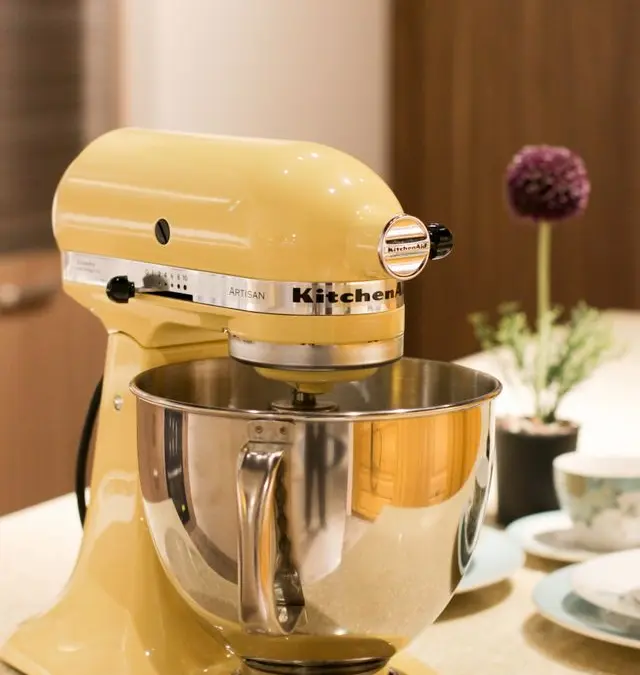
There, beside the welcome mat, sat my mother’s mixer.
It was 7:40 on a Saturday morning. I’d opened the front door to get the newspaper, still in my bathrobe, with my coffee in one hand. The paper was there. So was the mixer.
Just sitting on the porch boards. Like a pumpkin somebody had left out after Halloween.
Denise hadn’t knocked. She hadn’t called. She hadn’t texted. She hadn’t even bothered to hand it back to me.
She’d just left it outside.
Anybody walking down Linden Street could have picked it up and carried it away. The man who jogs past every morning with his two huskies. The kids who ride their bikes to the gas station for slushies. Anybody.
I set my coffee down on the railing and bent down and picked it up.
And right away, I knew something was wrong.
It was filthy.
Dried yellow cream had hardened around the seam where the head of the mixer meets the body. It was thick and cracked, like old paint on a fence. Some of it had dripped down into the little vents on the side of the motor housing. It had crusted on the beater shaft. There were flecks of it on the speed lever.
The bowl was inside the house somewhere, I guessed. Or still at Denise’s. The mixer had come back alone.
It looked like she hadn’t even tried to rinse it. Not a paper towel. Not a wet rag. Nothing.
I carried it inside. It’s heavy. Almost twenty-five pounds. My mother used to say you could stop a burglar with it.
I set it on the kitchen counter, in its spot. The spot by the window where the morning sun comes in.
I stared at it for a minute.
Then I plugged it in.
I flipped the switch.
The motor made a horrible noise.
A grinding, straining sound. Like something inside was chewing on gravel. The beater shaft jerked and stuttered instead of turning smooth. It smelled hot. A thin, burned smell, like a hair dryer left on too long.
I’d never heard that sound before. Not once in my whole life. Not once in all the years my mother owned it.
I turned it off right away.
I stood there with my hand still on the switch.
Thirty-six years.
That mixer had worked for thirty-six years.
And after four days at Denise’s house, something was terribly wrong with it.
I felt sick.
Not because of the money. I could buy a new mixer. They sell them at Target. They come in sixteen colors now, including one called “Pistachio” and one called “Hibiscus.”
I felt sick because this one couldn’t be replaced.
A new one wouldn’t have the little chip on the base where my brother Danny knocked it with a baseball bat in 1994. It wouldn’t have the faint brown stain on the cord where Mom set it too close to the stovetop once. It wouldn’t have thirty-six years of Sunday afternoons in it.
It wouldn’t be hers.
My daughter Lucy came into the kitchen in her pajamas, rubbing her eyes. She’s ten. She has my mother’s chin and my mother’s way of standing with one hip out when she’s waiting for an explanation.
She saw the mixer on the counter. She saw my face.
“Grandma’s mixer came back,” she said.
“Yeah.”
“Is it okay?”
I didn’t answer right away.
She came over and looked at it. At the crusted yellow cream. She wrinkled her nose.
“Mrs. Denise didn’t wash it?”
“No, baby.”
“Did she break it?”
I looked at my mother’s mixer.
“I think so,” I said.
My neighbor Denise has borrowed so many things from me this year that I’ve practically lost count.
I want to explain that part first. Because I know how this sounds. I know it sounds like I’m a woman who got mad over a kitchen appliance. And I need you to understand that it wasn’t about the mixer. Not only.
It started innocently enough.
Denise and her husband, Gary, moved into the blue house next door two years ago. They have a son, Tyler, who’s sixteen and mostly lives inside a hoodie. Denise is about my age, early forties. She’s loud and friendly and wears a lot of athleisure and calls everybody “hon.” She brought us a plate of brownies the day they moved in. Store-bought, with the plastic still on them, but it was a nice thought.
We weren’t best friends. We were neighbors. We waved. We talked over the fence about the weather and the HOA and whether the new people at the end of the street were ever going to mow their lawn.
I liked her well enough. Everybody did.
Back in March, she needed my ladder.
She knocked on the door one Saturday afternoon and said Gary was out of town and the gutter over her garage was hanging loose and she needed to get up there. Did I have a ladder?
I did. A twelve-foot aluminum one my husband Tom bought at Home Depot when we moved in. I told her to take it.
I didn’t think twice.
She brought it back eleven days later. It had blue paint splattered all down one side. She’d painted Tyler’s bedroom with it. She leaned it against our garage and said, “Thanks, hon!” and went back inside.
Tom looked at it that night.
“Is that paint?”
“Yeah.”
“She didn’t say anything?”
“She said thanks, hon.”
Tom looked at me for a long moment. He didn’t say anything else.
Then she asked for the pressure washer.
Then she started on the kitchen.
My slow cooker. For a potluck at her church.
My food steamer. For a diet she was trying.
The big blue cooler. For Tyler’s soccer tournament in Columbus.
My favorite roasting pan. The heavy stainless steel one with the rack, that Tom’s mother gave us for our tenth anniversary.
Every single time, she promised she’d bring it right back the minute she was done.
That almost never happened.
Sometimes I’d wait days longer than she said.
The slow cooker was supposed to come back on Monday. It came back the following Thursday. With dried chili around the rim.
Sometimes I had to ask more than once. Three times for the pressure washer. Four times for the cooler. I’d text her, very politely. Hey Denise! No rush, but whenever you get a chance, could you bring back the cooler? Thanks! And I’d add a smiley face, so she wouldn’t think I was mad.
She’d answer: Oh my gosh, totally forgot! This weekend!
And then she’d forget again.
When things came back, they were often dirty.
The roasting pan came back with burned black stuff baked onto the bottom that took me three nights of soaking and scrubbing to get off. I never fully did. There’s still a dark ring in one corner.
And sometimes a small piece would be missing.
The pressure washer came back without the fifteen-degree nozzle. The yellow one. The one you use for driveways. The food steamer came back without the little rice basket that goes on top. The cooler came back without the drain plug, so now it leaks out the bottom.
I mentioned the nozzle once.
“Oh, really?” Denise said. “Huh. I didn’t even use that one. It must have fallen off in your garage.”
It hadn’t. I’d looked.
She never seemed embarrassed.
She never offered to replace anything.
She barely even said thank you.
And I kept telling myself it wasn’t worth it.
She lived right next door. We saw each other every day. Our kitchen windows face each other across a strip of grass and a row of hydrangeas. I could see her doing dishes at night. She could see me.
I didn’t want trouble. I didn’t want to be the neighbor who keeps score. I wanted things to stay friendly.
So I kept saying yes.
I need to tell you something about myself.
I’m not good at saying no. I never have been.
I was the girl in school who did the whole group project because the other three kids didn’t show up to the meetings. I’m the woman at work who always ends up planning the office baby showers. I’m the one who gets asked to bring “just a little something” to the PTA bake sale and somehow ends up bringing six dozen cupcakes.
My mother was the same way. Worse, maybe.
She once lent our family car to a man from church for “just the weekend” and didn’t get it back for three months. She drove my brother and me to school in my grandfather’s old pickup truck that whole time and never complained once.
When I asked her why she didn’t just tell him to give it back, she said, “He needed it more than we did, sweetheart.”
She said that about everything.
He needed it more. She needed it more. They needed it more.
And then, about the mixer, she said something different.
My mother bought that KitchenAid in 1989.
I was six. I remember the day it came. A big brown box from Sears, delivered by a man in a uniform. Mom cut the tape with a steak knife and lifted it out like it was a baby. Cream-colored. Heavy. Shiny chrome bowl.
She’d saved for it for almost a year. My dad drove a truck for a freight company, and Mom cleaned houses three days a week, and we didn’t have money for things like that. She kept a coffee can on top of the refrigerator. Every week, she put something in it. Five dollars. Ten, when she could.
She set the mixer on the counter by the kitchen window. And it stayed there for thirty-two years.
Every Sunday, she used it.
That was our day. After church. After the dishes from lunch. Mom would put on her apron, the yellow one with the little blue birds on it, and tie her hair up, and turn on the radio to the oldies station.
And she’d bake.
Cakes. Bread dough. Cookies. Pie crust. Birthday desserts. Sometimes something new she’d seen in a magazine at the dentist’s office.
My brother Danny and I would sit at the kitchen table and watch. The mixer would hum beside her. A low, steady sound. Like a big cat purring.
When she was done, she’d let us lick the beaters. One each. Danny always got the one with more on it. I don’t know how. He just did.
Some of my happiest memories in the world are in that kitchen. The smell of vanilla. The radio playing The Supremes. Mom humming along, off-key. The mixer purring. The light coming in the window.
Her yellow cake with chocolate frosting was famous.
At least, famous on our street. Everybody’s birthday got one. Every new baby. Every funeral. If somebody in our neighborhood died, Mrs. Ellison’s yellow cake showed up at the house the next day. It was the law.
She never wrote the recipe down. She said it was in her hands.
Even when she got older, she kept using that mixer.
Her hands got stiff. Arthritis. She couldn’t open jars anymore. She couldn’t knead bread by hand. But she could still turn on that mixer and let it do the work.
“This thing’s the best friend I’ve got,” she told me once. She was seventy-one. “Doesn’t talk back. Doesn’t need anything. Just does its job.”
Then her heart started to fail.
Congestive heart failure. Her legs swelled up. She got short of breath. Standing in the kitchen for more than a few minutes wore her out. She’d have to sit down on the stool and rest.
Eventually, she couldn’t bake at all.
But she never let anybody take that mixer off the counter. My brother tried once. He said it was taking up space and she wasn’t using it. She told him if he touched it, she’d haunt him personally.
The last Sunday she baked was in October, three years ago.
I came over with Lucy. Lucy was seven. Mom was in her wheelchair by then. She couldn’t stand at the counter.
“I want to make the yellow cake,” she said. “With Lucy.”
So we did.
I wheeled her up to the counter. Lucy stood on the step stool. Mom told her what to do. Every step. Out loud. From memory.
“Two sticks of butter. Soft, not melted. Now the sugar. Not like that, honey, you’re dumping it. Slow. Let the machine do the work.”
Lucy turned the speed lever. The mixer hummed.
Mom closed her eyes and listened to it.
“That’s the sound,” she said. “You hear that, Lucy? That’s what it sounds like when it’s happy.”
I wrote the recipe down that day. On an index card. Everything she said. For the first time ever.
That card is in my recipe box now. It’s stained with butter. It says, at the bottom, in my handwriting: “Let the machine do the work. —Mom.”
She died six weeks later. At home. In her own bed.
My brother lives in Phoenix. He took the dining room table and Dad’s watch.
I took the mixer.
And for three years, I used it every Sunday. Not always for cake. Sometimes for pancake batter. Sometimes for mashed potatoes. Sometimes just because.
Every time I turned it on, I heard that hum, and I thought of her.
It wasn’t just an appliance.
It was a piece of my mother.
So when Denise showed up at my door last Tuesday, I knew what my answer was going to be.
It was about four in the afternoon. I’d just gotten home from work. I work at a dental office. Front desk. I was still in my scrubs.
Lucy was sitting on the porch steps with a library book.
Denise came up the walk in leggings and a pink zip-up jacket. She had her phone in her hand.
“Hey, hon! Quick question.”
“Hi, Denise.”
“Could I use your mixer for a cake?”
She pointed through the screen door. You can see the kitchen from the front door. You can see the counter by the window. You can see the mixer.
“I’m having people over Friday,” she said. “Gary’s work people. Like, eleven of them. And I want to make this cake I saw on Instagram. With whipped cream filling? It’s supposed to be amazing. But I don’t have a mixer.”
I shook my head.
“Sorry, Denise,” I said. “I’d rather not lend that one out.”
She looked surprised. Genuinely surprised. Like nobody had ever told her no before.
“Why not?”
“It belonged to my mother,” I said. “It’s really special to me.”
Denise laughed.
Not a mean laugh, exactly. More like I’d said something silly. Like if I’d told her I couldn’t lend her my umbrella because it had feelings.
“Oh, come on!” she said. “I’m only making one cake.”
I tried to stay firm.
“I know,” I said. “But I’d really prefer to keep it here. I could lend you my hand mixer, though. It works great for whipped cream.”
“A hand mixer?” She made a face. “For this cake? Hon, the recipe says stand mixer. It takes forever by hand.”
“It doesn’t take that long.”
“I’ll take excellent care of it,” Denise said. She put her hand on her chest. “I promise. I’ll treat it like it’s my own.”
I should have said no again.
I should have repeated it. Same words. Calm. Sorry, Denise, I’d rather not. And closed the door.
That’s what I’d tell anybody else to do. That’s what I’d tell Lucy.
But Denise kept standing there.
She didn’t leave. She just stood in my doorway with her phone, smiling at me, waiting. Like we were playing a game and it was my turn. Like if she just stood there long enough, the answer would change.
And Lucy was sitting on the porch steps, watching us.
I could feel her watching.
And somehow, I started to feel uncomfortable about saying no. Like I was being difficult. Like I was being rude. Like Denise was being perfectly reasonable, and I was the one making it weird.
I didn’t want another awkward conversation. I didn’t want her to tell people I was stingy.
So I gave in.
“All right,” I said. “But please be careful with it.”
Denise grinned. “Of course!”
I went into the kitchen. I unplugged the mixer. I wiped it down with a dish towel, even though it was already clean. I put the bowl on it. I gave her the paddle attachment and the whisk.
“The whisk is for the cream,” I said. “Not the paddle. And don’t run it on high for too long. It’s old. It gets hot.”
“Got it, hon. Whisk. Not too long.”
She took it from me. She hoisted it up onto her hip like a bag of groceries.
I winced.
She carried it down the steps, past Lucy, across the lawn, and into her house.
The screen door banged shut behind her.
I regretted it immediately.
I stood there in the doorway and watched her house for a long time.
Lucy looked up at me from the steps.
“Mom?”
“Yeah, baby.”
“Why did you say yes,” she said, “when you said no?”
I didn’t have an answer for her.
I stood there in my scrubs and couldn’t think of a single thing to say to my ten-year-old daughter.
“Because she really wanted it,” I said finally.
Lucy thought about that.
“I really wanted a phone,” she said. “And you said no.”
“That’s different.”
“How?”
“Because I’m your mom.”
She looked at me for a second. The way my mother used to look at me. One hip out.
Then she went back to her book.
I told myself not to worry.
It was a sturdy machine. Mom used it for decades without any real problems. It survived Danny and a baseball bat. It survived two moves. It survived me making bread dough at two in the morning the week Mom died, because I couldn’t sleep and I didn’t know what else to do with my hands.
Surely Denise couldn’t hurt it making one cake.
That’s what I told myself.
Friday night, I could see into Denise’s dining room from my kitchen window.
The lights were on. People were sitting around her table. Eleven of them. I could hear laughing.
I washed my dishes and tried not to look.
At about nine o’clock, I saw Denise in her kitchen. Standing at the counter. Doing something with her arms. Fast. Frustrated.
I couldn’t see what she was doing.
I didn’t want to know.
I turned off my kitchen light and went to bed.
Saturday morning, I found the mixer on the porch.
After I turned it off. After Lucy came in and asked if it was okay. After I stood there with my hand on the switch for I don’t know how long.
I took a deep breath.
“Stay here,” I told Lucy. “I’ll be right back.”
I didn’t change out of my bathrobe. I didn’t even think about it. I walked out the front door and across the wet grass in my slippers and up Denise’s front steps.
I knocked on her door.
At that point, I wasn’t even angry. Not really.
I was disappointed. Hurt. But I still thought there might be an explanation.
Maybe she’d dropped it by accident. Maybe it slipped off the counter. Maybe she felt terrible and didn’t know how to tell me, and that’s why she left it on the porch without knocking. Maybe she was over there right now, too embarrassed to face me.
I was ready to listen.
I was ready to say, These things happen. I know you didn’t mean to.
The door opened.
Denise was standing there in a fuzzy robe, holding a mug of coffee.
She looked completely relaxed.
“Oh, hey,” she said.
I tried to keep my voice steady.
“Denise, I just found my mixer on the porch.”
“Yeah. I dropped it off last night.”
“It’s covered in dried cream.”
She shrugged.
I kept going. “And when I turned it on, the motor made a terrible noise. It’s grinding. It smells like it’s burning.”
Denise took a sip of coffee.
Then she said something I couldn’t believe.
“Honestly, you should probably just buy a new one.”
I stared at her.
“What?”
“That thing is ancient,” she said.
My jaw got tight.
“Denise,” I said. “It belonged to my mother.”
She waved her hand. The one without the coffee. Like she was shooing a fly.
“Well, it stopped working halfway through making my cream,” she said.
I waited.
She was going to apologize now. I was sure of it. This was the part where she said, I’m so sorry, I feel awful.
She didn’t.
“I had eleven people sitting in my dining room,” she said, “waiting for dessert. And suddenly I couldn’t finish the cake. The whole thing was a disaster. I had to serve them ice cream out of the carton. Out of the carton. In front of Gary’s boss.”
She sounded annoyed. Like I’d done something to her.
Then she said:
“So, thanks for ruining my evening, I guess.”
For a moment, I couldn’t speak.
I just stood there on her porch in my bathrobe and slippers with my feet wet from the grass.
She’d borrowed something precious to me. After I said no. After I told her why.
She’d returned it broken.
She’d left it outside without telling me.
She hadn’t even wiped it off.
And somehow, she was blaming me.
I looked at her standing there in her fuzzy robe with her coffee.
Not worried at all.
Not one bit of guilt on her face.
Not even a little sorry.
And suddenly, I understood something.
Denise didn’t think she’d done anything wrong.
To her, my things were just there. Available. Whenever she needed them. If they came back late, that was my problem. If they came back dirty, I could clean them. If something broke, well, I should’ve owned something newer.
I thought about the ladder with the blue paint.
The pressure washer without the nozzle.
The cooler without the plug.
The roasting pan with the black ring that won’t come off.
Every single thing I’d handed over because I didn’t want to seem unfriendly.
And I realized all my patience hadn’t made her more careful.
It had taught her she didn’t need to be.
I didn’t shout.
I didn’t argue.
I just looked at Denise for another moment.
Then I turned around and walked back across the wet grass to my house.
Behind me, I heard her say, “Hon? You okay?”
I didn’t answer.
Tom was in the kitchen when I came back in. He’d just come down. He was looking at the mixer on the counter. At the crusted cream.
“What happened?”
I told him.
I told him everything. The porch. The noise. The smell. Ancient. Thanks for ruining my evening, I guess.
Tom’s face went red. Slowly. From his neck up.
He’s a quiet man. An electrician. He doesn’t get angry often. When he does, it’s like a slow kettle.
“I’m going over there,” he said.
“No.”
“Beth. I’m going over there.”
“No, Tom.” I put my hand on his arm. “You’ll yell. She’ll yell. Gary will come out. Tyler will film it on his phone. And it’ll be all over the neighborhood Facebook group by lunch that you threatened her. And she’ll be the victim.”
He looked at me.
“So what do you want to do?”
I looked at the mixer.
“I don’t know yet,” I said.
That evening, I sat at the kitchen table, looking at it.
Tom took Lucy to get pizza so I could have some quiet. I sat there alone with the light over the sink on and the mixer on the counter in front of me.
I remembered Mom at the counter on Sunday afternoons. The yellow apron with the blue birds. The radio. The smell of cake filling the whole house.
The way she let me lick the beaters.
The way she said That’s what it sounds like when it’s happy.
How proud she was of that machine. How long she saved for it. The coffee can on top of the fridge.
Denise had treated it like a piece of junk.
To me, it was worth more than the house.
I got up and got a bowl of warm water and a soft toothbrush and a dish towel.
And I started cleaning it.
Slowly. Carefully. The way you’d clean a wound.
The cream had hardened so much it was like cement. I had to soak it with a warm rag and wait, then scrape it gently with the toothbrush. Bit by bit. Around the seam. Out of the vents. Off the beater shaft.
It took me an hour and a half.
When I was done, it looked almost like it used to. Almost.
But I knew what it would sound like if I turned it on.
So I didn’t.
Lucy came home and found me still sitting there.
She sat down next to me at the table. She looked at the mixer.
“You cleaned it.”
“Yeah.”
“Does it work now?”
“No, baby.”
She was quiet for a while.
“Mom,” she said. “Are you going to make Mrs. Denise pay for it?”
“I don’t know.”
“You should.”
I looked at her.
“Grandma would say she needed it more,” I said. “That’s what Grandma always said.”
Lucy thought about it.
“Grandma wouldn’t let Uncle Danny take it off the counter,” she said. “She said she’d haunt him.”
I laughed. I couldn’t help it.
“You remember that?”
“You tell it every Thanksgiving,” Lucy said.
By the next morning, I’d made up my mind.
I wasn’t going to let this be another thing Denise could laugh off and forget.
And I wasn’t going to waste my breath arguing with somebody who honestly believed she’d done nothing wrong.
I was going to do this differently.
I came up with a plan.
The first part was finding out what was actually wrong.
On Monday, I took the day off work. I wrapped the mixer in a bath towel and put it in the back seat of my car and drove it to Gus’s Appliance Hospital on Fourth Street.
It’s a little shop between a vape store and a nail salon. It’s been there since the seventies. The sign is hand-painted. Inside, it’s floor-to-ceiling old appliances. Toasters. Vacuums. A jukebox with no front. There’s a cat named Maytag asleep on the counter.
Gus is about seventy-five. Greek. Bald, with huge white eyebrows and reading glasses on a chain. My mother brought her vacuum cleaner here for thirty years.
He looked up when I came in. He saw the mixer in my arms.
“Oh,” he said. “Oh, that’s a beauty. Where’d you get her?”
“She was my mother’s. Rose Ellison.”
Gus put down his screwdriver.
“Rose Ellison? The yellow cake lady?”
I stared at him. “You knew her?”
“Knew her? She brought me a yellow cake every Christmas for twenty years. Because I fixed her Electrolux for free in 1987 when her husband was out of work.” He shook his head. “I was sorry to hear she passed. I went to the service. I stood in the back.”
I didn’t know that. I didn’t know any of it.
I almost cried right there in Gus’s Appliance Hospital.
He set the mixer on his workbench and took off the top housing with a screwdriver. He turned on a little lamp and looked inside with his reading glasses pushed down on his nose.
He was quiet for a long time.
Then he made a sound. Like a doctor who sees something on an X-ray he doesn’t like.
“Who did this?” he said.
“My neighbor. She borrowed it.”
“Your neighbor did this?”
“What’s wrong with it?”
Gus took off his glasses.
“Okay,” he said. “So inside, there’s a gear. It’s called the worm gear. It’s made of plastic, on purpose. It’s supposed to be the weak spot. If somebody overloads the machine, that gear strips before the motor burns out. It’s like a fuse. It protects the motor.”
“Okay.”
“Your gear isn’t stripped,” Gus said. “It’s melted.”
I didn’t understand.
“The grease in here,” he said, “is supposed to last forty years. Your mother’s grease looked fine, I bet, up until last week. Now it’s cooked. Black. Like tar. Somebody ran this thing on the highest speed for a long time. A very long time. I mean, thirty minutes. Forty. Without stopping.”
He pointed at something inside.
“And then when the gear started going, instead of stopping, they kept pushing. See this? The head’s been forced. Somebody tried to lift the head while it was still locked down. Pried it. Bent the pin.”
He looked at me over his glasses.
“Your neighbor wasn’t making a cake,” he said. “She was fighting with it.”
I sat down on the stool by his workbench.
“Can you fix it?”
Gus looked at the mixer for a long time.
“I can fix it,” he said. “The motor’s okay. That’s the good news. Those old motors, they don’t make them like that anymore. That motor’ll outlive both of us.”
“And the bad news?”
“New gear. New grease. New pin. Have to take the whole thing apart, clean out that cream, it got into the bearings. Probably have to order a part from a guy in Wisconsin.” He scratched his eyebrow. “Two weeks. Three hundred and ten dollars.”
I nodded.
“Do it,” I said.
He wrote up a work order. On a carbon paper pad. Like it was still 1985. He tore off my copy and handed it to me.
At the bottom, under PROBLEM, he’d written: Overheated — ran on high 30+ min. Gear melted. Grease burned. Head pin bent from forcing. Cream in vents/bearings. Owner was not at fault.
He’d underlined the last line.
“Why’d you write that?” I asked.
Gus shrugged.
“In case you need it,” he said.
The second part of my plan was the list.
That night, after Lucy finished her homework, I sat down at the kitchen table with a notebook.
“What are you doing?” Lucy asked.
“Making a list.”
“Of what?”
“Everything Mrs. Denise ever borrowed.”
Lucy’s eyes got big. She pulled her chair over.
“Can I help?”
I thought about it. Then I slid the notebook over to her.
“You write,” I said. “I’ll talk.”
We went through all of it.
I checked old texts on my phone for dates. I went out to the garage and looked at things. Lucy wrote it all down in her careful fifth-grade printing.
Ladder — March 4. Returned March 15. Blue paint on side.
Pressure washer — April 12. Returned May 2 (asked 3 times). Missing yellow nozzle.
Slow cooker — May 20. Returned May 30. Dirty.
Food steamer — June 8. Returned June 22. Missing rice basket.
Cooler — July 1. Returned August 3 (asked 4 times). Missing drain plug. Leaks.
Roasting pan — September 14. Returned September 28. Burned black on bottom. Won’t come off.
Then, at the bottom:
Grandma’s mixer — October 15. Left on porch October 19. Broken. Dirty. Gus says not our fault.
Lucy drew a little heart next to Grandma’s.
Then she looked at the list. She counted with her finger.
“Seven things,” she said. “In seven months.”
“Seven things.”
“She took something every month.”
I hadn’t thought of it that way.
“And she only gave one back the same,” Lucy said. “Nope. None. She didn’t give any back the same.”
Then I did something I’d never done before.
I went online and looked up the prices. A new fifteen-degree nozzle for the pressure washer: $12.99. A replacement rice basket for the steamer: $14.50. A drain plug for the cooler: $8.75.
The roasting pan, I couldn’t replace. It was discontinued. I put it down as “can’t be replaced.”
And the mixer repair: $310.
I added it up.
$346.24.
Lucy looked at the number.
“That’s a lot,” she said.
“It’s not that much,” I said. “Not really. Not compared to what it’s worth.”
“What’s it worth?”
I looked at the counter by the window. The empty spot where the mixer used to be.
“You can’t put a number on it,” I said.
The third part of my plan took a little more courage.
On Wednesday, I went across the street to see Mrs. Feldman.
Ruth Feldman is eighty-four. Widowed. She’s lived on Linden Street since 1971. She knows everything about everybody and she’s never once used the word “gossip,” because she says what she does is “keeping up.”
She opened the door before I knocked. She’d seen me coming.
“Beth,” she said. “Come in. Sit. I’ll put the kettle on. This is about Denise, isn’t it?”
I stared at her.
“How did you—”
“Honey,” Mrs. Feldman said. “I’ve lived across from that house for fifty-three years. I watched her carry your mother’s mixer across that lawn on Tuesday like a sack of potatoes. I watched her put it on your porch Friday night at eleven-fifteen. In her bathrobe. She looked around first to make sure nobody was watching.”
She waved me toward the kitchen.
“Somebody was,” she said.
We sat at her kitchen table. She made me tea in a cup with roses on it. She put out a plate of those little windmill cookies.
“She borrowed my Harold’s drill,” Mrs. Feldman said. “In May. The yellow DeWalt. He bought it in 2009, the year before he passed. I don’t use it. I can’t. My hands. But I keep it. It’s in the hall closet. I just like knowing it’s there.”
She stirred her tea.
“Denise came over and said she needed to hang some shelves. I said fine. That was May. It’s October.” She looked at me. “I’ve asked her twice. She says she’ll bring it right over. She never does.”
“Mrs. Feldman, I’m so sorry.”
“Don’t be sorry, honey. You didn’t take it.” She sipped her tea. “But you’re not the only one.”
She told me about the others.
The Nguyens two houses down. Denise borrowed their folding tables and six chairs for a Fourth of July party. Two chairs came back broken. One table never came back at all.
The Hendersons at the corner. Their wheelbarrow. Gone since August.
The young couple at the end of the street, the ones who never mow their lawn. Their tent. Their camp stove. Their kayak. The kayak came back with a hole in it.
“She’s very friendly,” Mrs. Feldman said. “Everybody says so. Very friendly. And everybody says yes. Because nobody wants to be the one who says no to the friendly lady next door.”
She set down her cup.
“I’ve been watching people say yes to that woman for two years,” she said. “And not one of them has ever said a word.”
She looked at me over her glasses.
“So,” she said. “What are you going to do?”
The next evening, Thursday, I knocked on Denise’s door again.
This time, I was dressed. I had my notebook. I had Gus’s carbon-paper work order. I had a printed page I’d made on the computer, with the list and the prices and the total at the bottom. $346.24.
And I had Lucy with me.
I’d thought about that a lot. Whether to bring her. Tom said maybe not. Maybe it wasn’t something a ten-year-old should see.
But she’d sat on those porch steps on Tuesday and watched me cave. She’d asked me why I said yes when I said no.
She needed to see the other part too.
Denise opened the door. She was in a sweatshirt that said GOOD VIBES ONLY. She saw me. She saw Lucy. She saw the notebook.
“Oh,” she said. “Hey, hon. Feeling better?”
“Hi, Denise,” I said. “Do you have a few minutes?”
She looked at the notebook again.
“Uh. Sure? What’s up?”
“I took the mixer to a repair shop,” I said. “Gus’s, on Fourth Street. He looked at it.”
I handed her the work order.
She read it. I watched her face. I watched her get to the bottom. Owner was not at fault. Underlined.
She snorted.
“So he’s saying it’s my fault?”
“He’s saying it ran on high for more than thirty minutes,” I said. “And somebody forced the head open while it was locked.”
Denise opened her mouth.
Then she closed it.
“I’d like you to pay for the repair,” I said. “It’s three hundred and ten dollars.”
She stared at me.
“You’re seriously billing me?”
“Yes.”
She laughed. Not a real laugh. “Hon. Come on. It was an old machine. It was going to break eventually anyway. You can’t blame me because it happened at my house.”
“Gus says the motor is fine,” I said. “Gus says it would have run another thirty years.”
“Gus says.” She rolled her eyes. “Gus wants your three hundred dollars.”
I handed her the list.
She looked at it. I watched her eyes go down it. Ladder. Pressure washer. Slow cooker. Steamer. Cooler. Roasting pan. Mixer.
Her face changed. Just a little.
“What is this?”
“It’s everything you’ve borrowed this year,” I said. “And what happened to it. And what it would cost to replace the pieces that are missing.”
“You kept a list?”
“I made one,” I said. “On Monday. With Lucy.”
Denise looked down at Lucy.
Lucy looked right back up at her. She didn’t look away.
“You missed the nozzle,” Lucy said. “The yellow one. For the driveway. We looked everywhere in our garage. It’s not there.”
Denise’s face went pink.
“Wow,” she said. “Okay. Wow. I did not know I was being tracked like a criminal.”
“You’re not a criminal,” I said. “You’re my neighbor. And I’ve been lending you things for seven months because I didn’t want to make trouble. That’s my fault. Not yours. I should have said something a long time ago.”
“Then why are you saying it now?”
“Because I told you no,” I said. “About the mixer. I told you it was my mother’s. I told you it was special. And you laughed. And you kept standing there until I said yes. And then you broke it and left it on my porch and told me I ruined your evening.”
Denise didn’t say anything for a moment.
Then she crossed her arms.
“I’m not paying three hundred dollars for an old mixer,” she said. “That’s ridiculous. If you want, I’ll give you fifty bucks. For your trouble. But that’s it.”
I nodded slowly.
“Okay,” I said. “Then I have one more thing to ask you.”
She looked suspicious. “What?”
“Lucy’s class is having a fall party next Friday,” I said. “I’m in charge of the drinks. And I need a punch bowl.”
Denise blinked. “A punch bowl?”
“The crystal one,” I said. “The big one. In your china cabinet. The one you use at Christmas.”
I’d seen it. Every Christmas, Denise has a party. Every Christmas, that punch bowl comes out. It’s enormous. Cut glass, with a pattern like diamonds, and twelve little matching cups that hang on hooks around the rim. When the light hits it, it throws rainbows on the ceiling.
She’s told me about it. More than once. At the fence. At the mailbox. Proudly.
It was her mother’s. Her mother got it as a wedding present in 1972. It’s the only thing Denise has from her.
Denise’s face went completely still.
“My mom’s punch bowl?” she said.
“Yes.”
“For a fifth-grade party?”
“Yes.”
“With, like, thirty kids?”
“Twenty-six,” Lucy said.
“No,” Denise said.
She said it fast. Like a reflex. Like slamming on the brakes.
“Absolutely not. No way. That was my mother’s. It’s irreplaceable. Do you know what kids would do to that thing? No.”
I waited.
I let her hear it.
I let the words sit there in the air between us, on her front porch, under the light. That was my mother’s. It’s irreplaceable. No.
Denise heard it.
I watched her hear it.
Her face went from pink to red. Her arms came uncrossed. Her mouth opened, and nothing came out.
“I’m not going to take it,” I said quietly. “I never was. I don’t need a punch bowl. The PTA has one. A plastic one.”
Denise stared at me.
“I just needed you to hear yourself say it,” I said.
She didn’t say anything.
She just stood there in the doorway in her GOOD VIBES ONLY sweatshirt.
“You said no,” I said. “Right away. You didn’t even think about it. You didn’t feel bad. You didn’t worry I’d think you were rude. You just said no. Because it was your mother’s and it’s irreplaceable.”
I held up Gus’s work order.
“That’s what I said to you on Tuesday,” I said. “Word for word. And you laughed.”
Denise looked down at Lucy. Then at me.
Then she shut the door.
Not a slam. Just shut it. Quietly. Firmly.
I stood there on her porch for a second.
Lucy looked up at me.
“Did it work?” she whispered.
“I don’t know, baby,” I said. “Let’s go home.”
It didn’t work. Not right away.
The next morning, Friday, I opened the neighborhood Facebook group on my phone while I was eating breakfast.
Denise had posted at 11:48 the night before.
PSA for Linden St and Maple Ct: Be careful who you’re nice to. Some people will act all friendly and lend you stuff and then come to your house with an itemized BILL and their KID to shame you. 🙄 For a 40-year-old appliance that was probably on its last legs anyway. Some people need to learn to let things go. Good vibes only, people!! ✌️
There were already fourteen comments.
I almost didn’t read them.
My stomach was in a knot. I thought they’d all be on her side. Ugh, that’s so petty. Some people. Sending hugs, Denise!
The first comment was from a woman I didn’t know. It said: Wow, that’s crazy. Sorry hon.
The second comment was from Linh Nguyen. Two houses down.
Denise, while we’re on the subject, can we get our folding table back? The white one. It’s been since July. Also two of the chairs came back broken. We didn’t say anything at the time.
The third comment was from Kevin Henderson, at the corner.
Still waiting on our wheelbarrow from August.
The fourth comment was from the young couple at the end of the street, the ones who never mow.
Not trying to pile on but the kayak came back with a hole in it and we had to pay $80 to patch it. We figured it was an accident. But yeah.
The fifth comment was from Ruth Feldman.
I didn’t even know she was on Facebook.
Denise, dear. I’d like Harold’s yellow DeWalt drill back, please. You borrowed it on May 9th to hang shelves. It was my late husband’s. It’s the last thing he bought before he passed. I don’t use it. But I like knowing it’s in the hall closet.
I believe Beth’s mother’s mixer was the same kind of thing for her.
Good vibes only. ✌️
I put my phone down on the table.
Tom was reading over my shoulder. He let out a long, low whistle.
“Mrs. Feldman,” he said. “Holy cow.”
By noon, Denise had deleted the post.
But there were thirty-one comments on it by then. And a lot of people had taken screenshots.
That night, around eight-thirty, somebody knocked on our door.
It wasn’t Denise.
It was Gary.
Denise’s husband. Fifty, maybe. Tall, with thinning hair and a gray mustache. He’s an accountant, or was. I’d only ever talked to him a handful of times. He waved from the driveway. He mowed his lawn on Saturdays. That was about it.
He was standing on our porch holding a box.
Inside the box was the yellow DeWalt drill. A white folding table, folded. And a pressure washer nozzle. Yellow. Fifteen degrees.
“Hi, Beth,” he said. “Tom.”
“Hi, Gary.”
He didn’t come in. He just stood there holding the box. He looked exhausted.
“I found this in the garage,” he said, holding up the nozzle. “Behind the water heater. I think it’s yours.”
I took it.
“Thank you.”
“The drill’s Ruth’s,” he said. “The table’s the Nguyens’. I’m going to take them over. I wanted to come here first.”
He looked down at the box.
“I didn’t know,” he said. “About any of it. The list. Your mother’s mixer. I didn’t know she’d borrowed half the street.”
“Gary,” Tom said. “Do you want to come in?”
Gary hesitated.
Then he came in and sat down at our kitchen table. Tom got him a beer. He held it but didn’t drink it.
“I lost my job in June,” he said.
Tom and I looked at each other.
“Downsized,” Gary said. “Twenty-two years at the same firm. They called me into a conference room on a Tuesday and gave me a box. Nobody on the street knows. Denise didn’t want anybody to know.”
He turned the beer bottle around on the table.
“She’s been trying to help,” he said. “In her way. The dinner last Friday? That was for my old boss. And two other guys from a firm in Dayton that might be hiring. Denise thought if she threw a nice dinner, made a nice impression, it might help me get in.”
He laughed a little. It wasn’t a happy laugh.
“She spent two hundred dollars on groceries we don’t have,” he said. “For a cake she saw on Instagram. And she doesn’t know how to bake, Beth. She’s never baked anything in her life. She buys brownies at Kroger and takes the plastic off.”
I didn’t say anything.
“She called me into the kitchen around nine,” Gary said. “In the middle of dessert. She was crying. She’d been whipping that cream for forty minutes and it wouldn’t get thick. She kept turning it up higher and higher. The machine was smoking. She didn’t know what was wrong.”
“Forty minutes?” I said.
“Forty minutes,” Gary said. “I looked at the carton. It was half-and-half. Not heavy cream. Half-and-half. It was never going to whip. Not in a million years.”
He put his face in his hands.
“And when the mixer stopped, she tried to pull the top up to get the bowl out. And it wouldn’t come. And she pulled harder. And something bent.”
He looked up.
“She was so embarrassed,” he said. “With my old boss sitting right there. She served him ice cream out of the carton. She told me later she wanted to die.”
“That doesn’t excuse leaving it on our porch,” Tom said quietly.
“No,” Gary said. “It doesn’t. Or not washing it. Or what she said to you.” He looked at me. “She told me what she said. ‘Thanks for ruining my evening.’ She told me that this morning. After the Facebook thing.”
He shook his head.
“She said it because she was ashamed,” he said. “That’s what she does. When she’s ashamed, she gets mean. She’s done it her whole life. I’m not saying that makes it okay. I’m just telling you.”
He sat there for a long time.
Then he reached into his back pocket and took out an envelope. He put it on the table.
“There’s a hundred and fifty dollars in there,” he said. “That’s what we can do right now. I’ll bring the rest when I can. I’m sorry it’s not all of it.”
I looked at the envelope.
“Gary,” I said. “You don’t have to—”
“Yes, I do,” he said.
He stood up.
At the door, he stopped.
“She cried for an hour after you left last night,” he said. “After the punch bowl thing. I didn’t know what happened. She wouldn’t tell me. She just sat at the dining room table looking at that stupid punch bowl in the china cabinet.”
He looked at me.
“Whatever you said to her,” Gary said. “I think it got in.”
Denise came over on Sunday.
It was about two in the afternoon. I was in the kitchen, making a grocery list. Lucy was at the table doing a puzzle.
Somebody knocked. Not the front door. The back door. The kitchen door, the one that faces Denise’s house across the hydrangeas.
Nobody ever uses that door.
I opened it.
Denise was standing there. No makeup. Hair in a ponytail. A plain gray sweatshirt.
She was holding a box.
“Can I come in?” she said.
I looked at her for a long moment.
Then I stepped back.
She came in. She set the box on the counter. She looked at the empty spot by the window, where the mixer used to be.
“Where is it?” she asked.
“At Gus’s,” I said. “Getting fixed. He says it’ll be ready next week.”
She nodded slowly.
She opened the box.
Inside was my slow cooker lid. I hadn’t even noticed it was missing. I’d been using a dinner plate on top.
The little rice basket for the steamer.
The drain plug for the cooler.
And a brand-new roasting pan. Stainless steel. With a rack. Still in the plastic.
“It’s not the same one,” Denise said. “I know. I looked online. Yours was discontinued. This is the closest one I could find.”
I looked at it. At the price sticker still on the side. Eighty-nine dollars.
“Denise. You didn’t have to—”
“Yes, I did.”
She stood there with her hands in the front pocket of her sweatshirt.
“I’m sorry,” she said.
She said it fast, like she had to get it out before she lost her nerve.
“I’m sorry about your mom’s mixer. I’m sorry I laughed when you said no. I’m sorry I kept standing there. I’m sorry I left it on the porch like that. I’m sorry I didn’t clean it. I’m sorry about what I said. About ruining my evening. That was a terrible thing to say. I knew it when I said it.”
Her voice cracked.
“I’m sorry about all of it,” she said. “The ladder. The cooler. The roasting pan. The nozzle Gary found behind the water heater. All of it.”
I didn’t say anything right away.
Lucy had stopped doing her puzzle. She was watching us from the table, very still.
“Why?” I asked finally.
Denise looked at me.
“Why did you keep borrowing things?” I said. “All year. Over and over. Even when they came back broken. Even when I had to ask four times.”
She was quiet for a long time.
Then she sat down at the kitchen table. Across from Lucy. She put her face in her hands.
“When I was a kid,” she said into her hands, “we didn’t have anything. My dad left when I was six. My mom worked at a laundromat. We lived in a trailer outside Chillicothe. We had nothing. Everything we used, we borrowed. From neighbors. From church. Clothes. Furniture. A Christmas tree, one year.”
She lifted her face.
“And nobody ever wanted it back,” she said. “That’s the thing. Nobody ever came asking. They just gave it to us. Because we were poor. Because they felt sorry for us. And I grew up thinking that’s just how it worked. You need something, you ask. People give it to you. They don’t care what happens to it after.”
She laughed a little. It wasn’t happy.
“And then I grew up,” she said. “And I married Gary. And we bought a house on a nice street. And I swore nobody would ever feel sorry for me again. I’d be the one with the nice house and the nice parties. And when we didn’t have something, I’d just borrow it. Because that’s how it works.”
She looked at the box on the counter.
“I never once thought about it from the other side,” she said. “Not once. Until you asked me for my mom’s punch bowl.”
“I lay awake all night,” Denise said. “After you left. I kept thinking about how fast I said no. How I didn’t even think. How I’d never let anybody touch that punch bowl. Not Gary. Not Tyler. Nobody. Because it’s the only thing of hers I have.”
She wiped her eyes with her sleeve.
“And I thought about you standing in your doorway on Tuesday,” she said. “Saying the exact same thing. And me laughing at you.”
She looked at me.
“And I thought, what kind of person does that?” she said. “And I didn’t like the answer.”
The kitchen was very quiet.
Lucy got up from the table. She went to the counter and pulled a paper towel off the roll. She walked over and handed it to Denise.
Denise took it. She looked at Lucy.
“Thank you, sweetheart,” she said.
“You’re welcome,” Lucy said.
Then Lucy went back to her puzzle.
Gus called on Thursday.
“She’s ready,” he said. “Come get her.”
I took Lucy with me after school. Gus had the mixer on his workbench, under the little lamp. He’d cleaned it. Really cleaned it. It was shinier than I’d ever seen it. Even the little chip on the base where Danny hit it with a bat looked cleaner somehow.
“New gear,” Gus said. “New grease. New pin. Got the cream out of the bearings. Took me two whole afternoons.”
He plugged it in.
“You want to do the honors?” he asked Lucy.
Lucy looked at me. I nodded.
She reached up and turned the speed lever.
The mixer hummed.
Low and steady. Smooth. No grinding. No burning smell. Just that sound. The big cat purring.
Lucy closed her eyes.
“That’s the sound,” she said. “That’s what it sounds like when it’s happy.”
Gus looked at her. Then at me.
“That’s what your mother used to say,” he said quietly. “When she brought me the vacuum. ‘Listen, Gus. It doesn’t sound happy.’”
I couldn’t say anything.
I paid him. Three hundred and ten dollars. A hundred and fifty from Gary’s envelope. The rest from me.
Gus wrote “PAID” across the work order in red pen. Then he paused. Then he wrote something else under it. He tore off my copy and handed it to me.
At the bottom, it said: Tell your daughter to use it every Sunday. Machines like this need to be used. —G.
That Sunday, I made Mom’s yellow cake.
Lucy stood on the step stool. I stood beside her. I read the recipe card out loud. The stained one, in my handwriting. Two sticks of butter. Soft, not melted.
The mixer hummed.
Around two o’clock, somebody knocked on the kitchen door.
The back one. Facing the hydrangeas.
It was Denise. Holding a carton of eggs.
“Gary said you needed eggs,” she said. “He said he saw you at the store and you forgot them.”
I hadn’t forgotten eggs. I had a dozen in the fridge.
I looked at her. She looked at the floor.
“Do you want to come in?” I said.
She came in. She stood by the counter. She watched Lucy turn the speed lever. She watched the butter and sugar go pale and fluffy.
“I don’t know how to bake,” Denise said quietly. “Like, at all. I bought half-and-half for whipped cream. Gary told you that, right?”
“He told us.”
“Forty minutes,” Denise said. “I stood there for forty minutes. I thought the machine was broken.”
Lucy laughed. Then she covered her mouth.
Denise looked at her. And then Denise laughed too. A real laugh. The first real one I’d heard from her in weeks.
“Okay,” Denise said. “Okay. It’s funny. It’s a little funny.”
“It’s really funny,” Lucy said.
“Can I ask you something?” Denise said to me.
“Sure.”
“Would you teach me? To make this?” She nodded at the mixing bowl. “The yellow cake. Gary has an interview in Dayton next month. A real one. Second round. And I want to make something for him when he gets home. Something I actually made. Myself.”
I thought about it.
I looked at the mixer. Humming away on the counter by the window. In its spot. In the sun.
“Yes,” I said.
Denise’s face lit up.
“But you’ll do it here,” I said. “In my kitchen. With me. Sundays. The mixer doesn’t leave this house.”
Denise nodded fast.
“That’s fair,” she said. “That’s completely fair.”
So she came back the next Sunday. And the one after that.
She wasn’t good at first. She cracked eggs like she was mad at them. She dumped the sugar in all at once. She tried to turn the speed up to high about fifteen times.
“Slow,” Lucy kept telling her. “Let the machine do the work.”
“Who taught you that?” Denise asked.
“My grandma,” Lucy said.
The third Sunday, Denise made the whole cake by herself.
I sat at the kitchen table and didn’t help. Lucy sat next to me. We watched.
She creamed the butter and sugar on medium. She added the eggs one at a time. She turned the mixer off before she scraped the bowl.
When the cake came out of the oven, it was a little lopsided. One side was higher than the other. The frosting had a bald spot on top.
Denise stood there looking at it like it was the Mona Lisa.
“I made that,” she said. “Me.”
“You made that,” I said.
She took a picture of it with her phone. Then another. Then she sent it to Gary.
Ten seconds later, her phone buzzed. She read it. Her eyes filled up.
“What’d he say?” Lucy asked.
Denise turned the phone around so we could see.
Gary had written: Who are you and what have you done with my wife. ❤️
Gary got the job in Dayton.
He starts in January. They’re not moving. He’ll commute. Forty-five minutes each way.
Denise brought him a yellow cake the night he got the call. She made it in my kitchen that afternoon, and carried it across the lawn on a plate with two hands, like it was made of glass.
The bald spot was smaller this time.
She still borrows things. Once in a while.
But it’s different now.
Last month she knocked on the front door and asked if she could borrow my good scissors. For wrapping presents.
I said, “Sure.”
She brought them back two hours later. She knocked. She handed them to me herself. She said, “Thank you so much.”
Then she stood there on the porch for a second.
“I wiped them off,” she said. “They had tape gunk on them.”
“Thank you, Denise.”
She nodded. She went home.
I stood there holding my good scissors and almost laughed.
And a couple of weeks ago, in early December, Denise knocked on the kitchen door.
She was holding something heavy. Wrapped in a towel.
She set it on the counter and unwrapped it.
It was the punch bowl. Her mother’s. Crystal, cut like diamonds, with the twelve little cups on hooks around the rim.
“Lucy’s class has a holiday party next week,” Denise said. “Lucy told me. She said you’re in charge of drinks again.”
I stared at her.
“Denise. No. I can’t take that. It’s your mother’s.”
“I know,” she said. “That’s why I want you to take it.”
She looked at me.
“I trust you with it,” she said. “You’ll bring it back clean. You’ll knock on the door. You’ll hand it to me yourself. You’ll probably wrap it in three towels.”
She smiled a little.
“I know you will,” she said. “Because I know how you take care of things.”
I didn’t know what to say.
I looked at the punch bowl. The light from the window hit it, and it threw little rainbows across the kitchen ceiling. Across the counter. Across the side of my mother’s mixer.
“Okay,” I said finally. “Thank you.”
“You’re welcome,” Denise said.
She went home.
I didn’t take it to the party.
I want to be honest about that. I couldn’t do it. Twenty-six fifth graders and a crystal punch bowl from 1972. I’d have had a heart attack.
I used the PTA’s plastic one.
But I kept Denise’s punch bowl on my kitchen counter for a week. Next to my mother’s mixer. Right there in the sun.
And when the week was over, I washed it by hand. Every single cup. I dried it with a soft towel. I wrapped it in three more towels.
I walked it across the lawn. I knocked on the door.
And I handed it to her myself.
Lucy still asks me about it sometimes.
Last week, in the car on the way home from school, she was quiet for a long time. Then she said:
“Mom. Ava asked if she could borrow my good markers. The fancy ones. The ones Grandma Tom’s mom gave me.”
“Grandma Joyce.”
“Grandma Joyce’s markers.”
“What did you say?”
Lucy looked out the window.
“I said no,” she said. “I said they were special. And she said, ‘Come on, I’ll be careful.’ And she kept standing there.”
My stomach tightened. “And?”
“And I said no again,” Lucy said. “The same way. And I said she could use my regular markers instead. And she did.”
She was quiet for a second.
“She didn’t get mad,” Lucy said. “I thought she would. She just said okay.”
I pulled into our driveway. I turned off the car.
I sat there for a second with my hands on the wheel.
“I’m really proud of you,” I said.
“I know,” Lucy said. “You said that last time.”
“I’m saying it again.”
She rolled her eyes. She got out of the car.
At the front door, she turned around.
“Mom? It’s easier the second time,” she said. “Saying no. The second time, it’s easier.”
Then she went inside.
That Sunday, I made Mom’s yellow cake.
Just me. Lucy was at a birthday party. Tom was out with Gary, looking at used cars for the Dayton commute. The house was quiet.
I stood at the counter and creamed the butter and sugar. Slow. On medium. I added the eggs one at a time.
The mixer hummed.
Low and steady. Smooth. The big cat purring.
Through the window, across the hydrangeas, I could see into Denise’s kitchen. She was at her counter. She had a hand mixer. A little white one. Brand new, I could tell. She was making something in a bowl. Frowning. Concentrating. Going slow.
She looked up. She saw me through the window.
She waved her hand mixer at me like a trophy.
I laughed. I waved back.
When the cake came out of the oven, I let it cool on the counter. Then I frosted it. Chocolate. The way Mom did it. A swirl on top, with the back of a spoon.
I cut a slice for myself.
I sat at the kitchen table in the late afternoon light, with my mother’s recipe card propped up against the sugar bowl, and her mixer on the counter in its spot by the window, and I ate it slowly.
Let the machine do the work, the card said.
She was right about that. She was right about most things.
But she was wrong about one.
Sometimes they don’t need it more than you do. Sometimes it’s okay to say so.
It took me forty-three years and a broken mixer to learn that.
I hope it takes Lucy less.