The moment I saw the wedding cake, I knew something was terribly wrong.
It was black.
Completely black. Three enormous tiers covered in glossy black frosting, sitting on a silver cart under the ballroom lights like something out of a funeral. Two servers in white jackets were rolling it slowly across the dance floor toward our table, and the closer it got, the quieter the room became.
There were small figurines on top. I could see that much from where I was standing. Little people in wedding clothes.
“That isn’t our cake,” I whispered.
My husband, Bradley, was standing right beside me. We’d been married for exactly three hours and twelve minutes. He was still holding my hand. I felt his fingers go stiff.
“What is that?” he said.
I didn’t know.
I didn’t know that the color of the frosting was the least of it. I didn’t know that when I got close enough to see those figurines, I’d feel the floor tilt under my feet. That whoever had sent that cake knew something about our family that I didn’t.
Something Bradley had been keeping from me.
Something a seven-year-old girl had been carrying all by herself.
My name is Hailey. I was thirty-two when I married Bradley Whitaker. We’d been together three years.
I’m a children’s librarian. I run story time at the Eastside branch every Tuesday and Thursday morning. Twenty toddlers on a carpet shaped like a turtle, and me in a chair with a picture book, doing all the voices.
That’s how I met Paige.
She was four. She came to story time one rainy Thursday in March, holding her father’s hand. She had on purple rain boots and a yellow raincoat with the hood still up, even inside. She sat at the very edge of the turtle carpet, as far from the other kids as she could get, and she didn’t take her hood down the whole time.
I read a book about a bear who loses his hat.
At the end, when all the other kids were running to their parents, Paige stayed sitting on the carpet. She looked up at me.
“Did the bear ever get his hat back?” she asked.
“He did,” I said. “It’s on the last page. Want to see?”
She nodded. I showed her.
She studied the picture for a long time. The bear wearing his red hat again.
“Good,” she said. “He was sad without it.”
Then she stood up and went to her father.
Her father was standing by the door with his hands in his pockets. Tall. Brown hair that needed cutting. A gray sweater with a hole in the elbow. He looked tired in a way that went past not-enough-sleep. Tired all the way down.
And when he reached out for Paige’s hand, I saw the scars.
They ran from his right wrist up his forearm and under the sleeve of the sweater. Shiny and pink and tight, the way burn scars look when they’ve healed but never quite settled.
He saw me see them. He pulled his sleeve down.
“Thank you,” he said. “She doesn’t usually talk to people.”
“She asked a good question.”
He looked down at Paige.
“She asks a lot of those,” he said. “At home.”
They came back every Thursday after that.
Paige moved a little closer to the middle of the carpet every week. By June, she was sitting in the front row. By July, she was taking her hood off.
Bradley stood by the door every time. Sometimes he’d sit in one of the tiny chairs along the wall, with his knees up by his ears, and read the paper. Sometimes he’d just watch Paige.
He never talked much. A hello. A thank you.
Then one Thursday in August, Paige raised her hand in the middle of a book about a family of ducks.
“Miss Hailey,” she said, “my mommy died.”
The whole carpet went quiet. Twenty toddlers turned around to look at her. One of the moms by the wall put her hand over her mouth.
I closed the book.
“I’m so sorry, Paige,” I said.
“There was a fire,” Paige said. Very matter-of-fact. “In our old house. Daddy got me out. He couldn’t get Mommy out. His arm got burned.”
I looked over at Bradley.
He’d stood up from the tiny chair. His face had gone completely white.
“Do you miss her?” I asked Paige.
“Yes,” she said. “Every day.”
“What was her name?”
Paige looked surprised. Like nobody had asked her that in a long time.
“Julie,” she said.
“That’s a beautiful name.”
“She had red hair,” Paige said. “Kind of red. Kind of brown. And she liked blue flowers.”
“Thank you for telling me about her,” I said.
Paige nodded. She seemed satisfied. Then she pointed at the book in my lap.
“Can you finish the ducks now?”
So I finished the ducks.
Afterward, Bradley waited by the door until all the other families had gone.
“I’m sorry about that,” he said. “She does that sometimes. Just tells people.”
“Don’t be sorry.”
He rubbed the back of his neck. He looked like he wanted to say something else.
“Most people,” he said, “when she says it, they get uncomfortable. They change the subject. Or they look at me like they want me to make her stop.”
“I asked her name,” I said. “That’s all.”
He looked at me for a long moment.
“Nobody asks her name,” he said quietly. “Nobody ever asks about Julie. They just say sorry.”
The fire happened when Paige was two and a half.
Bradley told me about it two months later, on our fourth date, at a diner on Route 30 at eleven at night. He’d been working up to it. I could tell. He kept starting sentences and not finishing them.
It was an electrical fire. Old wiring in an old house they’d bought because they loved the porch. It started in the wall behind the living room couch at three in the morning.
Bradley woke up to the smoke alarm. Julie was already up. She’d gone downstairs for water.
He got to Paige first. Her room was closest. He wrapped her in a blanket and carried her out the upstairs window onto the porch roof and handed her down to a neighbor who’d come running.
Then he went back in for Julie.
He didn’t make it to the stairs.
The firefighters pulled him out of the upstairs hallway. He was in the burn unit for three weeks. He had four skin grafts on his arm and his shoulder.
Julie was found at the bottom of the stairs.
They told him later it was the smoke, not the fire. That she probably never felt anything.
He didn’t believe them. I don’t think he ever did.
“She was trying to get to us,” he said, at that diner, with his coffee going cold in front of him. “She was going up the stairs. Toward Paige’s room. I know she was.”
I didn’t say anything. I just put my hand on the table near his. Not touching. Just near.
“I should have gone down first,” he said. “I should have checked downstairs first.”
“Bradley. You saved your daughter.”
“I know,” he said. “Everybody says that.”
He looked out the window at the parking lot.
“I’d have saved them both,” he said, “if I’d been faster.”
That was the first time I understood something about Bradley.
He carried that fire with him everywhere. In his arm. In his shoulders. In the way he checked the smoke detectors every single Sunday morning. In the way he couldn’t sit with his back to a door.
And in the way he couldn’t talk about Julie.
He could tell me about the fire. The facts. The timeline. He’d gone over it so many times in his head he could recite it like a police report.
But Julie herself? Who she was? What she laughed at? What she was like on a Tuesday morning?
He never said.
Paige said.
Paige said all the time.
I never expected to love another woman’s child.
I want to be honest about that. When Bradley and I started dating, I was nervous about Paige. I didn’t know how to be around a kid who’d lost her mother. I didn’t want to step on anything. I didn’t want to try too hard.
But Paige made it easy.
She loved bedtime stories. Not one. Three. Always three. And she wanted the voices. If I read a dragon in a normal voice, she’d stop me and say, “No. Dragon voice.”
She loved pancakes shaped like animals. I’m terrible at it. My bunnies look like potatoes. My elephants look like potatoes with a tail. She didn’t care. She’d look at every single one and tell me what it was supposed to be.
“That’s a turtle.”
“It’s a bear.”
“It’s a turtle, Hailey.”
“Okay, it’s a turtle.”
And she asked questions. A thousand of them. Why is the sky blue. Why do cats have whiskers. Why do people have to die. Why do we have eyebrows. Where does the water go when it goes down the drain. Is God a girl or a boy or neither. Can fish feel sad.
I answered every single one I could. And the ones I couldn’t, I said, “Let’s look it up,” and we’d go to the library and look it up together.
She kept a photograph beside her bed.
It was in a silver frame. Bradley and Julie on their wedding day. Standing under a big oak tree, laughing at something off-camera. Bradley in a dark suit, younger, without the tired in his eyes. Julie in a simple white dress, with reddish-brown hair loose around her shoulders.
And tucked behind her ear was a tiny blue flower.
“That’s a forget-me-not,” Paige told me, the first time I put her to bed. She pointed to the flower in the picture. “Mommy’s favorite. She grew them in the garden. At our old house.”
“They’re beautiful.”
“They all burned up,” Paige said.
I didn’t know what to say.
“Grandma Carol says they come back,” Paige said. “Every spring. Even if you don’t plant them. They just come back by themselves.”
“I didn’t know that,” I said.
“It’s true,” Paige said. “I looked it up. With you. At the library.”
I didn’t remember that. But I believed her.
I never asked her to put that picture away.
Not once. It never even crossed my mind. Julie was her mother. Nobody could replace her. I didn’t want to replace her. I just wanted to be there, too.
Some nights, after the three bedtime stories, Paige would pick up the frame and look at it.
“Mommy liked the color blue,” she’d say. Or, “Mommy sang a song about a spider.” Or, “Mommy made spaghetti with no sauce because I didn’t like sauce.”
And I’d say, “Tell me about the spider song.”
And she would.
Over time, the three of us became a family. Not overnight. But it happened. The way water wears down a stone. Slowly, and then you look up one day and everything has a different shape.
Bradley proposed on a Saturday in October. Two and a half years after we met.
He did it at the library. After hours. He’d talked to my boss. He’d put a book on the turtle carpet. The one about the bear who loses his hat.
Inside, on the last page, where the bear gets his hat back, he’d taped a ring.
And Paige, who was six by then, was hiding behind the nonfiction shelves, holding her hands over her mouth so she wouldn’t scream.
She screamed anyway.
I said yes. Obviously. I said yes and cried and Bradley cried and Paige came running out and threw herself at both of us, and we all fell over onto the turtle carpet together in a big heap.
Three months later, I found out I was pregnant.
I took the test in the bathroom at the library on my lunch break. I sat on the closed toilet lid and looked at the two pink lines for twenty minutes. Then I called Bradley.
He didn’t say anything for a long time.
Then he laughed. A big, shaky, astonished laugh.
“Paige is going to have a little brother or sister,” he said. “Hailey. Paige is finally going to have a sibling.”
He said it over and over that night. At dinner. Brushing his teeth. In bed.
“A sibling. A real family. Paige is going to have a sibling.”
He was over the moon.
So was I.
We told Paige that weekend.
We sat her down on the couch. Bradley held one of her hands and I held the other. Bradley said, “Paige, we have some really exciting news.”
She looked from him to me. Very serious.
“Is it a puppy?”
“No,” Bradley said. “Better.”
“Nothing’s better than a puppy.”
“Hailey’s going to have a baby,” Bradley said. “You’re going to be a big sister.”
Paige stared at us.
Then she looked at my stomach. For a long time.
“In there?” she said.
“In there,” I said.
She put her hand on my stomach. Very gently. Like it might break.
“Hi,” she said to it. “I’m Paige.”
Then she looked up at me.
“Can it hear me?”
“Not yet,” I said. “But soon.”
“Then I’ll tell it everything later,” she said.
And then she asked if we could also get a puppy.
I’d always dreamed of a beautiful wedding.
I know that’s not very modern of me. I know some people think it’s silly to want flowers and a white dress and a three-tier cake. But I’d wanted it since I was a little girl. My parents got married at the courthouse on their lunch break. I used to look at other people’s wedding albums and imagine my own.
So I threw myself into planning it.
I spent weeks choosing a dress. I found one with an empire waist that would fit around my belly. By the wedding, I’d be six months along.
I ordered the flowers myself. White roses and pale pink peonies and little sprigs of baby’s breath.
And I chose a magnificent three-tier white cake. Vanilla with raspberry filling. Decorated with delicate sugar flowers cascading down one side. From a bakery called Petite Fleur, which had a six-month waiting list I’d gotten onto by sheer luck.
On top, there’d be two figurines. Custom-made, painted to look like Bradley and me. Bradley in his navy suit. Me in my dress, with my dark hair pinned up and a tiny round belly.
I sent the bakery photos of us. They sent sketches back. I approved them. I sent them a fruit basket afterward because I was so happy.
Bradley joked that I should become a wedding planner.
“You’ve got spreadsheets,” he said, looking over my shoulder one night. “Color-coded spreadsheets. For flowers.”
“Somebody has to.”
“I’m just saying. You’d crush it.”
Everything seemed perfect.
There was only one thing that bothered me. Every now and then.
Whenever someone mentioned the wedding around Paige, she’d get quiet.
Not upset. Not crying. Just quiet. She’d stop talking in the middle of a sentence. She’d look down at her hands. She’d go into her room and close the door.
The first time I really noticed was at dinner, about two months before the wedding.
Bradley was talking about the reception. The DJ. The first dance.
“And then,” he said, turning to Paige, “after the wedding, Hailey’s officially going to be your new mommy.”
Paige looked down at her plate.
She didn’t say anything. She just pushed her peas around with her fork.
“Isn’t that exciting?” Bradley said.
“Yeah,” Paige said. Very quietly.
She didn’t finish her dinner.
That night, after the three bedtime stories, I sat on the edge of her bed.
“Hey,” I said. “You okay, sweet pea?”
“Yeah.”
“You were quiet at dinner.”
She shrugged. She was looking at the photograph in the silver frame. Julie with the blue flower behind her ear.
“Are you nervous about the wedding?” I asked.
She shrugged again.
“It’s okay to be nervous,” I said. “Lots of things are changing. A wedding. A baby. That’s a lot for anybody.”
She didn’t say anything.
I waited. Sometimes with Paige, you just have to wait.
But she didn’t say anything else. She rolled over and faced the wall.
“Goodnight, Hailey,” she said.
I asked Bradley about it later. In the kitchen. While he was doing the dishes.
“She seems quiet,” I said. “When we talk about the wedding.”
“She’s fine.”
“Is she?”
He turned off the water.
“She’s seven, Hailey,” he said. “Big changes are hard. She just needs time to adjust.”
“I know. I just want to make sure she’s okay. Maybe we should talk to her. Together. About what the wedding means. About her mom.”
Something flickered across his face. Just for a second.
“She loves you, Hailey,” he said. “She just needs time. Trust me. I know her.”
And I believed him.
I believed him because he was her father. Because he’d been through the worst thing that can happen to a person and come out the other side. Because he was standing at my kitchen sink with his scarred arm in the soapy water, looking at me like I was the best thing that ever happened to him.
I believed him.
I shouldn’t have.
There was one other person I worried about.
Bradley’s mother. Carol.
Carol Whitaker was sixty-three. A retired third-grade teacher. Neat gray hair in a short bob. Cardigans in every color of the rainbow. She lived about fifteen minutes away in the house Bradley grew up in. She watched Paige two afternoons a week, Mondays and Wednesdays, while Bradley worked late.
She had always been polite to me. Always. She said please and thank you. She sent me a birthday card every year. She brought a casserole when I had the flu.
But we’d never been close.
There was always a little distance between us. A little coolness. Like a window with the screen still in.
At Thanksgiving, the first year Bradley and I were together, Carol had a photo of Julie on her mantel. A big one. Julie laughing, on a beach somewhere, wind in her hair.
I’d looked at it for a long time.
Carol came up beside me.
“She was very special,” Carol said.
“She was beautiful.”
“She was more than beautiful,” Carol said. Not unkindly. Just firmly. “She was my daughter. Not by birth. But she was.”
Then she walked away to check on the turkey.
I never knew what to make of that.
When we told Carol about the engagement, she said, “Congratulations.” She hugged me. She hugged Bradley.
Then she looked at Paige for a long moment.
“And how do you feel about it, sweetheart?” she asked.
Paige looked up at her grandmother. She opened her mouth.
“She’s thrilled,” Bradley said. “Aren’t you, Paige?”
Paige closed her mouth. She nodded.
Carol looked at Bradley.
She didn’t say anything else.
When we told her about the baby, she cried.
I thought they were happy tears at first. Then I wasn’t so sure.
She held me for a long time. Then she held Bradley. Then she went into the kitchen and stood at the sink with her back to us.
Later, when Bradley was outside with Paige, I found Carol in the kitchen, still standing at the sink.
“Carol? Are you okay?”
She turned around. She wiped her eyes with a dish towel.
“I’m fine, dear,” she said. “I’m just. It’s a lot. All at once.”
“I know.”
“Julie wanted more children,” Carol said quietly. “Did Bradley tell you that? She wanted three. They were going to start trying again. The summer after the fire.”
I didn’t know that.
Bradley had never told me that.
“I’m sorry,” I said. “I didn’t know.”
Carol looked at me for a long moment.
“No,” she said. “I don’t suppose you did.”
I didn’t know, back then, how many things I didn’t know.
On our wedding day, Paige looked adorable.
She wore a pale pink flower-girl dress with a sash and little cap sleeves. Carol had done her hair in a French braid that morning, with tiny white flowers woven through it. Paige twirled in front of the mirror at the hotel about forty times.
“Do I look pretty?” she asked me.
“You look like a princess.”
“Like a real one?”
“Like a real one.”
She twirled again. Then she stopped. She looked at me in my dress. At my belly, round and tight under the empire waist.
“You look pretty too, Hailey,” she said.
“Thank you, sweet pea.”
She came over and put both her hands on my stomach.
“Hi,” she said to the baby. “Today’s the wedding. You’re coming too.”
The baby kicked. Hard. Right under her hand.
Paige’s eyes went huge.
“It kicked me!”
“She likes you.”
“She?” Paige looked up at me. “Is it a girl?”
I hadn’t meant to say it. We’d found out two weeks earlier but hadn’t told anyone yet. Not even Carol. We were going to announce it at the reception.
I looked at Paige’s face. Her huge eyes.
“Yes,” I said. “It’s a girl. But that’s our secret for now. Okay?”
Paige pressed both hands to her mouth.
“A sister,” she whispered through her fingers.
“A sister.”
She put her ear to my stomach.
“Hi, sister,” she whispered. “I’m Paige. I’m going to tell you everything.”
The ceremony was at a garden venue outside the city. An old estate with a stone patio and a big lawn and a white gazebo covered in climbing roses.
Paige walked down the aisle first, throwing white rose petals. She took it extremely seriously. She threw exactly one petal per step, counting under her breath. When she ran out three steps early, she stopped, looked at her empty basket, and then pretended to throw three invisible petals.
Everybody laughed. Paige didn’t seem to mind.
Then it was my turn.
My dad walked me down. He was crying before we even started. My feet ached in my shoes. I was six months pregnant and it was eighty-two degrees.
I didn’t care.
Bradley was standing at the end of the aisle in his navy suit. When he saw me, his face did something I’ll never forget. It cracked open. All that tired went out of it. For a second, he looked like the man in the silver frame. The one laughing under the oak tree.
He kept holding my hand the whole ceremony. Squeezing it. Whispering.
“I’m so happy,” he kept saying. “Hailey. I’m so happy.”
I couldn’t stop smiling.
The reception was even better.
It was in the ballroom of the estate. Big chandeliers. Long windows looking out over the lawn. A dance floor of polished oak.
We ate. We danced. Bradley’s college roommate gave a toast that made everybody cry and then made everybody laugh. My Aunt Linda did the Electric Slide with a glass of wine in each hand. Paige danced with every single person in the room, including the eighty-seven-year-old man from Bradley’s office who had to use a cane.
Carol sat at her table near the front, in a pale lavender dress. She clapped politely. She smiled at the right times. She danced once with Bradley, to the song they’d picked for the mother-son dance.
She didn’t dance with me. She didn’t come near me all night.
I told myself it didn’t matter.
At eight-thirty, the DJ tapped his microphone.
“All right, everybody! It’s that time! Please turn your attention to the center of the room for the cutting of the cake!”
Everybody cheered.
Bradley took my hand. We walked to the edge of the dance floor.
The kitchen doors swung open.
And two servers rolled out an enormous black cake.
Conversations stopped.
Not all at once. In a wave. Like a ripple going out across water. The people closest to the kitchen saw it first and went quiet. Then the next tables. Then the next.
Within a few seconds, the whole ballroom was silent except for the DJ’s music, some soft piano thing, which suddenly sounded wrong. Like music in a horror movie right before something happens.
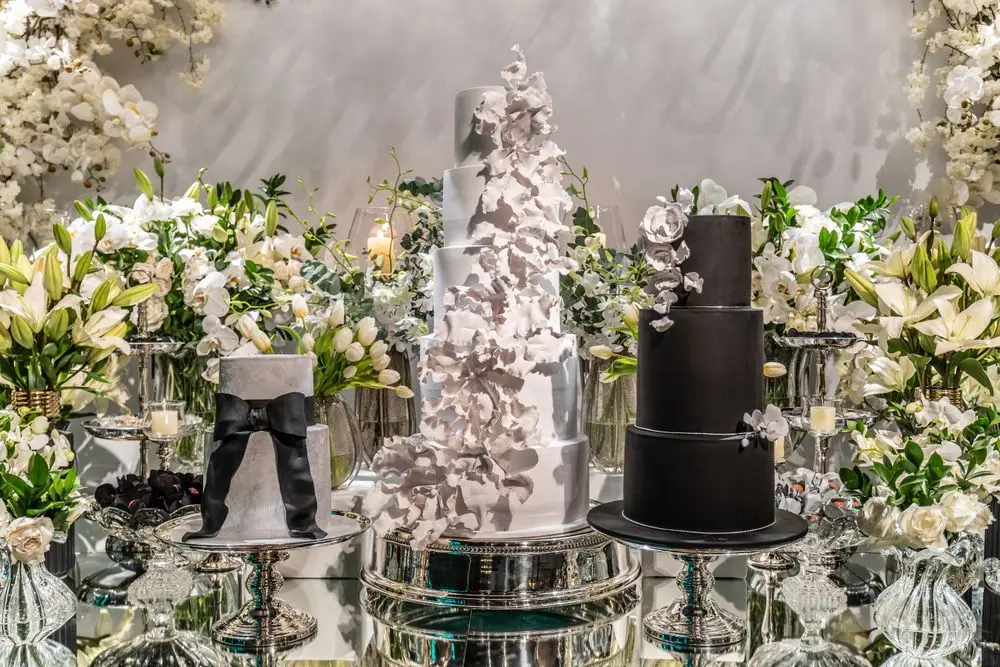
Three tiers. Tall. Taller than our cake was supposed to be. Covered completely in black frosting. Smooth and glossy, like it had been poured. No sugar flowers. No raspberry. No white anywhere.
Guests looked at each other.
Somebody at the back laughed. A short, nervous laugh. Like they thought it was a joke. Like maybe we’d done it on purpose. Maybe it was a theme.
My Aunt Linda said, very loudly, “Well, that’s different.”
“That isn’t our cake,” I whispered.
Bradley looked at me. He looked at the cake. His mouth was open.
“What?” he said. “What is that?”
The servers stopped the cart in front of us. One of them, a young man with a ponytail, smiled at me. He looked proud.
“Congratulations,” he said.
I couldn’t say anything.
I turned around and hurried toward Iris.
Iris was our wedding coordinator. Fifty-five, maybe. Silver hair in a perfect bun. A headset over one ear. A clipboard she never put down. She’d planned more than six hundred weddings. She’d told me that at our first meeting, very calmly, like she was telling me the weather.
She was standing by the kitchen door. Her face had gone pale.
“Where’s my cake?” I said.
“I’m so sorry, Hailey,” she said. And I could see she meant it. She looked just as confused as I was. “I ordered exactly what you approved. Exactly. I spoke with Petite Fleur yesterday. Let me call them right now.”
She was already dialing.
I turned back to the dance floor.
The servers were still standing next to the black cake. The one with the ponytail was saying something to Bradley. Bradley was shaking his head.
“It came with specific instructions,” the server was saying. “It was delivered specifically for this wedding. Whitaker. It said Whitaker on the paperwork.”
Iris came back thirty seconds later.
“I just spoke to the bakery,” she said quietly. “They say your cake was prepared exactly as ordered and delivered here at four-fifteen this afternoon. White. Three tiers. Sugar flowers. They have the delivery confirmation.”
“Then where is it?”
“I don’t know,” Iris said. “But I’m going to find out.”
Bradley came over.
“I want to talk to the manager,” he said. His voice was tight. “Right now. This is unacceptable.”
Iris nodded. “I’ll get him.”
Meanwhile, the guests were whispering.
I could feel them. All of them. Two hundred people, watching me. Watching Bradley. Watching the black cake.
I stood there at the edge of the dance floor in my wedding dress, with my swollen feet and my aching back and my baby kicking, staring at the cake.
I was trying very hard not to cry.
Months. Months of planning. The spreadsheets. The sketches. The fruit basket I sent the bakery. The six-month waiting list.
And somebody had replaced it. The centerpiece of my whole reception. With this.
Who would do that?
Why?
Then I noticed the figurines.
From where I was standing, they looked a lot like the ones I’d chosen. A bride and a groom, standing on top of the highest tier. The groom in a dark suit. The bride in white.
Except something was wrong.
I didn’t know what yet. I just felt it. A little prickle on the back of my neck.
I walked toward the cake.
The groom wore a dark suit like Bradley’s. Navy. Same cut. Somebody had painted a little brown hair on him, a little cleft in his chin. It was Bradley. No question.
Beside him stood a bride in a white gown.
But it wasn’t my gown. It was simpler. Straight down, no empire waist.
And her hair wasn’t dark.
It was reddish-brown.
Loose around her shoulders.
And tucked behind her ear was a tiny blue flower.
My breath caught.
I knew that flower. I’d seen it every night for three years. In a silver frame. Beside a little girl’s bed.
It was Julie.
And between them, there was a third figurine.
A little girl. Standing between the bride and the groom. Holding both their hands.
Her dress was pale pink. Cap sleeves. A sash.
Her hair was in a braid.
It was Paige.
The dress she was wearing today. The braid Carol did this morning.
Then I saw the words.
Written in white icing on the black frosting, just beneath the figures. Neat, careful script. The only white on the whole cake.
Don’t make me forget Mommy.
I couldn’t move.
I just stood there. My hands at my sides.
Someone had recreated Bradley’s first wedding. Him and Julie. The oak tree photo, in sugar and paint. And they’d put Paige between her parents, holding both their hands.
And they’d taken me out.
Completely.
On my wedding day. In front of two hundred people. On a cake.
I didn’t exist.
“Sweetheart?”
Bradley was behind me.
“What’s wrong?”
I couldn’t talk. I pointed at the cake.
“Look at the bride,” I said.
He leaned forward.
For several seconds, he didn’t say anything at all.
I watched his face. I watched him see the reddish-brown hair. The blue flower. I watched the color go out of him.
“That’s Julie,” he whispered.
“I know.”
He looked at the little girl figurine. At the pink dress. At the braid.
Then he read the words.
Don’t make me forget Mommy.
His face changed.
It wasn’t just shock. It wasn’t just anger. It was something else. Something I’d only seen on him once before. At that diner, at eleven at night, when he told me about the stairs.
Fear.
“Get this thing out of here,” he said to the server with the ponytail. His voice was shaking. “Now. Get it out.”
The server reached for the cart.
“No!”
I grabbed Bradley’s arm. Hard. My nails went into his sleeve.
“Nobody touches it,” I said. “Not until we find out who did this.”
“Hailey. People are staring.”
“Let them stare.”
“Hailey—”
“Someone deliberately brought a picture of your dead wife to our wedding,” I said. My voice was rising. I couldn’t stop it. “On a cake. With your daughter. And a message. I want to know who. And I want to know why.”
Bradley looked at me.
He looked shaken. Genuinely shaken. His hands were trembling.
And that scared me even more than the cake.
Because if this was just some stranger’s sick joke, he’d be angry. Furious. Ready to fight somebody.
But he wasn’t angry.
He was scared.
Like he already knew something I didn’t.
Iris came back with the manager. A short, round man named Mr. Delgado in a black suit, sweating through his collar.
Iris took one look at the cake. At the figurines. At the message.
Then she looked at my face.
“Let’s take a moment,” she said quietly. “Let’s step aside, just for a few minutes, while I check the delivery records. I’ll take care of everything out here. Okay?”
She signaled the DJ. He started playing something upbeat. Some song about dancing in September.
The servers wheeled the black cake across the dance floor and through a side door into a small private room off the ballroom.
The doors swung shut behind it.
People started talking again. Loud. Too loud. The way people do when they’re trying to pretend something didn’t just happen.
Bradley wanted me to sit down.
“You’re pregnant,” he said. “You’ve been on your feet all day. Please. Just sit down for a minute.”
I didn’t sit down.
“Where’s Paige?” I said.
He blinked.
“Where’s Paige, Bradley?”
“With my mother,” he said. “At her table. She’s probably wondering what’s going on.”
I looked across the ballroom at Carol’s table.
Carol wasn’t there.
Neither was Paige.
Something cold went through me.
Carol.
Carol, who’d always been polite. Who’d never been close. Who’d stood at the sink with her back to me when we told her about the baby. Who’d said, Julie wanted more children. Did Bradley tell you that?
Carol, who did Paige’s hair that morning. In that braid.
I suddenly wondered whether Carol had ever really accepted me at all.
Twenty minutes later, Iris found us in the hallway outside the private room.
She had a sheet of paper in her hand. Her face was very calm. The kind of calm that comes from being very, very angry.
“Your actual cake,” she said, “is in the kitchen. In the walk-in refrigerator. It’s completely untouched.”
“What?”
“It was delivered at four-fifteen. As ordered. White. Sugar flowers. The figurines are perfect. Bradley in his suit. You in your dress.” She paused. “It’s beautiful, Hailey. It’s exactly what you wanted.”
“Then how—”
“Someone delivered the black cake at seven-forty,” Iris said. “To the service entrance. They told the receiving staff it was a replacement. That there’d been a last-minute change. That the bride and groom had requested it.”
“We never—”
“I know you didn’t,” Iris said. “The kitchen staff didn’t check with me. They should have. They didn’t. That’s on us, and I’m going to deal with it.”
She handed me the sheet of paper.
It was a delivery slip. From a bakery I’d never heard of. Sweet Somethings, in a town about forty minutes away.
Custom order. Three tiers. Black fondant. Custom figurines (3). Message in white.
And at the bottom, under Customer Contact, there was a phone number.
Bradley took it out of my hand.
He looked at it.
He didn’t move.
“That can’t be right,” he said.
“What?” I said. “Whose number is that?”
He didn’t answer.
I took the paper back.
I didn’t need him to answer. I knew that number. It was in my phone. It was on the emergency contact sheet on our refrigerator. It was the number I called every Monday and Wednesday to say I was running late from the library and could she stay with Paige for an extra twenty minutes.
Carol.
Bradley turned around and walked down the hallway.
He didn’t say anything. He just went. Fast.
I followed him.
We found her in a quiet hallway on the other side of the ballroom. Near the coat check. By a big window that looked out over the dark lawn.
She was standing alone. Holding her purse in front of her with both hands. In her pale lavender dress.
Paige wasn’t with her.
She turned around when she heard us coming. She saw Bradley’s face. She saw mine.
She didn’t look surprised.
“Mom,” Bradley said. “Did you order that cake?”
Carol looked at him. Then at me.
Then she lowered her eyes.
“Yes,” she said.
For a moment, I couldn’t say anything.
I’d known. I’d known since I saw that phone number. But hearing her say it out loud was different.
“You did that to me?” I said.
“Hailey.” Her voice was very quiet. “I never wanted to hurt you.”
“You put his dead wife on my wedding cake!”
“I know how it looks.”
“How it looks?” My voice cracked. I didn’t care. “You erased me! From my own wedding! In front of two hundred people! You put Julie up there and you put Paige between them and you took me out. Like I don’t exist. Like I’m nothing.”
Carol pressed her lips together.
She didn’t argue. She didn’t defend herself.
She just stood there.
Bradley was furious.
I’d never seen him like that. Not ever. His face was red. His scarred hand was clenched into a fist at his side.
“Whatever problem you have with my marriage,” he said, “you should have come to me. To me. Not done this. Not humiliated my wife. Not today.”
“I have come to you, Bradley,” Carol said. “Repeatedly.”
“About what?”
She looked at him for a long time.
“Paige,” she said.
That stopped him.
He went very still.
“Don’t,” he said. “Don’t bring Paige into this.”
“She’s the reason I did it.”
I stared at her.
“What does Paige have to do with that cake?”
Carol didn’t answer right away.
She opened her purse. Her hands were shaking. She took out her phone. She tapped the screen a few times.
Then she held it out to me.
It was a photograph of a child’s drawing.
Crayon on white construction paper. I knew that paper. We had a whole pack of it in the kitchen drawer.
There were three stick figures in the middle.
A man in a dark suit. Brown crayon hair.
A woman in a white dress. Orange-brown hair, scribbled long. And a little blue dot by her ear.
A little girl between them. Pink dress. Holding both their hands.
And everything around them, every inch of the paper that wasn’t the three figures, was colored black.
Heavy black crayon. Pressed so hard it had torn through in one corner. Over and over and over. Like whoever drew it had been trying to cover something up. Or keep something out.
“Paige drew this last week,” Carol said. “At my house. On Wednesday.”
A wave of dread went through me.
“She drew your cake?” I said.
“No,” Carol said quietly. “She drew her family.”
I looked at Bradley.
He wouldn’t look at me.
He was staring at the floor. At the carpet. At anything.
“I asked her about it,” Carol said. “After she finished. I asked her why everything around them was black.”
She looked at Bradley.
“She said she wished her daddy understood that Julie was still her mommy,” Carol said.
“Of course she is,” I said. “Of course Julie is still her mommy. Nobody ever said otherwise.”
Carol gave Bradley a long look.
“Apparently,” she said, “somebody made her believe otherwise.”
Bradley shook his head.
“You’re twisting everything.”
“Then explain,” Carol said, very quietly, “why your daughter has been crying at my house.”
I felt the floor shift under me.
I put my hand on the window frame. I didn’t think I’d fall. I just needed to hold onto something.
“Paige has been crying?”
Carol nodded.
“Every Monday and Wednesday,” she said. “For the past two months. Since you started really planning the wedding. She comes to my house after school and she’s fine for an hour, and then she goes into the guest room and closes the door and she cries.”
“Why didn’t anyone tell me?”
Carol looked at Bradley again.
“She thinks she’s supposed to stop talking about Julie,” Carol said. “After today. After the wedding. She thinks once you’re married, Julie goes away.”
I turned to Bradley.
“Did you know about this?”
“She’s been emotional about the wedding,” he said. He still wasn’t looking at me. “It’s normal. Kids get emotional.”
“That’s not what I asked.”
He didn’t answer.
He looked out the window. At the dark lawn. At the lights strung in the trees.
Carol told me the rest.
She told me she’d tried to talk to Bradley about it. Three times. Once in July. Once in August. Once two weeks ago, when Paige came home from school with a project about families, and Paige had drawn Bradley and me and the baby, and then, in the corner, very small, a woman with reddish-brown hair. Floating. Like a ghost.
Every time, Carol said, Bradley told her the same thing. That Paige needed to move forward. That dwelling on Julie wasn’t healthy. That she needed to focus on the new family. On the future.
“And then last Wednesday,” Carol said, “she showed me this.”
She looked down at the drawing on her phone.
“And she said, ‘Grandma, I want Daddy to see it. But I’m scared to show him. Because he’ll say I’m being sad again.’”
I didn’t say anything.
I couldn’t.
“So I decided,” Carol said, “that Bradley needed to see how much his daughter was hurting. In a way he couldn’t change the subject from. In a way he couldn’t tell me not to encourage.”
“So you made it a cake,” I said.
“I called a baker I know. An old friend. I showed her the drawing. I asked her to make it into a cake. Exactly the way Paige drew it.”
“Why black?”
Carol’s eyes filled with tears.
“Because that’s how Paige colored everything around them,” she said. “I asked her why. She said, ‘Because it feels like my old family is disappearing. Like everything around it is going dark.’”
I stared at her.
I understood. Part of me did. Part of me heard that, the words of a seven-year-old girl, it feels like my old family is disappearing, and wanted to sit down on the hallway carpet and cry.
But the rest of me was so angry I could barely see.
“So you took her private drawing,” I said, “something she showed you because she trusted you, and you turned it into a public spectacle? At my wedding? In front of everybody she knows?”
Tears were running down Carol’s face now.
“I thought Bradley would finally listen.”
“You could have just shown him the drawing!”
“I did,” Carol said.
She looked at her son.
“I showed him on Thursday,” she said. “The day after she drew it. I texted him the picture. You know what he said?”
Bradley closed his eyes.
“He said, ‘Mom. Please stop encouraging her sadness. It’s not helping.’”
Bradley didn’t say anything.
He just stood there with his eyes closed.
“Does Paige know?” I asked. “About the cake?”
Carol hesitated. Then she shook her head.
“No,” she admitted. “She had no idea. I didn’t tell her.”
That made me angrier than anything.
A seven-year-old girl had shared something painful with her grandmother. Something private. Something she was scared to show her own father.
And a grown woman had taken it and turned it into a surprise. A humiliating, public surprise. At a wedding. Without even asking her.
“I understand you were worried,” I said. My voice was shaking. “I do. I believe you. I believe you were trying to help her. But you had no right to do this, Carol. No right. Not to me. And not to her.”
Carol nodded miserably. She was crying so hard now her mascara was running down her cheeks.
“You’re right,” she said. “You’re right. I’m sorry. I’m so sorry.”
I wasn’t ready to forgive her.
Not even close.
But that could wait.
Right now, I needed to find Paige.
“Where is she?” I said.
“I don’t know,” Carol said. “She asked to go to the bathroom. Right before the cake came out. I told her to come right back. She didn’t.”
I turned around and walked away.
Bradley said, “Hailey—”
I didn’t stop.
I found Iris in the ballroom. I told her I needed to find Paige. She took off her headset and handed it to an assistant without asking a single question.
“Go,” she said. “I’ll handle everybody here. Take as long as you need.”
I found Paige in a small lounge near the restrooms.
It was a little sitting room with flowered wallpaper and a velvet loveseat and a big gold mirror. The kind of room nobody ever uses except to fix their lipstick.
She was sitting on the loveseat all by herself.
Her pink flower-girl dress was wrinkled. One of the little white flowers had fallen out of her braid. She was twisting the end of her sash between her fingers, around and around and around.
When she saw me in the doorway, she stood up right away.
“Hailey,” she said. “Are you mad?”
I came in and sat down beside her on the loveseat.
My back hurt. My feet were killing me. I didn’t care.
“Why would I be mad at you, sweetheart?”
“Because of the cake.”
A wave of dread went through me.
“You saw it?”
She nodded.
“I was coming back from the bathroom,” she said. “And everybody got quiet. And I looked. And I saw it.” She was twisting the sash tighter. “It’s my picture. The one I made at Grandma’s. It’s my picture but it’s a cake.”
“I know.”
“Grandma said she wanted Daddy to see my picture,” Paige said. “She said she’d find a way to show him. I didn’t know she meant a cake. I didn’t know she meant in front of everybody.”
“I know, baby.”
She stared down at her shoes. Little white shoes with buckles. One of the buckles had come undone.
“I’m sorry,” she whispered.
“Paige. Look at me.”
She looked up.
“You haven’t done anything wrong,” I said. “Nothing. Not one thing. Do you hear me?”
She didn’t say anything.
She didn’t believe me. I could see it on her face.
I took a breath.
“Can I ask you something?” I said. “You don’t have to answer if you don’t want to.”
She nodded.
“Why did you draw that picture?”
Her eyes filled up with tears. Her chin started shaking.
“Because Mommy’s going away,” she said.
I put my hand over hers. Over the twisted sash.
“What do you mean, sweet pea?”
“Daddy said you’re going to be my new mommy now,” she said. “After the wedding.”
I waited.
“And he said when the baby comes, we’re going to be a real family.”
My heart broke a little. Right there.
“We already are a family, Paige,” I said. “We’ve been a family for a long time.”
“But if you’re my mommy,” Paige said, “then what happens to my other mommy?”
“Nothing happens to her,” I said. “Nothing at all.”
Paige looked at me. Uncertain. Like she wanted to believe me but didn’t know if she was allowed to.
“Daddy said I should try calling you Mom,” she said. “After the wedding. He said it would make you happy.”
I felt sick. Actually sick. Like the floor of my stomach dropped out.
“Did he?”
She nodded.
“I wanted to,” she said. “I did. I practiced. In my room. I said ‘Mom’ to my pillow.”
Her voice cracked.
“But then I looked at Mommy’s picture,” she said, “and I thought she’d be sad. If I called somebody else Mom. I thought she’d be up there in heaven and she’d hear me and she’d be so sad.”
I pulled her into my arms.
She came. She curled up against my side, against the bump, with her braid against my shoulder.
“Paige,” I said. “Listen to me. You never have to call me Mom. Never. Not unless you want to. And if you never want to, that’s okay too. I’ll still love you exactly the same. Exactly. Not one bit less.”
She was quiet.
Then she said, very small:
“But Daddy said talking about Mommy too much might upset you.”
I held very still.
“Because of the baby,” Paige said. “He said you’re going to have your own baby now, and if I keep talking about Mommy, it might make you sad. And it’s not good for the baby if you’re sad.”
For several seconds, I couldn’t answer.
I just sat there on that velvet loveseat with my arms around her.
Bradley had never once talked to me about any of this.
Not once.
I had never asked Paige to stop talking about Julie. Never. I’d done the opposite. I’d asked her about the spider song. About the spaghetti with no sauce. About the forget-me-nots in the garden. I’d asked Julie’s name, that very first Thursday on the turtle carpet, when nobody else would.
And all this time, Bradley had been telling her I’d be upset.
“Does talking about Mommy make you sad?” Paige whispered. She was looking up at me. “Does it make you sad, Hailey?”
“No, sweetheart,” I said. “It doesn’t.”
“Even when I say I miss her?”
“Especially then.”
She looked at me. I watched her try to understand it.
Then her face crumpled. And she started crying. Really crying. The kind that comes up from somewhere deep, that a seven-year-old has been holding in for way too long.
“Sometimes,” she said, through the sobs, “when you read to me, I feel happy. Like really happy. When you do the dragon voice. And then afterward, after you leave, I think Mommy would be sad. Because I was happy with you. Because I was happy with somebody else.”
I held her so tight.
“Oh, Paige,” I said. “Oh, baby.”
I held her for a long time.
When she calmed down a little, I pulled back so I could see her face.
“Can I tell you something about your mommy?” I said.
She sniffed. She nodded.
“I never met her,” I said. “But I know some things about her. Because you told me. Remember? You told me she liked blue. And she sang a song about a spider. And she made spaghetti with no sauce because you didn’t like sauce.”
Paige nodded.
“A mommy who makes spaghetti with no sauce,” I said, “is a mommy who wants her little girl to be happy. More than anything. That’s what moms want. That’s the only thing they want.”
Paige was listening. Really listening.
“Your mommy loved you, Paige,” I said. “So much. I don’t believe she’d ever want you to stop being happy. Not for one second. I think she’d want you to laugh at the dragon voice. I think she’d want you to eat pancakes shaped like turtles. I think if she could see you, she’d be so glad there’s somebody here to read you three stories every night.”
“Really?”
“Really.”
She wiped her face with the back of her hand. She looked at me for a long time.
“Can I still keep her picture?” she asked. “By my bed?”
I thought about the silver frame. The oak tree. Julie laughing. The forget-me-not behind her ear.
“Of course you can,” I said. “Nobody has the right to take it away. Nobody. Ever.”
Paige let out a long, shaky breath. Like she’d been holding it for months.
Then she leaned against me. Her head on my shoulder. Her hand on my stomach.
“I love you, Hailey,” she said.
“I love you too, sweet pea.”
For the first time that whole evening, I was crying, and it had nothing to do with the cake.
I was crying for a little girl who’d been carrying a terrible fear all by herself.
For months.
While I made spreadsheets about flowers.
When Paige was calmer, I asked Iris, who had appeared quietly in the doorway at some point without my noticing, to stay with her for a few minutes.
Iris sat down on the loveseat. She took off her shoes. She put her feet up on the little velvet footstool.
“Paige,” she said, “have you ever seen a wedding coordinator take her shoes off?”
Paige shook her head.
“It’s very rare,” Iris said seriously. “Like seeing a unicorn. You have to promise not to tell anybody.”
Paige almost smiled.
I went to find Bradley.
He was waiting outside the private room where they’d put the black cake. Sitting on a bench in the hallway with his elbows on his knees and his head down.
He looked up when he heard me coming.
“How is she?” he asked.
I sat down next to him. Heavily. My back was screaming.
“She’s afraid she’s going to lose her mother again,” I said.
His shoulders dropped.
“Hailey…”
“Did you tell Paige she should call me Mom?”
He was quiet for a second.
“I suggested it,” he said.
“Did you tell her that talking about Julie might upset me?”
He hesitated.
That hesitation told me everything.
“I didn’t mean it like that,” he said.
“Then what did you mean?”
He rubbed his face with both hands.
“I wanted her to accept you,” he said. “I wanted her to let you in. All the way in. I thought if she kept focusing on Julie, she’d never move forward. She’d be stuck. Forever. Looking at that picture.”
“She already accepted me, Bradley,” I said. “She loves me. She told me tonight. She’s told me a hundred times.”
“I know.”
“Then why did you make her feel guilty about it?”
He didn’t answer.
I made him remember.
All the times Paige had gone quiet during the wedding planning. At dinner. When he called me her new mommy. When she went to her room and shut the door.
He looked at the floor.
“She asked me something,” he said finally. “About a month ago. At bedtime. After you’d gone downstairs.”
“What?”
“She asked if Mommy’s picture would still be allowed in the house,” he said. “After the baby came. She asked if she’d have to put it in a drawer.”
I closed my eyes.
“What did you say?”
He swallowed.
“I told her to focus on the future,” he said. “I told her she was going to have a sister and a new mommy and a whole new family, and that she should be excited about that. I told her we should all try to look forward.”
“You didn’t tell her she could keep the picture.”
“No.”
“You let her think she might have to put it away.”
“I didn’t think—” He stopped. “No. I didn’t tell her she could keep it.”
“Why didn’t you tell me?” I said. “Any of it. That she was asking. That she was crying at your mom’s. That your mom showed you the drawing. Why didn’t you tell me?”
“I didn’t want to burden you,” he said. “You’re pregnant. You’ve been so happy. You’ve worked so hard to make everything perfect.”
“Perfect,” I said. “Perfect for who?”
He looked at me.
He looked completely lost.
Then, very quietly, he said something I wasn’t expecting.
“After the fire,” he said, “every time Paige cried for Julie, I felt like I was back in that house.”
His voice broke.
He was staring down at his right hand. At the scars.
“Every time,” he said. “She’d cry, ‘I want Mommy,’ and I’d be back in that hallway. In the smoke. I’d smell it. I’d feel the heat on my arm. I’d hear the stairs.”
He was crying now.
“I couldn’t save her mother, Hailey,” he said. “I couldn’t save her. I went for Paige first, and I got her out, and I went back, and I couldn’t get to the stairs. And every time Paige asks me something about Julie, every single time, I’m right back there. Not getting to the stairs.”
I reached for his hand. His scarred one.
He let me take it.
But I didn’t soften my question. I couldn’t. Not this time.
“So you decided Paige should stop remembering her?”
“No,” he said. “No. That’s not—I just wanted us to be happy again. All of us. I wanted a fresh start. A new house. A new family. A new baby. Where nobody was crying all the time. Where I didn’t have to go back to that hallway.”
“She’s allowed to miss Julie,” I said, “and be happy with us. Bradley. She can do both. Those things aren’t opposites.”
He covered his face with his free hand.
“I thought starting over would help,” he said.
“Starting over,” I said, “doesn’t mean pretending Julie never existed.”
We sat on that bench in silence for a long time.
Somewhere on the other side of the wall, the DJ was playing “Shout.” I could hear people singing along. A little bit softer now. A little bit louder now.
Bradley held onto my hand.
Finally, he looked up at me.
His eyes were red. His face was wet.
“I’ve made a terrible mistake,” he said.
“Yes,” I said. “You have.”
He nodded.
“And you need to fix it,” I said. “With Paige. Not just with me. With her.”
“I know.”
“Tonight.”
“I know,” he said. “Tonight.”
He went to her before we went back to the reception.
I stood in the doorway of the little flowered lounge. Iris had her shoes back on. She slipped out past me and squeezed my arm as she went.
Bradley knelt down in front of the loveseat. In his navy suit. On the carpet.
Paige looked at him. She looked scared.
“Paige,” he said. “I need to tell you something. And I need you to really listen. Okay?”
She nodded.
“Your mommy,” he said, “Julie, will always be your mommy. Always. Forever. Nothing can ever change that. Not a wedding. Not a baby. Nothing.”
Paige’s lip started to tremble.
“You can talk about her whenever you want,” Bradley said. “Any time. All the time. At dinner. At bedtime. In the car. Whenever you think about her. You can tell me. You can tell Hailey. You can tell Grandma. Nobody’s going to be upset. Nobody’s going to be sad.”
“Not even Hailey?”
“Especially not Hailey,” Bradley said. “Hailey’s never been upset about it. Not once. I was wrong to say that. I made it up. I’m sorry. I’m so sorry, sweetheart.”
Paige looked over at me in the doorway.
I nodded.
“And you never have to call Hailey anything different,” Bradley said. “You can call her Hailey for the rest of your life. That’s okay. That’s her name. She likes it.”
“I do,” I said.
Paige looked at her father for a long time.
Then she asked him something. Very quietly.
“Daddy? Do you still miss Mommy?”
Bradley’s face broke.
I watched it happen. Three years of holding something together, and it just broke. Right there on the carpet in a little flowered lounge at our wedding.
He started crying. Really crying. His shoulders shaking.
“Every day, sweetheart,” he said. “Every single day. I miss her every day.”
Paige slid off the loveseat.
She put her arms around his neck. She held on as tight as she could.
“Me too, Daddy,” she said into his shoulder. “Me too.”
And they stayed like that. On the floor. Holding each other.
I stood in the doorway with my hand on my stomach.
The baby kicked.
Later, Carol came to find us.
She’d fixed her makeup. Mostly. Her eyes were still red.
She apologized to Bradley first. Then to me. Again.
Then she knelt down in front of Paige, slowly, the way older people do, with one hand on the arm of the loveseat.
“Paige,” she said. “I need to say sorry to you, too.”
Paige looked at her.
“Your drawing was yours,” Carol said. “It was private. You showed it to me because you trusted me. And I took it without asking, and I made it into something big and loud and embarrassing. In front of everybody. And that wasn’t fair to you.”
Paige was quiet.
“I should have asked you,” Carol said. “I should have said, ‘Can I show this to Daddy?’ And let you decide. I’m sorry I didn’t.”
Paige thought about it.
“It was a really big cake,” she said finally.
Carol let out a sound that was half a laugh and half a sob.
“It was a really big cake,” she agreed.
I talked to Carol for a few minutes in the hallway after that. Just the two of us.
“I need to say something,” I said.
“Please.”
“Protecting Paige,” I said, “means listening to her. That’s what she needed. Somebody to listen. Not somebody to take what she said and turn it into a show.”
Carol nodded.
“You’re right,” she said. “You’re absolutely right. I was so angry at Bradley. And so scared for her. I thought if I did something big enough, he couldn’t ignore it.” She looked down. “I didn’t think about you at all. I’m ashamed of that.”
I didn’t say anything.
“For what it’s worth,” Carol said, “it’s not that I didn’t accept you. I want you to know that. It was never about you.”
“It felt like it was about me.”
“I know,” Carol said. “I know it did.”
She looked out the window at the dark lawn.
“Julie used to come to my house every Sunday,” she said. “For three years. Before the fire. She’d bring Paige. We’d make bread together. She was the daughter I never had. And then she was gone. And then Bradley wouldn’t say her name. Wouldn’t let anybody say her name.”
She wiped her eyes.
“And then you came,” Carol said. “And you were so wonderful with Paige. And I was so glad. Truly. And then I watched Bradley start acting like Julie had never existed. Like you were a replacement. And I thought, if he can erase her, he can erase anybody. And I didn’t want that for you, either.”
She looked at me.
“I’m not saying it makes what I did okay,” she said. “It doesn’t. I’m just telling you why.”
I looked at her for a long time.
“I’m not ready to forgive you yet,” I said.
“I know.”
“But I hear you.”
She nodded. Her eyes filled up again.
“That’s more than I deserve,” she said.
By the time we came back into the ballroom, most of our guests were dancing.
Iris had worked a miracle. While we’d been gone, she’d told the DJ to open the dessert bar early. She’d had the staff bring out cookies and fruit and little chocolate cups. She’d somehow convinced my Aunt Linda to lead a conga line.
Nobody was talking about the black cake anymore. Or if they were, they were doing it quietly, in corners, the way people do.
Iris met us by the door.
“Do you still want to cut the cake?” she asked. “The real one? It’s in the kitchen. It’s perfect. I can have it out in five minutes. We can make an announcement.”
I looked at Bradley.
He looked at me.
I thought about it. The six-month waiting list. The sugar flowers. The raspberry filling. The figurines of Bradley and me, with my tiny round belly.
The big moment. The one I’d been dreaming about since I was a little girl looking at other people’s wedding albums.
“Can we do it quietly?” I asked. “Just us? In the private room? With Paige?”
Iris didn’t even blink.
“Absolutely,” she said.
So that’s what we did.
The black cake was gone. Iris had made sure. In its place, on a little table in that small private room off the ballroom, was our cake. Three white tiers. Sugar flowers tumbling down the side. Two little figurines on top. Bradley in his navy suit. Me in my empire-waist dress.
Paige stood between us.
She looked at the figurines for a long time.
“There’s no me,” she said.
I looked at the cake. She was right. There were two figurines. Just two. Bradley and me.
I’d ordered it. I’d approved the sketches. I’d sent the bakery a fruit basket.
I hadn’t even thought to put Paige on it.
“You’re right,” I said slowly. “There’s no you. That was my mistake. I’m sorry, sweet pea.”
Paige looked at it a second longer.
Then she reached up and took one of the little white flowers out of her braid. A real one. Slightly wilted now. She set it gently on top of the cake, right between the two figurines.
“There,” she said. “Now I’m there.”
Bradley had to turn around for a second.
We cut the cake together. All three of us. Bradley’s hand on the knife, then mine over his, then Paige’s little hand on top of both of ours.
It wasn’t the grand moment I’d imagined.
There was no DJ announcement. No two hundred people cheering. No photographer, until Iris quietly went and got him.
But it meant more. So much more.
The photographer took one picture. Just one. The three of us, with our hands on the knife, and Paige’s wilted white flower between the figurines.
It’s the best picture from the whole wedding.
In the weeks after, a lot of things changed.
Bradley started seeing a grief counselor. A man named Dr. Okafor who specializes in trauma. Bradley went every Tuesday at six. The first few sessions, he came home and didn’t talk at all. He just sat on the back steps in the dark.
After about a month, he started talking.
He told me things about Julie I’d never heard. That she was terrible at parallel parking. That she cried at every single episode of a home renovation show. That she once tried to bake a birthday cake for Bradley and accidentally used salt instead of sugar, and they ate it anyway, laughing so hard they couldn’t breathe.
“I didn’t let myself remember any of that,” he said one night. We were sitting on the back steps together. “For four years. I just remembered the fire. Like that’s all she was.”
“She was a lot more than the fire,” I said.
“She was,” he said. “She really was.”
He started answering Paige’s questions.
All of them. Even the hard ones.
“Daddy, what was Mommy’s favorite color?”
“Blue. Like her flowers.”
“What was her favorite food?”
“Pad thai. Extra peanuts. She’d pick out all the bean sprouts and give them to me.”
“Did she like me?”
Bradley stopped.
“Paige,” he said. “She loved you more than anything in the whole world. The day you were born, she held you and didn’t let anybody else hold you for three hours. Not even me. The nurses had to make her let go so they could check you.”
Paige’s whole face lit up.
“Three hours?”
“Three hours.”
Paige started seeing someone too. A child therapist named Ms. Rivera, who had an office full of stuffed animals and a sand table. Paige went every Thursday after school. She liked it. She said Ms. Rivera let her talk about Mommy as much as she wanted and never once looked sad about it.
One Thursday, Paige came home with a drawing.
Same kind of construction paper. Same crayons.
Four stick figures this time. A man in a dark suit. A woman with dark hair and a big round belly. A little girl in a pink dress. And above them, up in the corner of the page, a woman with reddish-brown hair and a blue dot by her ear. Floating in the sky. Smiling.
The background wasn’t black.
It was blue. Light blue crayon, with a big yellow sun in the corner. And all along the bottom of the page, little blue flowers. Dozens of them.
“Forget-me-nots,” Paige said, pointing. “Grandma says they come back by themselves.”
I hung it on the refrigerator.
It’s still there.
Carol came to dinner on a Sunday in November.
It was the first time she’d been to our house since the wedding. Bradley had invited her. I’d said yes. Slowly. I’d thought about it for a week.
She brought bread. Homemade. She said she used to make it with Julie every Sunday.
At the door, she stopped. She was holding something else besides the bread. A small cardboard box.
“I have something for Paige,” she said. “If that’s all right with you. I wanted to ask first.”
I looked at her.
She’d asked first.
“What is it?” I said.
She opened the box.
Inside were things. A hairbrush with a few reddish-brown hairs still in it. A blue silk scarf. A cookbook with notes in the margins in round, loopy handwriting. A cassette tape labeled “Paige’s Spider Song.” And a little packet of seeds.
Forget-me-not seeds.
“These were Julie’s,” Carol said. “I kept them. After the fire. A few things were at my house that day. I’ve been holding onto them for four years.”
She looked at me.
“I didn’t give them to Paige before,” she said, “because Bradley said it would upset her. But I think she should have them. If you agree.”
I looked at the cassette tape. Paige’s Spider Song.
“Yes,” I said. My voice wasn’t steady. “I agree.”
Paige opened the box at the kitchen table.
She took everything out one at a time. Very carefully. She held the hairbrush for a long time. She put the blue scarf around her neck. She opened the cookbook and traced the handwriting with her finger.
Then she picked up the cassette tape.
“What’s this?”
“It’s your mommy,” Carol said quietly. “Singing to you. When you were a baby. I recorded it one night when she was rocking you at my house.”
Paige stared at it.
“Can we listen?”
We didn’t have a cassette player. Nobody does anymore.
Bradley went out to the garage and came back twenty minutes later with his old boombox from college, covered in dust. He plugged it in on the kitchen counter. He put in the tape.
He pressed play.
There was some hissing. A creak, like a rocking chair.
Then a woman’s voice. Soft. A little off-key. Laughing a little in between the words.
The itsy bitsy spider went up the water spout…
Paige didn’t move.
She sat at the kitchen table in the blue silk scarf with her hands flat on the table and listened.
Bradley was standing by the counter with his hand over his mouth.
Carol was crying silently.
I was too.
When the song ended, there was more hissing. Then the voice again, much quieter. Talking, not singing. Like she’d forgotten the recorder was on.
“There you go, baby girl. There you go. Mommy’s got you. Mommy’s always got you.”
And then the tape clicked off.
Paige looked up at all of us.
“That’s her,” she whispered. “That’s Mommy.”
“That’s her,” Bradley said.
She turned to me.
“Hailey,” she said. “Did you hear her? That’s my mommy’s voice.”
“I heard her,” I said. “She sounds wonderful.”
Paige nodded. She looked down at the cassette in the boombox.
“Can we play it again?” she said.
We played it again.
We played it about eleven more times that night.
Our daughter was born on March twentieth. The first day of spring.
Seven pounds, three ounces. A full head of dark hair. Lungs like a fire alarm.
We named her Rose.
Paige came to the hospital the next morning with Carol. She was wearing the blue silk scarf. She’d worn it almost every day since November.
She stood next to my hospital bed and looked down at the baby in my arms.
“Can I hold her?”
“Sit down in the chair,” I said. “And put your arms like a cradle.”
She sat. She made a cradle. Very seriously.
Bradley lifted Rose out of my arms and put her into Paige’s.
Paige held her sister for a long time without saying anything. Her face was so close to Rose’s they were almost touching.
“Hi,” Paige whispered. “I’m Paige. I’m your big sister. I told you I’d tell you everything.”
Rose yawned.
“So first,” Paige said, “you have two mommies. Kind of. There’s Hailey. She’s your mommy. She reads three stories and does the dragon voice. And there’s my Mommy Julie. She’s in heaven. She sang the spider song. You can hear it on the tape. Grandpa’s boombox. I’ll play it for you.”
Bradley had his hand on my shoulder. It was shaking.
“And there’s Daddy,” Paige continued. “He’s good at pancakes but not shapes. Hailey’s better at shapes. Kind of. And there’s Grandma. She makes bread. And you can talk about anybody you want. Whenever you want. Nobody gets sad. That’s a rule.”
She looked up at me.
“Right, Hailey? That’s a rule?”
“That’s a rule,” I said.
A few weeks after we brought Rose home, I went into Paige’s room one evening to tell her it was time for stories.
She was standing on her bed. Arranging something on the shelf above her pillow.
Julie’s wedding picture was on one side. The silver frame. The oak tree. Bradley and Julie laughing. The forget-me-not behind Julie’s ear.
And next to it was a new frame. A wooden one. Paige had painted it herself, at Ms. Rivera’s office. Blue, with little yellow flowers.
Inside was the picture from our wedding. The only one from the cake cutting. Bradley and me and Paige, all three of our hands on the knife. My pregnant belly round under my dress. Paige’s little wilted white flower between the figurines on the cake.
She’d put them side by side. Exactly the same height. Touching at the corners.
She turned around and saw me in the doorway.
“Is it okay,” she asked, “if I keep both?”
I came in and sat down on the edge of her bed. Next to where she was standing.
I looked at the two pictures.
Julie under the oak tree. Me at the cake table.
Two weddings. Two brides. One little girl who loved both of us.
“Of course,” I said. “Of course it’s okay.”
Paige smiled.
She climbed down off the bed and sat next to me. She took my hand.
“You know what, Hailey?” she said. “I think our family has room for everybody.”
I looked at those two pictures for a long time.
What Carol did at my wedding was wrong. I’ve never pretended otherwise. Not to her. Not to Bradley. Not to myself. That black cake nearly destroyed one of the happiest days of my life, and I still think about the way it felt, standing on that dance floor with two hundred people watching me, seeing myself erased.
But it also cracked something open. Something that had been sealed shut in our house for a long time. Something none of us had been brave enough to touch.
We didn’t need a perfect wedding.
We didn’t need a perfect fresh start.
We needed room. Room for Paige’s memories. Room for Bradley’s grief. Room for my love. Room for a crying baby named Rose and a blue silk scarf and a boombox from 1996 and a tape that hisses before the singing starts.
Room for Julie.
And for the first time, sitting on the edge of that little bed, I believed we were finally learning how to make it.
“Okay,” Paige said, after a while. “Stories now?”
“Stories now.”
“Three?”
“Three.”
“With the dragon voice?”
“With the dragon voice.”
She climbed under the covers. I picked up the first book. Down the hall, Rose started crying, and I heard Bradley’s footsteps going to her, and then his voice, soft and off-key, singing.
The itsy bitsy spider went up the water spout.
Paige heard it too. She looked at me.
“Daddy’s singing Mommy’s song,” she whispered.
“He is.”
She lay there and listened for a minute. Her eyes on the two pictures above her bed.
“Good,” she said. “Rose should know it.”
Then she pointed at the book in my lap.
“Okay,” she said. “Go.”
I opened it, and I started to read.
In April, Paige and I planted the seeds from Carol’s box.
We picked a spot in the backyard by the fence, where the sun comes in the afternoon. We dug little holes with a spoon, because Paige said a shovel was too big for something so small. Rose watched from her bouncy seat on the patio, kicking her feet.
We watered them every day.
For three weeks, nothing happened. Paige checked every morning before school. Every afternoon when she got home.
“Maybe they don’t work,” she said one day. “Maybe they’re too old.”
“Give them time,” I said.
Then one Saturday in May, she came running into the kitchen in her pajamas, screaming.
“Hailey! Daddy! Come look! Come look!”
We went out to the backyard.
By the fence, in the afternoon sun, there was a little patch of green. And in the middle of it, tiny, no bigger than a fingernail, five blue flowers.
Paige knelt down in the dirt in her pajamas and looked at them for a long time.
“Grandma was right,” she said. “They come back.”
Bradley knelt down beside her. He put his arm around her. With his scarred hand, he touched one of the little blue petals. Very gently.
“They do,” he said. “They come back.”
Paige leaned into him.
Then she looked up at me. Standing on the patio with Rose on my hip.
“Next year,” she said, “Rose can help plant them. Right?”
“Right,” I said.
“And the year after that?”
“Every year,” I said. “As long as you want.”
Paige smiled. She looked back down at the flowers.
“Hi, Mommy,” she whispered.
Nobody told her to stop.