Pastor Gary caught me by the elbow on the church steps after the eleven o’clock service, the second Sunday of October.
“Walt,” he said, holding on like he was afraid I’d fall down the stairs. “Do you have a minute?”
I had a minute. I had a whole afternoon of minutes. I’m eighty-four years old and a widower, and my Sunday plans usually amount to a pot roast I’ve already put in the slow cooker and the Bears losing on television.
“What can I do for you, Gary?”
He steered me off to one side, by the brick planter where the ladies’ auxiliary keeps their mums, out of the way of the people heading to their cars. He kept his voice low. He’s a good man, Gary Whitfield. He’s been our pastor at Grace Lutheran for eleven years, and he comes over to my house every Wednesday afternoon to play checkers. He’s never once beaten me.
“I just wanted you to know,” he said, “that we’re all praying for you. Me and Linda and the whole congregation. Whatever you need, Walt. Rides to appointments, meals, anything at all. Bobby told us about your memory.”
I looked at him.
“What about my memory?”
He patted my arm. He had a look on his face I’d seen before, but never pointed at me. It was the look people gave my wife Eleanor in the last year, when the cancer had gone to her bones and everybody knew it but nobody said it.
“It’s all right,” he said gently. “You don’t have to talk about it if you don’t want to.”
“Gary,” I said. “What did Bobby tell you?”
He hesitated. I watched him decide whether to say it.
“He said the doctors diagnosed you with early-stage dementia this summer,” Gary said. “He said you’ve been getting lost driving home from the store. He said you left the stove on twice and he found you one night out in the backyard in your pajamas, looking for Eleanor.”
I stood there on the church steps with the October wind blowing leaves across the parking lot and my mouth hanging open.
“He said he didn’t want to embarrass you,” Gary went on, “so he asked us to keep it quiet. But he thought the church should know, so we could keep an eye on you.”
“Gary,” I said, “I beat you at checkers four days ago. In nineteen moves.”
He blinked.
“You did,” he said slowly.
“Does that sound like a man who’s looking for his dead wife in the backyard?”
Gary didn’t answer. He just looked at me for a long time, and I watched something change in his face. The pity drained out of it, and something more careful took its place.
“Walt,” he said. “Maybe you’d better go have a talk with your grandson.”
I drove home with both hands on the wheel, and I didn’t get lost once.
My name is Walter Gaines. I worked thirty-eight years at the Burlington Northern rail yard in Galesburg, Illinois, most of it as a carman, inspecting and repairing freight cars. I retired in 2004 with a pension and a bad shoulder. Eleanor and I were married fifty-four years. We raised one daughter, Karen, in the same two-story frame house on Maple Avenue where I still live.
Karen died in 2015. It was an aneurysm, out of nowhere, at forty-six years old, while she was folding laundry. She left two children behind. Bobby was twenty-two and Megan was eighteen. Their father had been out of the picture since Bobby was in grade school, living somewhere in Arizona with a second family, and he didn’t come to the funeral.
So Eleanor and I did what grandparents do. We helped. Megan was starting nursing school at Carl Sandburg College that fall, and we covered her books and her rent so she wouldn’t have to quit. She’s a pediatric nurse now at Cottage Hospital and calls me every Tuesday night like clockwork.
Bobby was harder.
He’s a good-looking boy. He has his mother’s smile and her quick way of talking, and when he wants to, he can charm the bark off a tree. But he was never one for sticking with things. He started at Western Illinois University and dropped out. He sold cars at the Chevy dealership for a while, then cell phones at the mall, then something with solar panels that involved a lot of driving around and knocking on doors. He’d get excited about every new thing and then lose interest.
And he always needed money.
It started small. Fifty dollars here, a hundred there. Rent’s a little short this month, Grandpa. My car needs brakes. When Eleanor was alive, she kept track of it in a little spiral notebook in the kitchen drawer. When she passed in 2019, I found it. The total at the bottom of the last page, in her neat Catholic-school handwriting, was $14,650. Underneath it she’d written, “For Karen’s boy.”
I never asked him to pay any of it back. I couldn’t. Every time I looked at him, I saw my daughter.
He’s thirty-three now. He lives in an apartment over on the east side of town, by the old Maytag plant. He comes by my house once or twice a week, usually around suppertime. Over the last year or so, he’d started being very helpful. He’d carry in my groceries. He’d go through my mail and stack it up neat on the dining room table. He’d check my pill organizer and ask whether I’d remembered to take my blood pressure pill.
I’d thought it was sweet. I’d thought he was finally growing up.
When I got home from church that Sunday, I didn’t go into the living room to watch the Bears. I went into the dining room and sat down at the table where Bobby always stacked my mail, and I looked at the stack.
There was a Menards flyer, a letter from the AARP, my water bill, and a postcard from the dentist reminding me about my cleaning.
I sat there and thought for a long time. Then I got up and went to the old roll-top desk in the corner of the living room, where I keep my files. I opened the drawer where I put my bank statements every month after I’ve checked them.
The last statement in there was from June.
It was the middle of October.
I hadn’t noticed. That’s the part that got me. Me, who balanced Eleanor’s checkbook to the penny every Sunday night for fifty-four years. Who never once in my life bounced a check. I hadn’t noticed that three months of bank statements had stopped coming.
I picked up the phone.
The next morning, Monday, I drove myself to the First Community Bank branch on Main Street at nine o’clock sharp, when they unlocked the doors. I asked for Deborah Sorensen.
Deborah has handled my accounts for twenty years. She started out as a teller when Eleanor and I still came in together every Friday to deposit my pension check, and now she’s the branch manager, with her own glass office and a little bowl of butterscotch candies on her desk. She saw me through the glass and came right out.
“Mr. Gaines,” she said. “I was going to call you today.”
That stopped me in my tracks.
“Were you?”
“Come sit down.”
She shut the door of her office, which she’d never done before. She sat behind her desk and folded her hands on top of a manila file folder.
“Mr. Gaines, I need to ask you some questions, and I don’t want you to take them the wrong way.”
“Go ahead.”
“Have you been to see a doctor recently? About your memory?”
“No,” I said. “I see Dr. Patel twice a year for my blood pressure. I saw him in August. He said I’ll outlive the both of us.”
Deborah nodded slowly. She opened the folder.
“Two weeks ago,” she said, “your grandson Robert came in here. He brought a letter from a doctor stating that you’d been diagnosed with moderate cognitive decline and were no longer capable of managing your own finances. He also brought a durable power of attorney form, signed by you, naming him as your agent. He asked us to add him to your savings account and your checking account.”
She slid two pieces of paper across the desk to me.
The first one was the doctor’s letter. It was printed on what looked like letterhead from a place called “Midwest Neurological Associates” in Peoria. It said that Walter J. Gaines, age 84, had been evaluated and found to have “moderate progressive dementia, Alzheimer’s type,” with “significant impairment in judgment and executive function.” It recommended that “a trusted family member assume responsibility for all financial and legal affairs.” It was signed by a Dr. Kevin Marsh, M.D.
I’d never heard of Dr. Kevin Marsh in my life.
The second piece of paper was the power of attorney. It was four pages long, a fill-in-the-blank form like the kind you can print off the internet. Bobby’s name was typed in as my agent, with powers over “all banking, real estate, and financial transactions.” At the bottom, on the line that said “Principal,” there was a signature.
Walter J. Gaines.
It looked a little like my signature, about the way a drawing of a horse by a fourth-grader looks like a horse. The W was all wrong. I’ve made my W the same way since 1948, when Sister Agnes at St. Patrick’s rapped my knuckles for making it sloppy.
There was a notary stamp next to it, too. A blue one. It said “Notary Public, State of Illinois,” with a name I didn’t recognize and a commission number.
I sat there with those two pieces of paper in my hands. I could feel my heart pounding in my ears.
“I didn’t sign this,” I said.
“I didn’t think you did,” Deborah said quietly.
“Did you add him? To my accounts?”
“No, sir.” She leaned forward. “A few things bothered me. Our policy is that when someone brings in a power of attorney, our legal department has to review it before we act on it. And I’ve known you for twenty years, Mr. Gaines. You were in here in September depositing a check from your brother-in-law and asking me about CD rates. You remembered my daughter’s name. You asked how her braces were coming along.”
“So you sent it to legal.”
“I sent it to legal. And I made a phone call myself.” She tapped the doctor’s letter. “There’s a Midwest Neurological Associates in Peoria. It’s a real practice. I called them. They don’t have a Dr. Kevin Marsh. They’ve never had a Dr. Kevin Marsh. And the phone number on this letterhead goes to a voicemail box that’s been full since September.”
I put the papers down on her desk. My hands were shaking.
“What about the notary?” I asked.
“I looked that up too. The commission number is real. It belongs to a woman named Tammy Ostrowski, who works at a check-cashing place on Henderson Street.” Deborah paused. “I haven’t called her. I thought that should probably come from your attorney.”
I sat in Deborah’s office for a long time without saying anything. Out in the lobby I could hear the teller counting out somebody’s twenties.
“Deborah,” I said finally. “What’s in my savings account right now?”
She turned to her computer and typed.
“Forty-one thousand, two hundred and eighteen dollars and some change.”
That was every dollar Eleanor and I had saved over fifty-four years. That was the money from thirty-eight years of crawling under freight cars in the snow. It was supposed to go to Megan and Bobby after I was gone, half and half, the way it says in my will.
“And my checking?”
“About three thousand. Your pension and your Social Security direct deposit every month like always.” Deborah hesitated. “Mr. Gaines, there’s one more thing.”
“What is it?”
“Your statements. Our records show that in July, your mailing address for statements was changed. They’ve been going to an apartment on Brooks Street since then.”
I knew the address. I’d helped Bobby carry a couch up the stairs to it last spring.
“Who changed it?”
“It was done over the phone. Someone called in with your account number, your date of birth, and the last four of your Social Security number.” She looked at me. “Mr. Gaines, does anyone else have that information?”
I thought about Bobby stacking my mail on the dining room table. About Bobby going through the roll-top desk to find my Medicare card when I had my flu shot at Walgreens last fall. About Bobby sitting at my kitchen table, very sweetly, helping me fill out my prescription refill forms.
“Yes,” I said. “Someone does.”
Deborah put a security alert on all my accounts that morning. Nobody could make any changes now without me coming into the branch in person with my driver’s license. She changed my statement address back to Maple Avenue. She set up a password on my account, and she told me to pick something nobody would ever guess. I chose the name of the dog I had when I was nine. Bobby never knew that dog. Neither did anybody else alive.
On my way out, she walked me to the door.
“Mr. Gaines,” she said, “you should talk to a lawyer. Today, if you can.”
“I will.”
“And I’m sorry,” she said. “You’d be surprised how often it’s family. It’s almost always family.”
I drove straight from the bank to Ed Lindqvist’s office.
Ed’s been my lawyer since 1976, when Eleanor and I made our first wills. He’s seventy-nine now and only goes in to the office three mornings a week, and his son does most of the real work. But he still keeps his old clients for himself. His office is above the hardware store on Seminary Street, up a flight of stairs that he takes one at a time now, the same as me.
He was there. His secretary, Joyce, who’s been with him since the Carter administration, took one look at my face and sent me straight back without asking whether I had an appointment.
Ed read the doctor’s letter and the power of attorney for a long time. He held the power of attorney up to the window and squinted at the signature. Then he set them down on his desk and took off his glasses.
“Well, Walt,” he said. “This is a forgery.”
“I know it is.”
“No, I mean it’s a crime. The signature, the notary stamp, the doctor’s letter, all of it.” He tapped the papers. “Somebody signed your name to a legal document and had it notarized without you there. Somebody made up a doctor. That’s forgery and it’s financial exploitation of an elderly person, and in Illinois, both of those are felonies.”
I didn’t say anything.
“I’m guessing it was Bobby,” Ed said.
“It was Bobby.”
Ed was quiet for a moment. He’d known Bobby since Karen used to bring him into the office as a toddler. He’d drawn up Karen’s will. He’d handled her estate.
“Walt,” he said, “you have some decisions to make. You can go to the police. You can contact the state’s Adult Protective Services. You can do both. Or you can do neither and handle it in the family. Those are your choices. But I want you to understand something.” He leaned forward. “This boy didn’t try to borrow twenty dollars. He tried to get control over everything you have. And he went to your church and told them you were losing your mind, so if you ever said anything about it, nobody would believe you.”
I hadn’t thought about it that way. My chest went cold.
“That’s what the church business was,” I said slowly. “So that when I found out, it’d look like I was confused. Like I didn’t know what I was saying.”
“That would be my guess.”
I sat there in Ed’s old leather chair, the same chair I’d sat in when we made Eleanor’s will and again when we settled Karen’s estate. I looked out his window at Seminary Street. They were already putting up the Christmas lights on the lampposts, even though it was only October.
“I don’t want to put Karen’s boy in jail, Ed.”
“I didn’t say you had to.”
“But I can’t let it go, either.”
“No,” Ed said. “You can’t.”
We talked for an hour. By the time I left, we had a plan. Ed would update my will and my estate papers properly, with a real power of attorney, signed by me in front of real witnesses, naming somebody I actually trusted. Ed would send a letter to the notary, Tammy Ostrowski at the check-cashing place, asking her some very polite questions. And I would go see Dr. Patel and get a real evaluation, on paper, so nobody could ever again say I didn’t know my own mind.
“What about Bobby?” I asked at the door.
Ed thought about it.
“When’s the next time the whole family’s together?” he asked.
“Christmas. Megan’s coming. Bobby’s coming. Megan’s boyfriend, my sister-in-law Dot. Pastor Gary and Linda usually stop by for pie.”
Ed nodded slowly.
“Then I’d suggest,” he said, “that you keep your mouth shut until Christmas.”
Dr. Raj Patel had been my doctor since 2009. He’s a tall, thin man about fifty, with gray coming in at his temples, and he has never once in fifteen years rushed me out of his office.
When I told him why I was there, he didn’t say anything for a while. He just sat on his little rolling stool with his hands on his knees.
“Mr. Gaines,” he said finally, “I am so sorry.”
“Don’t be sorry. Just test me.”
He gave me the whole battery, every test they’ve got. He asked me to remember five words and say them back to him later. Face, velvet, church, daisy, red. He had me draw a clock showing ten minutes after eleven. He had me count backward from a hundred by sevens. He asked me what year it was, what month, what county we were in. He had me name as many animals as I could think of in one minute. I got to thirty-four before he stopped me, and I was just getting warmed up.
At the end, he asked me to repeat the five words from the beginning.
“Face, velvet, church, daisy, red,” I said. “Is that it, or do you want them in alphabetical order?”
Dr. Patel laughed out loud.
He sent me down the hall for blood work, and the next week he scheduled me for a brain scan at the hospital, just to be thorough. Two weeks after that, I came back to his office, and he handed me a letter on his real letterhead, with his real signature and his real phone number at the bottom.
It said that Walter J. Gaines had been evaluated on such-and-such a date and had scored twenty-nine out of thirty on the Montreal Cognitive Assessment. It said his brain imaging showed only “normal age-related changes.” It said he showed “no evidence of dementia or cognitive impairment of any kind” and was “fully capable of managing his own medical, financial, and legal affairs.”
At the bottom, in pen, Dr. Patel had written something by hand: “Walt is the sharpest 84-year-old I know. RP.”
I folded that letter very carefully and put it in an envelope.
That was the first envelope.
The second came from Ed Lindqvist the week before Thanksgiving.
He’d sent his letter to Tammy Ostrowski at the check-cashing place, and she’d called him the next morning, crying. She told him a young man had come in with an older gentleman on a Tuesday in late September. The young man had the power of attorney all filled out. The older gentleman sat in a chair by the window and didn’t say much. When she asked him if he was Walter Gaines, he nodded. She checked an ID the young man handed her and stamped the papers.
“She showed me the logbook,” Ed told me on the phone. “Notaries in Illinois have to keep a journal. The older gentleman signed it. Walt, it’s not your signature. It’s not even close to your signature.”
“Then who was it?”
“I don’t know. But I asked her to describe him.” Ed paused. “She said he was about seventy, heavyset, with a gray ponytail and a Harley-Davidson jacket.”
I knew exactly who that was. I’d seen him once at Bobby’s apartment, playing video games on the couch. Bobby called him Duke. He was somebody’s uncle, somebody Bobby knew from a bar on the east side.
“She feels terrible,” Ed said. “She says she’s never done anything like that before. She says she should have asked for the ID from the man himself, not from Bobby. She’s agreed to give us a written statement.”
So that was the second envelope. It held a copy of the forged power of attorney, Tammy Ostrowski’s statement, a copy of the bank’s letter showing the address change in July, and a typed letter from Ed explaining all of it in plain English.
Megan found out the week after Thanksgiving.
I hadn’t planned to tell her before Christmas. I didn’t want her carrying it around. But she came by on a Tuesday night instead of calling, and she found me sitting at the dining room table with both envelopes in front of me, and she knew right away something was wrong. She’s always been able to read me. Karen was the same way.
“Grandpa,” she said, taking off her coat. “What’s going on?”
So I told her. All of it, from Pastor Gary on the church steps to Duke with the gray ponytail.
Megan didn’t say anything while I talked. She just sat there across the table from me in her pink nurse’s scrubs with cartoon bears on them, and she got paler and paler.
When I finished, she put both hands flat on the table.
“I knew he was in trouble,” she said quietly. “I didn’t know it was this bad.”
“What kind of trouble?”
She hesitated. She looked at the wall, at the picture of Karen and Eleanor and me at Megan’s high school graduation.
“Gambling, Grandpa. Online. Sports betting on his phone. It started a couple of years ago, when it got legal. He told me about it last spring when he was drunk at Aunt Dot’s birthday party. He said he was up a few thousand, he was going to quit while he was ahead.” She swallowed. “Then in August he called me at two in the morning and asked me to lend him eight hundred dollars. He said some people were after him. Not like the mob or anything. Collection agencies. A payday loan place. He said he owed about twenty-three thousand dollars.”
I sat back in my chair.
“Did you lend it to him?”
“No.” Her eyes filled up. “I told him to go to a meeting. Gamblers Anonymous. I gave him the number. And he hung up on me, and he didn’t talk to me for two months.” She wiped her face with her sleeve. “Grandpa, I didn’t think he’d do something like this. I swear. I would have told you.”
“I know you would, sweetheart.”
“What are you going to do?”
I told her about Christmas.
Megan looked at me for a long time across the table.
“Grandpa,” she said, “that’s going to be the worst Christmas of our lives.”
“I know it is.”
“And you’re going to do it anyway.”
“Your grandma used to say there’s no good time for bad news,” I said. “But there’s a right place. And the right place is in front of the people he lied to.”
Megan didn’t argue. She got up and came around the table and hugged me, the way she used to when she was little, with her arms all the way around my neck.
“Okay,” she said into my shoulder. “But I’m sitting next to you.”
On the second Wednesday in December, Pastor Gary came over for checkers.
He’d been coming every Wednesday since October, same as always. But for the first few weeks after that Sunday on the church steps, he’d been different. Careful. He watched me while we played. He asked me questions like “Did you have a good breakfast this morning, Walt?” and “Are you remembering to take your pills?” He’d let me win, and I could tell he was letting me win, and it made me so mad I could have thrown the board across the room.
That Wednesday, when he came in, I sat him down at the kitchen table and slid Dr. Patel’s letter across to him before I even opened the checkers box.
He read it twice. He got to the handwritten part at the bottom, and he set it down and took off his reading glasses and rubbed his eyes.
“Walt,” he said.
“Bobby lied to you, Gary. He lied to everybody at church. He did it so nobody would believe me when I found out he was trying to steal my savings.”
Gary looked up at me. He didn’t ask how I knew or whether I was sure. He just looked at me with those tired brown eyes of his.
“I’ve been treating you like a sick man for two months,” he said. “I’m so sorry.”
“Then stop letting me win,” I said. “It’s insulting.”
He laughed. Then he wiped his eyes.
“Does the congregation need to know?” he asked.
“Not yet. After Christmas. But I’d like you and Linda to come by for pie on Christmas Day, same as always. Around three o’clock.” I paused. “Bobby’s going to want to say something to everybody. I think you ought to hear it.”
Gary looked at me for a long moment. Then he nodded slowly, opened the checkers box, and set up the board.
He didn’t let me win that day. He played as hard as he’s ever played in eleven years.
I beat him in twenty-three moves.
Christmas Day was cold and gray, with about two inches of snow on the ground and more coming down in that light, slow way that looks like somebody shaking a feather pillow out of a window.
I was up at six. I put the ham in the oven at nine, a twelve-pound spiral cut from the Hy-Vee with the glaze packet on the side. I’m not much of a cook. Eleanor did all that for fifty-four years, and I’ve been getting by on slow cooker recipes and the frozen section ever since. But I can manage a ham, and I can manage Eleanor’s green bean casserole, because her recipe card is still in the tin box on the counter in her handwriting, and I follow it to the letter.
Megan came at noon to help. She brought sweet potatoes and a pie from the bakery and her boyfriend, Caleb, a tall, quiet young man who works construction and hardly ever says a word. Megan had told him everything. He shook my hand at the door and held on for a second longer than usual, and that was all.
My sister-in-law Dot came at one, Eleanor’s younger sister, eighty-one, with her bad hip and her walker and a plate of her famous date bars. I’d told Dot, too. She’d been so angry she wanted to drive straight over to Bobby’s apartment with her walker and “beat him to death with it,” and Megan had to talk her down.
Bobby got there at one-thirty.
He came in the front door stamping snow off his boots, with a gift bag in each hand and a big smile on his face. He’d dressed up a little, in a nice blue button-down shirt tucked into his jeans. He had his girlfriend with him, a pretty young woman named Ashley with long dark hair, in a tight red sweater dress and tall black boots. I’d met her twice. She worked at a nail salon at the mall.
“Merry Christmas, everybody!” Bobby said.
He hugged Megan. She stood stiff as a board.
He hugged Dot. Dot patted him on the back so hard he coughed.
Then he came over to me, where I was standing by the fireplace. He took my arm by the elbow, gently, carefully, the way you’d help a very old man across an icy street.
“Grandpa,” he said, in a low, kind voice. “You doing okay today? Here, let me get you to your chair.”
He walked me across the living room, as if I hadn’t been crossing that same rug ten times a day for fifty years, and settled me into my recliner. He fussed with the afghan on the arm of the chair. Then he crouched down in front of me so we were eye to eye.
“Do you know who everybody is today, Grandpa?” he asked softly. “Do you remember everybody’s names?”
I looked at him for a long moment.
“I know exactly who everybody is, Bobby,” I said.
He smiled and patted my knee. “That’s great, Grandpa. That’s really great.” He stood up and looked over at Ashley and gave her a little sad shake of his head, as if to say, he’s having one of his good days. Ashley put her hand on her heart.
Across the room, Megan’s knuckles had gone white around her glass of eggnog.
Pastor Gary and his wife, Linda, came at quarter to three. I’d asked them to come for dinner instead of just pie this year, and they’d said yes. Gary shook my hand at the door, and he looked over my shoulder at Bobby, and I saw his jaw go tight for just a second. Then he smiled and said, “Merry Christmas, Bobby,” in a perfectly normal voice.
“Pastor Gary!” Bobby crossed the room and pumped his hand. “So glad you could come. It means a lot to Grandpa.” He lowered his voice. “He’s having a pretty good day today, actually. He’s been real clear.”
“Is that right,” Gary said.
“Yeah. I think having everybody here helps. Keeps him grounded, you know?”
“I’m sure it does,” Gary said.
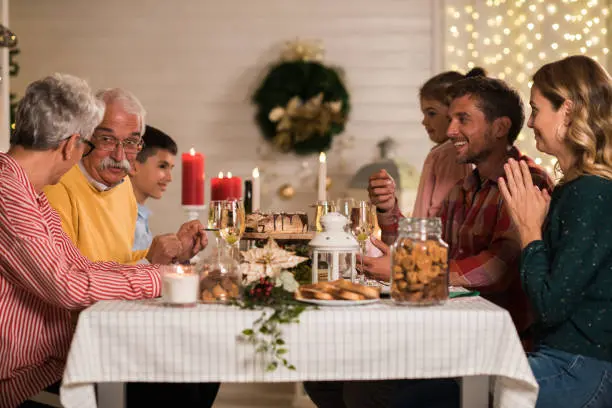
We sat down to dinner at three-fifteen. Ten of us, around the old oak dining table with both leaves in. Eleanor’s good china, the kind with the little blue flowers, that I only bring out at Christmas and Easter. Megan had set the table and put a red candle in the middle, and outside the dining room window, the snow was still coming down in the gray light.
I said grace, the same one I’ve said at every Christmas dinner since 1965. “Come, Lord Jesus, be our guest, and let these gifts to us be blessed.” When I looked up, Bobby was watching me with his head tilted to one side, the way you’d watch a dog do a trick it’s not supposed to remember.
It was a nice dinner, for a while. I’ll say that. The ham was good, and Eleanor’s green beans came out right. Dot told the story about the time Eleanor tried to bake a Christmas goose in 1971 and set the oven mitt on fire. Caleb laughed at it, which surprised everybody. Ashley asked Linda about her grandchildren.
All through dinner, Bobby kept checking on me. Leaning over to cut my ham for me. Asking if I needed more water. When I reached for the salt, he moved it closer to my hand and said, “Here you go, Grandpa, it’s right here,” in the voice you’d use with a three-year-old.
Under the table, Megan’s foot kept nudging mine. I nudged back.
When the plates were mostly empty and Megan had gotten up to start the coffee, Bobby picked up his fork and tapped it against his wine glass.
Ding, ding, ding.
The table went quiet. Megan stopped in the kitchen doorway with the coffee pot in her hand.
“Hey, everybody,” Bobby said, standing up. He smiled around the table. “I just want to say a few words. If that’s okay.”
“Go ahead, honey,” Ashley said.
Bobby held his wine glass up. He looked down at the tablecloth for a second, as if he were collecting himself. When he looked up again, his eyes were wet.
“This has been a really hard year for our family,” he said. His voice had gone soft and shaky. “Some of you know, and some of you don’t, but Grandpa’s been going through some stuff this year. With his memory.”
Dot made a sound like a teakettle starting to boil. Megan’s hand tightened on the coffee pot.
“I just want to thank everybody for being so patient with him,” Bobby said. “Especially Pastor Gary and the folks at church. You guys have been amazing. And I want Grandpa to know…” He turned and looked down at me, and a tear rolled down his cheek. “I just want you to know, Grandpa, that I’ve got you. You don’t have to worry about anything anymore. Your house, your bills, your money, any of it. I’m going to take care of everything. Just like you took care of us after Mom died.”
He wiped his eye with his free hand.
“It’s been really hard watching him slip away,” he said, to the table. “But I’m just so grateful we get one more Christmas with him while he still knows who we are.”
Ashley started crying. She reached over and squeezed Bobby’s hand. Across the table, Linda looked over at her husband with a puzzled frown, and Gary didn’t look back at her. He was looking at me.
I pushed my chair back from the table.
The legs scraped loud on the hardwood floor. Everybody looked over.
I stood up. It took me a second, the way it always does now, with one hand on the table for balance. But I stood up straight, all the way, the way I used to stand for inspection at the rail yard.
“Thank you, Bobby,” I said. “That was very moving.”
Bobby smiled at me, a little uncertain.
“Now,” I said, “I’d like to say a few words of my own.”
I reached into the inside pocket of my good wool jacket, the brown tweed one Eleanor bought me at Carson’s for our fortieth anniversary, and I took out two envelopes.
The first one was long and white, with the First Community Bank logo printed in green in the corner.
Bobby saw it.
I watched the smile freeze on his face. I watched his eyes go from the envelope to my face and back to the envelope, and I watched him understand. All the blood went out of his cheeks. His hand started to shake, and the wine in his glass started to slosh.
Then the glass slipped right out of his fingers.
It hit the edge of the table and bounced and fell on its side, and the red wine went everywhere. It splashed across Eleanor’s good white tablecloth and over his blue shirt and onto Ashley’s lap. Ashley jumped up with a little scream, and her chair fell over backward.
Nobody else moved.
“Bobby,” I said, “you told Pastor Gary and everybody at Grace Lutheran that I have dementia. You told them I wander around the backyard at night looking for my dead wife. You told them I leave the stove on and get lost driving home from the Hy-Vee.”
I opened the first envelope. I took out Dr. Patel’s letter and held it up.
“This is from Dr. Patel. My doctor for fifteen years. I went to see him in October.” I read from it slowly, in a clear voice, so everybody at that table could hear. “‘Mr. Gaines scored twenty-nine out of thirty on the Montreal Cognitive Assessment. Brain imaging shows normal age-related changes only. There is no evidence of dementia or cognitive impairment of any kind. Mr. Gaines is fully capable of managing his own medical, financial, and legal affairs.'”
I looked up.
“There’s a note at the bottom in his own handwriting. It says I’m the sharpest eighty-four-year-old he knows.”
Pastor Gary closed his eyes.
“Grandpa,” Bobby said. His voice came out hoarse. “Grandpa, wait…”
I set the letter down on the table and opened the second envelope. I took out the forged power of attorney and held it up so everybody could see the signature at the bottom.
“In September,” I said, “Bobby took this into the First Community Bank, along with a letter from a doctor named Kevin Marsh, who doesn’t exist. This power of attorney would have let Bobby take over my bank accounts, my house, and everything Eleanor and I saved in fifty-four years of marriage.” I turned it so the signature faced the table. “That’s supposed to be my name. I’ve been signing my name the same way since 1948. That isn’t it.”
“Oh my God,” Linda whispered.
“The bank didn’t do it,” I said. “Deborah Sorensen down at First Community knew something was wrong and stopped it. She also found out that back in July somebody called the bank, pretending to be me, and changed where my statements went. They’ve been going to Bobby’s apartment on Brooks Street. I haven’t seen a bank statement since June.”
I put the paper down.
“And the man who signed my name in front of the notary was a friend of Bobby’s. A man named Duke. The notary told my lawyer all about it.”
The dining room was so quiet I could hear the furnace come on in the basement. Ashley was standing behind her overturned chair with red wine dripping off her dress onto the rug, staring at Bobby with her mouth hanging open.
“Bobby,” she said, “you said he gave you permission. You said he signed it at his kitchen table. You told me…”
“Ash, shut up,” Bobby said.
“You told me he WANTED you to have it!”
“I said shut up!”
Megan set the coffee pot down on the sideboard, hard.
“Don’t you talk to her like that,” she said. “Don’t you talk to anybody in this house like that ever again.”
Bobby turned to look at his sister. His face was blotchy and red, and his shirt was soaked with wine.
“You knew about this?”
“I found out three weeks ago.” Megan’s voice was shaking, but she didn’t back down. “Grandpa told me everything. And I told him about the betting, Bobby. The twenty-three thousand. I’m not keeping your secrets anymore.”
Bobby stood there for a long moment, looking around the table at all of us. At Dot, who was glaring at him over her date bars like she was ready to come over the table. At Caleb, who had quietly gotten up and was standing behind Megan’s chair with his arms crossed. At Pastor Gary, who still hadn’t opened his eyes.
Then he looked at me.
And his face crumpled. All at once, just like when he was six years old and broke Eleanor’s good cut-glass candy dish and tried to hide the pieces under the couch.
“I’m sorry, Grandpa,” he said. “I’m sorry. I didn’t know what else to do. They were going to sue me. The payday loan place sent a guy to my work. I’m three months behind on rent. I owe the casino app eleven thousand and the credit cards another nine. I just needed some time. I was going to pay it all back. I swear to God, I was going to put it all back before you ever noticed.”
“With what?” I asked quietly.
He didn’t answer.
“With what, Bobby?”
“I don’t know,” he said, and he sat down hard in his chair in the puddle of wine, and he put his face in his hands. “I don’t know. I’d win it back. I always think I’ll win it back.”
Nobody said anything for a long time.
Pastor Gary opened his eyes. He looked across the table at Bobby, with his face in his hands and his shoulders shaking. Then he looked at me.
“Walt,” he said quietly. “What do you want to happen now?”
I’d been thinking about that question since October. I’d lain awake thinking about it more nights than I could count. I’d thought about calling the police. I’d thought about Ed Lindqvist saying “felony.” I’d thought about Karen at forty-six, lying on the laundry room floor with a basket of Bobby’s T-shirts spilled around her.
“I want him to go to that meeting Megan told him about,” I said. “Gamblers Anonymous. Every week. I want him to delete every one of those betting apps off his phone tonight, in front of me. And I want him to sign a paper with Ed Lindqvist agreeing he’ll never come near my bank or my mail or my money again.”
Bobby lifted his face out of his hands.
“And if he does all that,” I said, “I won’t go to the police. Not this time.”
“Grandpa…”
“But if he breaks one bit of it, Bobby, just one bit, then Ed has a folder in his office with everything in it. The forged papers and the notary’s statement and the bank’s records. And he’ll take it straight to the state’s attorney without asking me first. I already signed the letter telling him to.”
Bobby stared at me.
“You’d do that?”
“I’m doing it now,” I said. “I’m just giving you a chance first. That’s more than you gave me.”
Bobby didn’t stay for pie.
He sat at the table for a long while after that, and then he took out his phone and slid it across the table to Megan. She went through it with him, one app at a time, while everybody watched. There were five betting apps. When the last one was gone, she handed the phone back to him without a word.
Then he got up and got his coat. Ashley wouldn’t leave with him. She asked Megan if she could call her a ride, and Caleb ended up driving her home himself. She hugged me at the door on her way out, which I didn’t expect. She was still crying.
“I’m so sorry, Mr. Gaines,” she said. “I didn’t know. I really didn’t.”
“I know you didn’t, honey,” I said. “Go get some club soda on that dress before it sets.”
Bobby stood in the front hall pulling on his boots. Nobody went to help him. When he had them on, he straightened up and turned around, and for a second I thought he was going to say something.
He didn’t. He opened the door and went out into the snow, and I watched him through the front window walking down the sidewalk toward his car with his hands jammed in his coat pockets and his head down.
Pastor Gary came and stood beside me at the window.
“I should have known,” he said quietly. “I should have come to you instead of believing him. Eleven years I’ve known you.”
“He fooled me too, Gary. He fooled me for a year.”
We watched Bobby’s taillights turn the corner at the end of Maple Avenue and disappear in the snow.
“For what it’s worth,” Gary said, “I think you did a hard and decent thing tonight.”
“It doesn’t feel decent.”
“No,” Gary said. “The hard ones usually don’t.”
Megan made the coffee, and Dot cut the date bars, and we had pie, and nobody talked much. Linda helped me strip the wine-soaked tablecloth off the table and carry it down to the basement to soak in the laundry sink with cold water and salt, the way Eleanor taught me. It didn’t come out. There’s still a faint pink stain right in the middle, about the size of a dinner plate. I use it anyway. It’s on the table right now.
The first week of January, I went back to Ed Lindqvist’s office and signed my new papers. A real durable power of attorney, signed by me in front of Ed and Joyce as witnesses, naming Megan as my agent if I ever do need somebody someday. A new health care directive. A small change to my will, too, which I’ll keep to myself.
Ed asked me if I wanted to cut Bobby out entirely.
I thought about it for a long time.
“Leave it like it is,” I said. “For now.”
Ed looked at me over his glasses and wrote something on his legal pad.
Bobby signed the agreement with Ed on January 9th. Megan drove him. She told me afterward that he didn’t say much, and that he signed it without reading it, and that Ed made him go back and read every word before he’d let him leave.
He’s been going to his meetings. Megan checks. There’s a Gamblers Anonymous group that meets Tuesday nights in the basement of the Methodist church on Kellogg Street, and Megan drove past it three Tuesdays in a row and saw his car in the lot each time. After that, she stopped checking. She says she’s trying to trust him a little. I don’t know if I’m there yet.
He moved out of the apartment on Brooks Street in February. He couldn’t make the rent anymore. He’s living with a friend from the meetings now, out in a trailer park by the interstate, and he’s working at a tire shop on Route 34. Megan says he set up a payment plan with the payday loan company. It’s going to take him about six years.
He hasn’t been to my house since Christmas.
In March, a letter came in the mail. It was in a plain envelope with no return address, with my name written on the front in Bobby’s handwriting, which looks so much like Karen’s it stopped my heart for a second.
I haven’t opened it yet. It’s sitting on the dining room table next to the stack of mail, which I go through myself now, every day, and which has had my bank statement in it every month since January.
Pastor Gary still comes over every Wednesday afternoon for checkers. He told the congregation the truth in January, in a short announcement after the second service, without using Bobby’s name. Afterward, about forty people came up to shake my hand. Mrs. Kowalski from the altar guild gave me a loaf of zucchini bread and told me she’d been praying for my memory for three months and would now redirect those prayers somewhere more useful.
Last Wednesday, Gary finally beat me.
It was the first time in eleven years. I didn’t let him, either. I’d been looking at Bobby’s letter on the dining room table instead of at the board, and I left my back row open, and he jumped two of my kings in one move.
He sat there staring at the board like he’d just won the Powerball.
“Walt,” he said. “Walt, I won.”
“I saw.”
“I actually won.”
“Don’t get used to it,” I said, and I set the pieces back up.