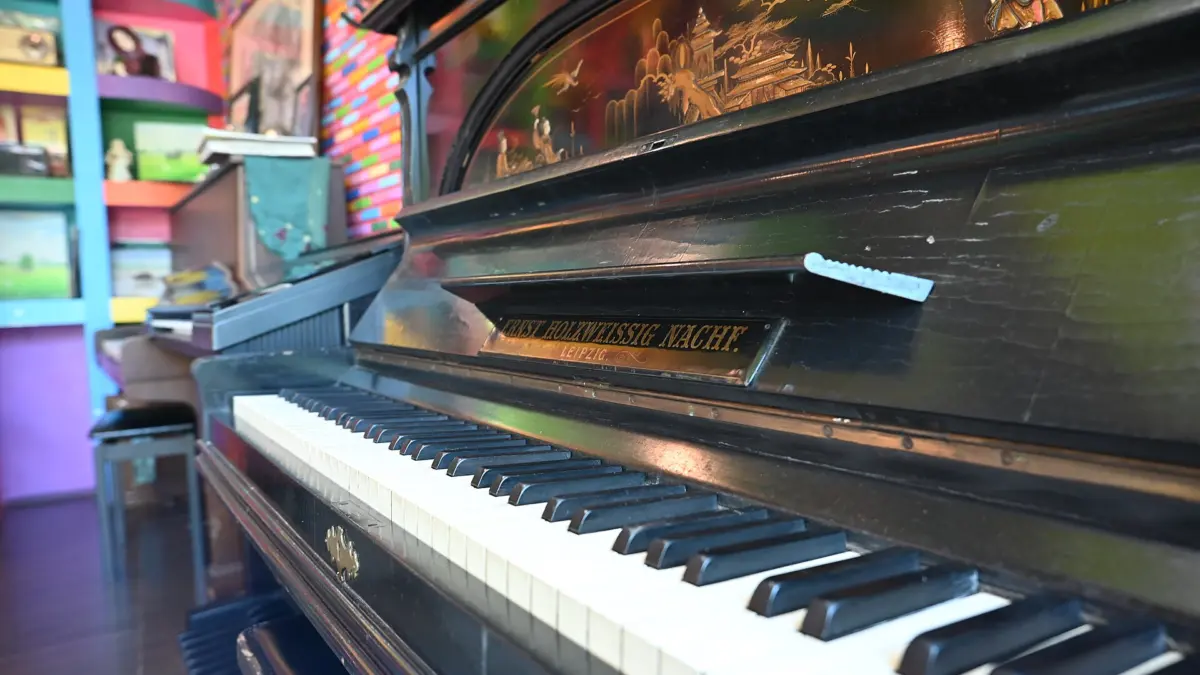
The listing said “Upright piano, works fine, needs tuning, you haul.” It was $150, which is what a piano costs when the people selling it mostly want it gone.
My son Eli was nine and had been playing on a keyboard with half the keys sticking. His teacher kept saying, very politely, that he had outgrown it. So on a Saturday in March, my brother-in-law and two of his friends spent an hour and a lot of bad language getting a 400-pound piano up our front steps.
It was walnut, scratched along the bottom where a vacuum had bumped it for decades. The middle C was a little yellower than the keys around it. Eli loved it immediately.
The Envelope Behind the Front Panel
Two weeks later the piano tuner came. His name was Ray, he was about seventy, and he talked to the piano the whole time he worked, like a vet with a nervous dog.
About twenty minutes in he went quiet. Then he said, “Ma’am? You’ll want to see this.”
He had taken off the front panel above the keys. Taped to the inside, flat against the wood where nobody would ever look, was a thick bundle of envelopes tied with a faded green ribbon. The tape had gone the color of weak tea.
“Happens more than you’d think,” Ray said. “People hide money in pianos. Love letters. One time a set of dentures.” He handed it to me carefully. “This isn’t money.”
There were eleven envelopes. Every one was addressed in the same round, careful handwriting to “Mrs. Albright, 14 Cedar Lane.” None of them had stamps. None had ever been opened.
Eleven Letters, Never Sent
I am not a person who reads other people’s mail. I want that on the record. I held out for almost two full days.
Then, on a Monday night after Eli was asleep, I opened the first one.
It was dated September 1974 and signed “Margaret.” She was eleven years old. Mrs. Albright, it turned out, was her piano teacher, and the letter was a thank-you note for “being patient with me about the left hand.” It was so earnest it made my chest hurt.
The letters went on for five years. Margaret wrote about learning her first Chopin piece. She wrote about practicing with the soft pedal down so her father wouldn’t complain. She wrote, at fourteen, that Mrs. Albright was “the only grown-up who listens to the whole song before saying anything.”
The last letter was different. It was dated June 1979, and the handwriting was faster.
She had frozen at her spring recital. Walked out, sat down, put her hands on the keys and couldn’t remember a single note. She stood up after a full minute and walked off the stage. “I’m sorry I embarrassed you,” she wrote. “I don’t think I am going to play anymore. Thank you for everything. I could never say it to your face, so I’m writing it down.”
She never sent that one either.
Finding Margaret
The seller’s listing had a name and a phone number. I called and got a man named Dennis, who was polite and a little confused.
The piano had been his mother’s, he said. It sat in her house for over forty years until she moved into assisted living that winter, and he and his sisters were clearing out the place. His mother had played as a girl, he thought, but never once while he was growing up. The piano was mostly where the family photos went.
“Is your mother’s name Margaret?” I asked.
There was a long pause. “How did you know that?”
I told him. He didn’t say anything for a while, and then he said, “Can I come get them? Actually, no. Could you bring them to her? I think she should hear it from you.”
The Visit
Margaret was seventy-two. She had short white hair and a cardigan with a brooch shaped like a bird, and she was much funnier than I expected. When Dennis introduced me as “the lady who bought the piano,” she said, “My condolences.”
I gave her the bundle. She knew what it was before she untied the ribbon. Her hands stayed very still on top of it.
“I taped those in there when I was seventeen,” she said. “I figured if I couldn’t throw them away and couldn’t send them, at least they could stay with the piano.”
She told me Mrs. Albright had come to the house a week after the recital. Margaret hid upstairs and let her mother answer the door. Mrs. Albright left a note that said, “The door is open whenever you are ready.” Margaret never went back. Mrs. Albright moved away a few years later, and that was that.
“Fifty years,” she said, mostly to herself. “I let one minute of my life make a decision for fifty years.”
Before I left, I said, without really planning to, “My son has his first recital in May. It’s in a church basement. The folding chairs are terrible. You’d be very welcome.”
She laughed and said she’d think about it, which I assumed meant no.
The Recital
She came. Dennis drove her, and she sat in the second row in the bird brooch, holding her program with both hands.
Eli played a simplified Minuet in G. He rushed the middle, the way he always does when he’s nervous, and then he slowed down and finished it clean. Afterward Margaret shook his hand very formally and told him that his left hand was excellent, and that left hands are the hardest part.
Then the recital teacher, who I had quietly spoken to the week before, asked if anyone in the audience would like to play something before the cookies.
Margaret didn’t move for a moment. Dennis looked at her. I looked at my shoes so she wouldn’t feel watched.
She stood up, walked to the old church upright, and sat down. She put her hands on the keys and left them there a few seconds, long enough that the room got very quiet.
Then she played. It was a short Chopin piece, the one from the letter she wrote at twelve. She missed a few notes and didn’t stop for any of them. When she finished, a room full of parents and kids and one confused janitor clapped like she had just played Carnegie Hall.
She sat there for a second, then turned around on the bench and found me in the crowd.
“Fifty years late,” she said. “But I finished the song.”
The Twelfth Letter
A week later an envelope came in our mailbox. It had a stamp this time. Inside was a short note in that same round handwriting.
“Thank you for bringing my letters home. I’m told Eli practices on my old piano every day. Please tell him to keep the soft pedal down if anyone complains, but not too often. Some songs are supposed to be heard. Margaret.”
Eli taped it inside the front panel of the piano, right where the others used to be. He said it seemed like where it belonged.
This story is fiction. The characters and events are invented, and any resemblance to real people is coincidental.